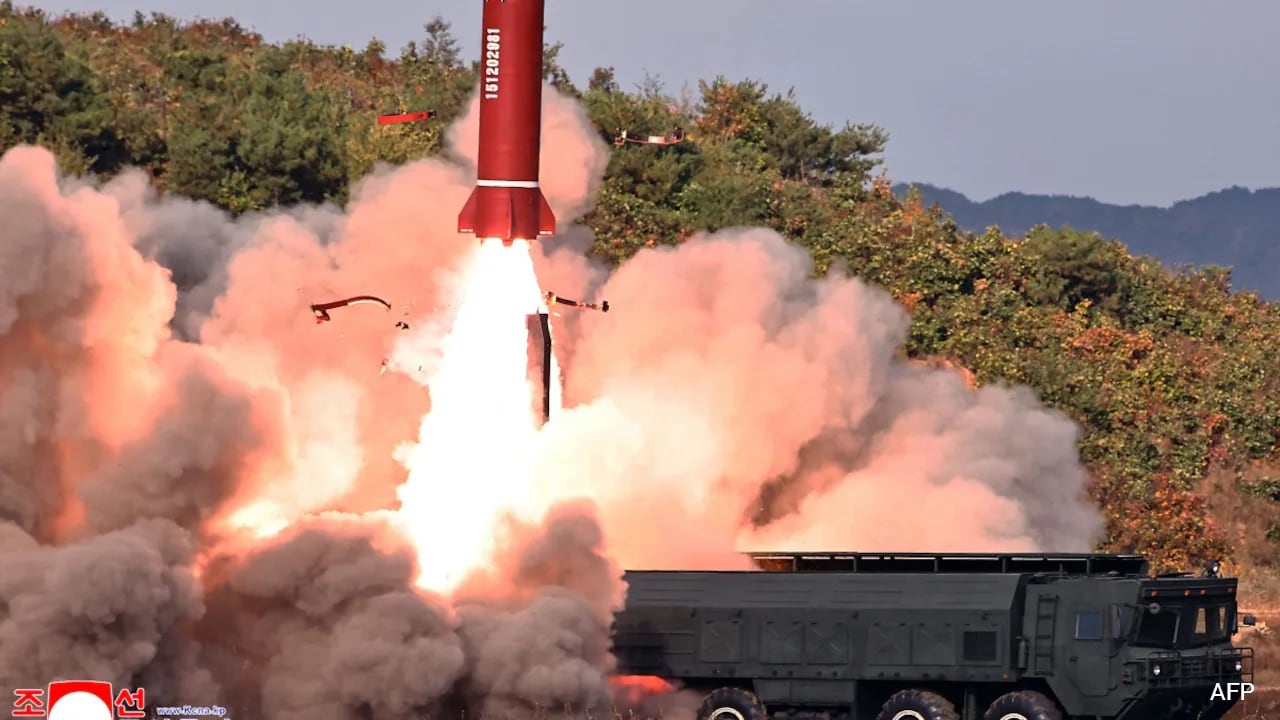
Standard reporting on North Korea's October 14, 2026 test-fire of two submarine-launched strategic cruise missile types off its east coast treats the event as an immediate leap in nuclear deterrence. That reading conflates platform integration with operational survivability. Firing two missile variants from an underwater hull—reportedly involving both a vertical launching system and a torpedo tube, likely tied to the 3,000-ton-class Hero Kim Kun Ok boat—demonstrates launch-envelope progress, not a mature second-strike force.
To evaluate what this test actually changes in Northeast Asian security, analysts must separate four operational layers: platform architecture, missile flight physics, anti-submarine warfare (ASW) attrition, and escalatory signaling. Conventional coverage usually stops at the headline claim of "strategic" capability and state media slogans about underwater combat readiness. A structured assessment reveals why range estimates, launch methods, and patrol endurance determine whether Pyongyang has built a credible deterrent or an expensive vulnerability. Building on this idea, you can also read: Inside the Federal Probe Targeting Ilhan Omar and the Weaponization Precedent.
How Standard Coverage Misreads Underwater Missile Tests
Typical coverage of Pyongyang's missile trials relies on a predictable loop: state media announces a test, foreign ministries note the launch in the East Sea (Sea of Japan), and commentators debate whether the weapon can reach South Korea or U.S. bases in Japan. That framing misses three cause-and-effect links that govern naval deterrence.
First, test success in a controlled range does not equal survivable patrol posture. A submarine that can launch a missile in a scheduled trial still faces acoustic detection, battery or reactor endurance limits, and command-and-control friction during a crisis. Second, pairing two cruise missile types in a single event points to payload differentiation or dual-tube qualification, yet public reporting leaves exact missile identities—such as whether variants align with the Pulhwasal-3-31 or Hwasal-2 families—unconfirmed. Treating unverified designations as settled facts distorts force-structure estimates. Third, timing matters as much as telemetry. The mid-October launch followed weeks of border friction after a September Demilitarized Zone landmine blast that injured three South Korean soldiers, a weapons museum opening, and tit-for-tat missile activity between the two Koreas. Observers at The Washington Post have also weighed in on this situation.
A test-fire proves an integration milestone; sustained, undetected underwater patrols prove deterrence.
The Four Pillars of Submarine Cruise Missile Viability
Evaluating any submarine-launched strategic cruise missile (SLCM) program requires testing four distinct pillars rather than relying on range circles drawn on a map.
Platform Architecture and Launch Mechanics
South Korean military assessments of the October 14 event indicated that one missile exited from a vertical launching system while another fired from a torpedo launcher, with outside analysts pointing to the Hero Kim Kun Ok hull. Two launch methods inside a single operational test suggest Pyongyang is validating either multi-tube compatibility or distinct canister/weapon profiles.
- Vertical launch cells generally support higher-volume or dedicated strike reloads built into a modified or purpose-built hull section, though retrofitting missile tubes onto older designs can introduce hydrodynamic drag, acoustic signatures, and weight-and-balance constraints.
- Torpedo tube launches offer flexibility across existing hulls without major structural redesign, but they occupy high-value tactical tubes and restrict reload tempo during an engagement.
- Hull classification remains a decisive variable. Analysts have noted questions around the boat's propulsion and conversion status—including whether a converted hull is seeing operational testing years after completion—because acoustic quietness and submerged speed govern survival long before a weapon clears the water.
Flight Profile and Air-Defense Economics
Unlike ballistic missiles that travel along high-altitude parabolic arcs detectable by early-warning radar, strategic cruise missiles fly low, terrain-hugging trajectories at subsonic speeds. Lower altitude delays radar line-of-sight detection, forcing coastal and shipboard air defenses to rely on low-altitude sensors, distributed interceptors, and shorter reaction windows.
However, cruise missiles trade speed and kinetic energy for stealthy routing and mid-course navigation accuracy. Their effectiveness depends on terrain-matching or inertial-plus-satellite guidance updates, fuel burn over complex coastlines, and warhead integration. Without verified public telemetry on range, flight duration, or terminal guidance, claims about target coverage in South Korea or Japan remain analytical deductions based on prior system families rather than confirmed test parameters.
Acoustic Exposure and ASW Attrition
The central strategic promise of a submarine deterrent is concealment before launch. The central operational hazard is exposure during launch.
- Pre-launch transit: Moving from port into patrol waters in the East Sea requires navigating shallow coastal approaches and choke points where Allied maritime patrol aircraft, surface combatants, and seabed sensors concentrate anti-submarine effort.
- Launch transient: Opening hatch doors, pressurizing or flooding tubes, ejecting canisters, and igniting booster or sustainer motors create distinct acoustic, pressure, and thermal signatures that can narrow a submarine's datum.
- Post-launch escape: Once a boat reveals its approximate firing sector, remaining submerged while evading counter-ASW prosecution tests crew training, sonar performance, and endurance far more severely than a peacetime test window.
Command, Control, and Escalatory Signaling
Strategic nuclear or high-consequence cruise missiles require secure communications between national command authorities and a submerged boat. Low-frequency or very-low-frequency links face physical bandwidth constraints and signal attenuation underwater, while rising to shallow depth to receive messages increases detection risk.
Politically, conducting the test without Kim Jong Un on site—with officials such as Kim Jong Sik and Jang Chang Ha overseeing the event—signals institutional routinization rather than a one-off spectacle. Paired with recent hypersonic and ballistic tests by both Koreas and stalled denuclearization diplomacy since 2019, the launch reinforces a cycle of parallel capability demonstrations across undersea and strike domains.
Facts Versus Educated Hypotheses
Separating confirmed observations from analytical inference prevents over-interpreting state media releases.
- Known facts: North Korea announced on October 15, 2026 that it test-fired two types of submarine-launched strategic cruise missiles in the East Sea on October 14 to evaluate underwater combat readiness and naval strategic mission skills. South Korean military authorities reported tracking the flights and identified one launch from a vertical system and one from a torpedo launcher.
- Educated hypotheses: Defense analysts assess that the launches likely involved the Hero Kim Kun Ok submarine and could relate to cruise missile lineages such as Pulhwasal-3-31 or Hwasal-2. Analysts also infer that the dual-method test reflects ongoing integration work rather than an immediately scalable, high-survivability second-strike fleet.
- Unverified details: Exact missile designations, verified combat ranges, warhead types, and sustained submerged patrol durations have not been publicly confirmed.
Operational Limits That Constrain Every Actor
No single technical fix or countermeasure resolves the friction in this environment. For Pyongyang, converting hulls, refining low-observable cruise guidance, and maintaining quiet underwater operations under persistent Allied surveillance carry steep engineering and resource costs. For Seoul, Tokyo, and Washington, tracking low-flying cruise profiles in cluttered littoral waters and maintaining continuous ASW coverage across dynamic regional crises requires sustained sensor fusion, interceptor inventory depth, and disciplined rules of engagement. Over-relying on any single sensor layer or assuming an adversary's boats are either invulnerable or easily localized both introduce dangerous blind spots.
Actionable Steps for Defense and Risk Teams
Analysts, defense planners, and corporate risk teams tracking Northeast Asian security can apply a disciplined four-part workflow to separate routine signaling from genuine operational shifts.
- Audit launch cadence and platform continuity: Track whether follow-on tests use the same hull, repeat vertical-and-torpedo launch combinations, or expand to additional submarines over multi-week intervals rather than isolated anniversaries or political events.
- Map the surrounding operational tempo: Correlate missile announcements with border incidents, combined military exercises, diplomatic signals, and parallel tests such as hypersonic or tactical ballistic launches to gauge whether the move is reactive signaling or part of a broader readiness cycle.
- Separate range claims from survivability indicators: Weight evidence on patrol duration, ASW counter-activity, and command-and-control resilience ahead of unverified range graphics when assessing escalation risk.
- Stress-test contingency plans against low-altitude and maritime friction: Ensure regional security and business continuity playbooks account for sudden naval alerts, airspace or maritime exclusion notices, and diplomatic shocks without assuming clean early warning.
The Strategic Play Moving Forward
Treat submarine-launched strategic cruise missile tests as an indicator of integration velocity and signaling discipline, not an overnight shift to guaranteed second-strike dominance. The decisive metric to watch next is repeatability—whether Pyongyang can execute multi-missile underwater launches consistently under realistic operational conditions while preserving hull survivability. Allied planners and risk analysts who anchor their assessments on repeatable operational behavior rather than state rhetoric will price regional escalation risk far more accurately.