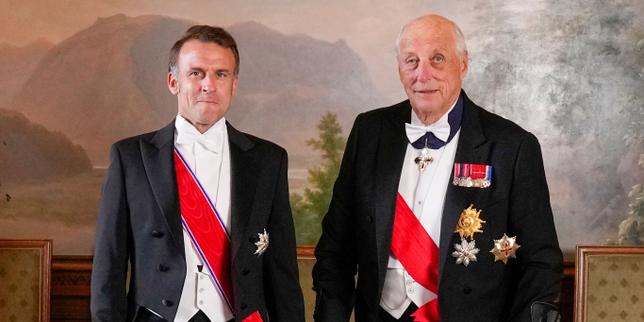
When a head of state passes away, conventional reporting defaults to standardized registers of grief and protocol. Tributes from foreign leaders like Emmanuel Macron and King Charles III are cataloged as diplomatic pleasantries, stripped of their underlying strategic utility. This analytical failure misses the operational reality of modern constitutional monarchies. A sovereign death is not merely a biographical conclusion; it is a systemic stress test for international alliances, institutional continuity, and soft power equilibrium.
Evaluating the passing of Norway's monarch requires dismantling the standard media narrative. Instead of viewing bilateral relations through the lens of polite diplomacy, we must examine them as managed assets governed by structural incentives, economic dependencies, and defense architectures. The transition of power resets these variables, forcing both domestic institutions and foreign partners to recalibrate their exposure.
The Architecture of Bilateral Soft Power
Diplomatic ties between mid-tier European powers and global actors are frequently mischaracterized as cultural affinities. In practice, they function as transactional security and economic frameworks disguised in ceremonial attire. When Emmanuel Macron highlighted the late king's role in strengthening Franco-Norwegian relations, he was pointing to a specific operational output: the alignment of energy security, defense procurement, and Arctic policy.
Norway occupies a non-replaceable node in Western European energy infrastructure. Following the structural shift in European gas markets, Norwegian hydrocarbon delivery became the primary stabilization factor for continental industrial output. Concurrently, bilateral ties with France involve deep industrial cooperation in defense sectors, including naval engineering and aerospace components.
The monarch acts as an invariant in this equation. Elected politicians face electoral churn, policy reversals, and shifting populist pressures. A long-reigning monarch provides a persistent point of contact that insulates long-term strategic agreements from short-term political volatility. When leadership transitions occur, the primary risk to foreign partners is not the loss of a sympathetic figure, but the potential friction introduced as a new head of state establishes diplomatic baseline norms.
The Cost Function of Monarchical Transitions
Constitutional transitions carry distinct economic and political friction costs. While parliamentary democracies absorb leadership changes through party mechanisms, hereditary systems rely on the transfer of symbolic capital. This transfer introduces two distinct variables: institutional drag and strategic repositioning.
Institutional drag manifests as a temporary paralysis in high-level state visits and bilateral summits. During mourning periods and coronation or accession protocols, diplomatic bandwidth is consumed entirely by internal protocol. For strategic partners relying on joint declarations or defense pacts, this creates a temporary planning vacuum.
Strategic repositioning occurs when a new monarch assesses their constitutional boundaries. Unlike an elected president who seeks to implement a manifesto, a constitutional monarch maintains stability by adhering strictly to neutrality. However, the perception of stability changes during a transition. Markets and foreign ministries price in the risk of internal constitutional debates—such as renewed republican movements—even if those risks have a low statistical probability of materializing.
[Sovereign Transition]
       │
       ├──> Internal Protocol & Mourning (Diplomatic Bandwidth Bottleneck)
       ├──> Institutional Continuity Check (Testing Constitutional Resilience)
       └──> Foreign Partner Recalibration (Energy & Defense Baseline Audit)
This structural framework reveals why foreign leaders respond with calculated urgency. Tributes from foreign capitals are signals of continuity. By publicly reaffirming the bilateral bond immediately upon a monarch's death, leaders like King Charles III and Emmanuel Macron attempt to lock in existing geopolitical arrangements before domestic or international competitors can exploit the transitional window.
Geopolitical Alignment in the Northern Tier
To understand the weight of Norway's international position, one must analyze the strategic geography of the High North. The stability of Norwegian governance directly impacts NATO's northern flank, maritime surveillance in the Greenland-Iceland-UK gap, and maritime resource management in the Barents Sea.
The late monarch's reign coincided with an era of profound transition in Arctic security. As ice sheets recede and commercial sea routes open, the economic and military value of Norwegian sovereignty escalates exponentially. Bilateral relationships with France and the United Kingdom are not historical reenactments; they are contemporary defense arrangements designed to maintain maritime deterrence against peer competitors.
France views Norway through the dual lens of European Union-adjacent energy security and independent defense projection. The United Kingdom views Norway through the lens of immediate maritime proximity and shared North Sea resource governance. Consequently, the death of the sovereign triggers an immediate audit by these allied powers to ensure that the new head of state maintains the exact same vectors of alignment.
Institutional Resilience and the Succession Mechanism
The structural strength of a constitutional monarchy is measured by the speed and invisibility of its succession. Modern European monarchies operate under strict legal frameworks that eliminate succession ambiguity through absolute primogeniture or designated statutory paths.
When succession occurs seamlessly, it demonstrates the robustness of the state's legal code over the personality of the individual officeholder. This mechanical inevitability is its greatest asset. Unlike presidential systems where a contested election can paralyze foreign policy for months, a monarchical transition is bound by deterministic timelines.
The incoming sovereign inherits a pre-mapped portfolio of constitutional duties, diplomatic obligations, and ceremonial responsibilities. The optimization challenge for the new administration is minimizing the friction of transition while signaling uncompromised adherence to existing international treaties and defense pacts.
Foreign ministries do not mourn the individual; they price the continuity of the state apparatus. The public statements issued from Paris and London serve as public confirmations that the underlying risk parameters of the bilateral relationship remain unchanged.
Strategic Execution for Allied States
For foreign policy planners observing a monarchical transition in a key allied nation, passive observation is an operational failure. The immediate imperative is the execution of a three-phase alignment protocol.
First, secure immediate high-level diplomatic contact during the transition window to prevent rival powers from filling the communication vacuum. Second, audit all existing bilateral energy and defense agreements to ensure no statutory clauses are triggered or complicated by the change in head of state. Third, establish direct working channels with the incoming monarch's advisory staff to align the ceremonial calendar with ongoing geopolitical negotiations.
The death of a sovereign marks the end of an era only in the rhetorical framing of public media. In the calculus of statecraft, it is a scheduled system reboot. Those who treat it as a purely emotional event miss the mechanics of power entirely.