The grass in Wiltshire does not just grow. It clings. In the damp warmth of early July, the morning mist hangs low over the African Village at Longleat, leaving a heavy, silver sheen on the paddocks. To the untrained eye, it is just another quiet morning in the English countryside. But for those who work here, the air carries a different weight. It is the weight of waiting.
For Alexa Maultby, a hoofstock keeper whose days are measured in the quiet rhythms of shifting herds and subtle changes in animal behavior, the waiting had become a silent companion. It began exactly one year ago, in July, when a female capybara named Mildred arrived at the park. Recently making waves recently: Why Blaming Broken Pipes at Gatwick is Missing the Real Crisis.
Mildred was an outsider. To introduce a new animal to an established space is always a gamble of chemistry and quiet negotiation. There is no guarantee of harmony. The park already had Bart, a resident male capybara who shared his home with a wandering assembly of Brazilian tapirs and three elegant, long-legged maned wolves. Adding Mildred to this mix was a calculated hope.
What followed was a slow-motion courtship, a quiet alignment of two lives. Then came the five-month countdown. Additional insights regarding the matter are detailed by Lonely Planet.
The 149-Day Clock
A capybara’s pregnancy is not loud. There are no dramatic declarations of impending birth. Instead, there is only a gradual widening of the flanks, a slight slowing of the gait, and an intense, instinctual focus. For Mildred, that clock ran for exactly 149 days.
During those five months, the keepers watched. They noted how much grass she chewed, how long she soaked in the water, and how she navigated the social dynamics of her mixed-species neighborhood. To live alongside tapirs and wolves requires a certain level of calm confidence. Mildred possessed it in spades. But as the summer heat began to gather, her focus shifted inward.
The gestation period for these giant South American rodents is typically between 120 and 150 days. Mildred took her time, carrying her cargo almost to the very limit.
Then, on a quiet Friday, the world changed.
The arrival was sudden. In the wild, a slow birth is a death sentence. Capybaras are the world’s largest rodents, but they are also prey. Their survival strategy is built entirely on a biological concept known as precocial birth.
It is a striking evolutionary strategy. Unlike human babies, or even the blind, helpless kits of common rabbits, capybara pups are born running.
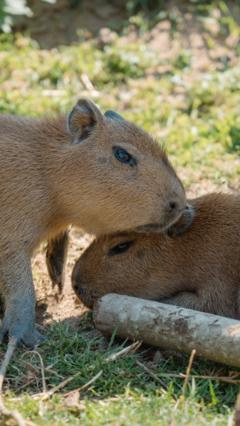
They arrive with their eyes wide open. Their bodies are fully clothed in coarse, golden-brown fur. Within a few hours of leaving the dark safety of the womb, they are walking, testing the air, and swimming. They do not have the luxury of a slow awakening. The world is too dangerous for that.
The two pups born to Mildred and Bart weighed just one kilogram each at birth. They were tiny, fragile packages of pure instinct.
Learning to Breathe in Two Worlds
To watch a newborn capybara navigate water for the first time is to watch millions of years of evolutionary design click into place.
They are semi-aquatic by definition, but that label feels too sterile for the reality of their existence. They belong to the water as much as they belong to the earth. Their bodies are masterpieces of engineering. Their eyes, ears, and nostrils are positioned high on their heads, like those of a hippopotamus or an alligator. It is a design that allows them to remain almost entirely submerged, breathing and watching the treeline for danger, while the rest of their body is hidden safely beneath the surface.
In their new purpose-built nursery at Longleat, complete with its own private pool, the pups began their education immediately.
The first lessons were clumsy. Webbed toes, perfect for paddling, take a few hours to master. The pups splashed, their tiny limbs working furiously against the gentle resistance of the water. When the exertion became too much, they resorted to a simpler tactic. They climbed up Mildred’s wet flanks, hitching a ride on her broad, flat back.
Mildred floated like a brown log, completely unbothered by her two passengers.
Consider the sheer contrast of this scene. Here, in the heart of Wiltshire, surrounded by ancient English oaks and the distant, elegant silhouettes of giraffes, a South American river bank has been perfectly recreated. The pups will spend the next sixteen weeks suckling from Mildred, but their independence is already showing. By the time they were just one week old, they were already nibbling on blades of fresh grass, their tiny teeth working with comical intensity.
They are growing. They will not stay at one kilogram for long. If all goes well, these miniature adventurers will eventually tip the scales at anything between 35 and 66 kilograms. They will go from being small enough to hold in two hands to being the undisputed heavyweights of the rodent world.
The Invisible Stakes of the Keepers
It is easy to look at a newborn animal and see only the charm of it. The tiny wet noses. The oversized feet. The quiet, high-pitched squeaks they use to keep in touch with their mother.
But behind every successful birth in a modern safari park is a human story of sleepless nights, careful observation, and profound responsibility. The keepers at Longleat do not just feed these animals; they become part of their social fabric. They are the guardians of a delicate balance.
"With Mildred having only arrived at the park last July, it is a fantastic achievement to have already welcomed two pups," Alexa Maultby noted.
Her words are modest, but they hint at the quiet triumph felt by the entire husbandry team. Every birth is a validation of their work. It means the animals feel safe. It means the habitat is right. It means that the complex, invisible web of care—nutrition, temperature control, social enrichment, and veterinary oversight—is functioning exactly as it should.
Right now, the sex of the pups remains a mystery. At this stage of their lives, determining whether they are male or female requires a hands-on health check, something the keepers are delaying to allow the new family time to bond without human interference. For now, they are simply the "new arrivals," two nameless pioneers exploring the edges of their enclosure.
They live in a quiet sanctuary next to the giraffe house, just a stone's throw from the African Village car park. Visitors who slow their pace can catch a glimpse of them.
A Quiet Lesson in Survival
There is a quiet power in watching these creatures. In a world that often feels loud, chaotic, and relentlessly fast, the capybaras offer a different rhythm. They do not rush. Even in their play, there is a deliberate, calm economy of movement.
They remind us of the beauty of adaptation. Their coarse, brittle hair is designed to dry almost instantly the moment they step onto dry land. Their webbed feet are silent paddles. Their very existence is a testament to the success of finding a niche and filling it perfectly.
As the summer sun begins to warm the Wiltshire air, the two pups will continue to test the limits of their private pool. They will swim a little further from Mildred. They will dive a little deeper. They will eat more grass and drink less milk.
The waiting is over for Alexa and the team at Longleat. But the story of these two small swimmers is only just beginning.
Under the watchful eye of Mildred, beneath the gray Wiltshire sky, the two pups drift slowly across the surface of their pool, their tiny noses pointed toward the horizon, perfectly at home in a world they are only just beginning to understand.
This beautiful footage shows the two newborn capybara pups at Longleat Safari Park enjoying their private nursery pool and taking rides on their mother's back. Longleat Capybara Pups Debut