Headline duty cuts under the India UK trade agreement look like an import windfall until you test them against quota ceilings, rules of origin, and local assembly economics. When the pact entered into force on July 15, 2026, it did not open a floodgate for British-built automobiles in India. Instead, it created a rationed Tariff Rate Quota (TRQ) system that rewards manufacturers with UK-origin internal combustion models, authorized distribution channels, and pricing power in high-margin engine bands.
Surface coverage of automotive trade pacts tends to treat tariff reductions as linear price drops. A reporter sees a drop from 110% duty toward lower rates and assumes every imported car becomes dramatically cheaper. That logic misses four structural mechanics that govern real unit economics:
- Quota rationing: Concessional tariffs apply to capped volumes allocated by authorities rather than unlimited imports.
- Manufacturing geography: Origin rules determine whether a vehicle qualifies as a UK-built import or sits outside the pact.
- Powertrain and price exclusion: Internal combustion engines receive early quota access, while alternative-fuel models face delayed timelines or separate conditions.
- Local assembly substitution: Completely Knocked Down (CKD) assembly in India already alters cost structures independently of Completely Built Unit (CBU) import quotas.
Deconstructing the Competitor Narrative
Standard news coverage around Jaguar Land Rover, BMW, and Skoda receiving import clearance frames the event as a simple regulatory green light. The underlying argument usually runs along three lines: a trade pact lowers import duty, approved automakers bring in cars at reduced tax, and buyers gain access to cheaper luxury vehicles.
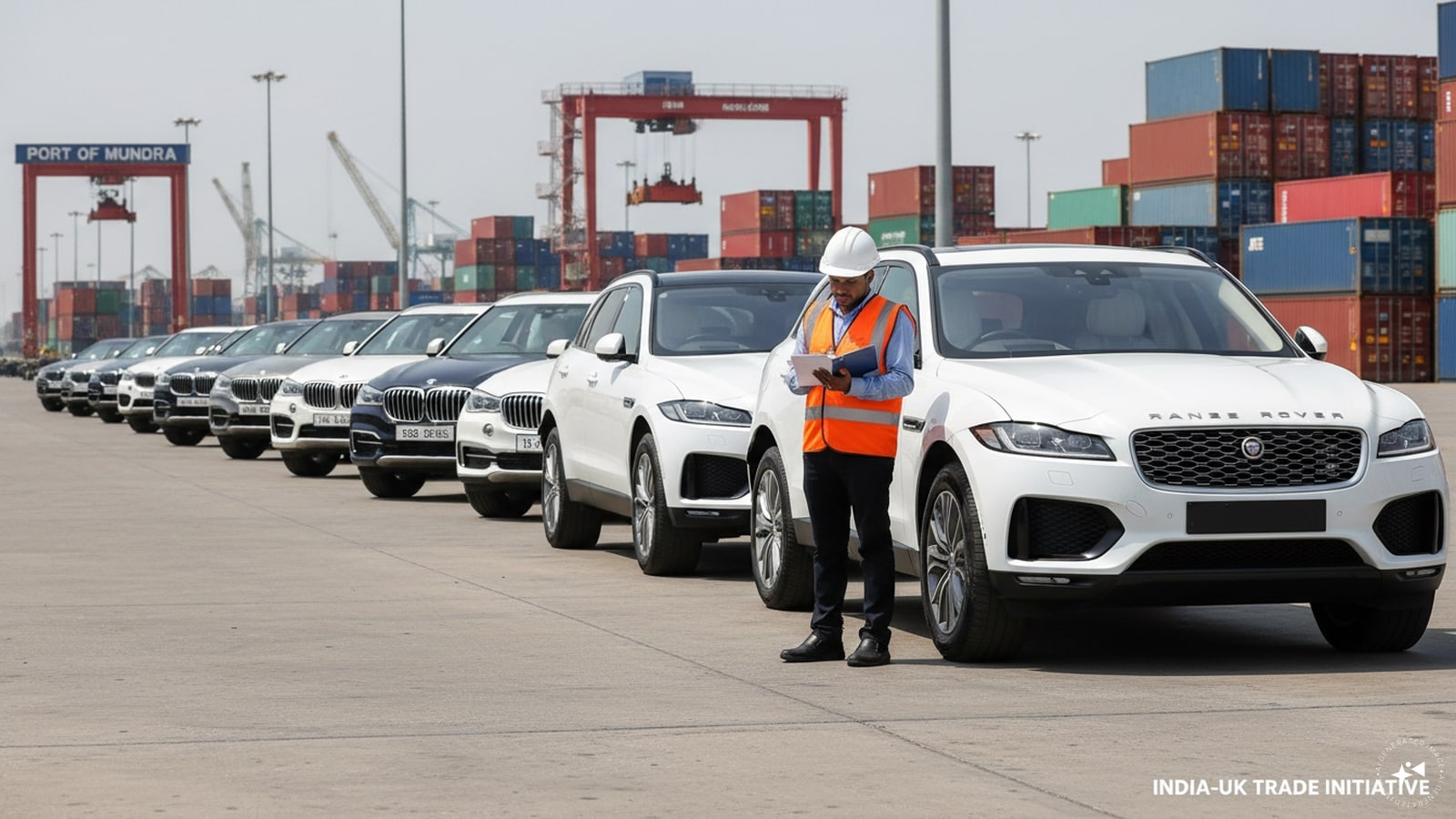
That chain skips crucial links in the value chain. Clearance to import under a quota is not the same as an unlimited tariff cut across an entire brand lineup. In the initial prorated allocation following the pact's July 15, 2026 entry into force, Jaguar Land Rover secured 325 units out of 642 approved vehicles across six applicants, while BMW India and Skoda Auto Volkswagen India received 75 units each, alongside allocations for dealerships. Treating a 75-unit or 325-unit allocation as a structural shift in mass luxury pricing confuses a pilot tranche with full-scale market supply.
Standard reporting also blurs the distinction between a statutory tariff schedule and effective landed cost. Even when customs duty on a specific engine band drops from 110% to 30% within quota, Indian ex-showroom and on-road prices still incorporate local taxes, logistics, dealer margins, and currency exposure. More importantly, an automaker facing a tight quota has a strategic pricing choice: pass the full duty savings to consumers to expand demand on a tiny volume base, or capture part of the margin spread to widen gross profit per unit.
The Four Structural Pillars of Import Quota Economics
To evaluate who actually wins when UK-built cars enter India under concessional terms, analyze the trade mechanics across four operational pillars.
Pillar 1: Quota Scarcity and Allocation Mechanics
In classical trade theory, tariff reductions expand consumer surplus and shift the supply curve outward. Under a Tariff Rate Quota, the supply curve at the concessional rate hits a hard vertical wall once the quota fills. Beyond that threshold, additional imports face higher out-of-quota duties.
For the 2027 calendar year, the Directorate General of Foreign Trade (DGFT) opened quota applications for 24,500 British passenger-car CBUs split across engine displacement bands: 6,000 units for small engines up to 1,500cc, 6,000 units for mid-sized petrol (1,500cc to 3,000cc) and diesel (1,500cc to 2,500cc) engines, and 12,500 units for large engines above 3,000cc petrol or 2,500cc diesel, plus separate commercial vehicle quota space. Only formally authorized entities—such as OEM subsidiaries, official importers, or approved dealer networks—can apply, and imported vehicles must be genuinely unregistered new cars rather than used-car arbitrage.
Consider what this means for a brand like Skoda or BMW versus JLR. If an automaker receives a small tranche relative to annual demand, concessional units act as halo or niche allocation rather than core volume drivers. Allocation size dictates whether a brand can reposition a model's price list permanently or merely run limited-batch availability.
Pillar 2: Rules of Origin and Plant Footprint
Trade agreements are bilateral legal contracts tied to country-of-origin rules, not brand badges. A car carrying a British badge does not automatically qualify for UK pact benefits if it is assembled or manufactured outside the United Kingdom.
For instance, models built at non-UK plants—such as vehicles produced in Slovakia—do not qualify as UK-origin imports under the pact's UK CBU framework. Conversely, a non-British corporate group such as BMW or Skoda Auto Volkswagen can tap UK CBU quotas if it brings in qualifying UK-manufactured models through authorized channels.
Known fact vs. educated hypothesis: It is a known fact that origin rules govern eligibility and that non-UK plants fall outside UK CBU concessions. It is an educated hypothesis that multi-plant OEMs with European and UK footprints will audit plant-by-plant production allocation to route high-duty-sensitivity low-volume trims through whichever origin channel yields the lowest total landed cost once separate trade tracks, such as India's broader trade negotiations with the European Union, mature.
Pillar 3: Powertrain Asymmetry and Phased Timelines
The pact's tariff design treats internal combustion engines and alternative-fuel vehicles differently. High-displacement internal combustion passenger vehicles see early duty compression within quotas—dropping from 110% toward lower rates over a multi-year schedule that scales up annual CBU quotas toward 37,000 units by year five—whereas hybrid, electric, and hydrogen vehicles face delayed duty relief or separate thresholds and price tiers.
That asymmetry creates a strategic tension in 2026 and 2027. Automakers pushing electrified luxury lineups cannot rely on immediate CBU duty relief to undercut rival electric imports; their near-term quota advantage sits concentrated in high-displacement internal combustion models where duty drops from 110% to 30% materially compress the customs base.
Pillar 4: The CBU vs. CKD Cost Function
Every luxury automaker operating in India manages a two-track cost function:
- CBU imports: Full vehicles shipped complete from abroad. High customs exposure makes them sensitive to tariff cuts and quota caps, yet they avoid heavy upfront plant tooling for low-volume variants.
- CKD local assembly: Knocked-down kits assembled domestically, such as JLR's local assembly operations in India. Local assembly lowers duty exposure on higher-volume models and insulates pricing from CBU quota exhaustion, provided volume justifies localized assembly lines.
A sharp duty cut on a CBU flagship narrows the gap between imported halo trims and locally assembled core models, but it does not erase the scale advantage of CKD assembly for high-volume luxury SUVs and sedans.
Cause and Effect Chains the Surface Story Misses
When duty on large-engine CBUs drops from 110% to 30% inside a quota, the visible effect is a potential price reduction on niche imports. Look one step deeper and three second-order effects emerge.
First, price-band compression reshapes trim ladders. Before tariff relief, a 110% customs duty inflated the pre-tax base of an imported large-engine model so severely that only ultra-high-net-worth buyers absorbed the sticker price. Lowering the duty rate inside the quota reduces the customs multiplier, allowing automakers to either cut ex-showroom prices—as seen when JLR adjusted prices on UK-built Range Rover SV models—or introduce higher-margin trims without crossing psychological price ceilings.
Second, quota scarcity creates allocation friction between OEMs and dealers. When DGFT allocates quotas across both OEM subsidiaries and dealerships, total available units are split across multiple commercial actors. A dealership that secures quota units gains a temporary sourcing advantage on specific UK-built models, while an OEM holding quota must decide how much volume goes to flagship showrooms versus regional markets.
Third, cross-border sourcing rules prevent simple arbitrage. Because vehicles must be unregistered when imported under the quota and origin rules tie concessions to UK production, traders cannot simply buy used UK cars or re-route non-UK stock through the quota window. Supply remains tightly coupled to factory build slots and regulatory approvals.
Operational Playbook for Automakers and Buyers
For Automotive Strategy and Commercial Teams
- Map every model variant to origin and engine band. Audit each trim's manufacturing plant, engine displacement, and fuel type before filing quota applications. Exclude non-UK-built models from UK quota planning to avoid customs compliance delays.
- Pair quota volume forecasts with price-elasticity tests. Do not cut prices across the board on a small allocation if demand already exceeds quota capacity. Test whether price pass-through drives incremental conversion or simply forfeits margin on cars that would have sold at a smaller discount.
- Separate CBU quota trims from CKD volume anchors. Keep core high-volume models anchored in local CKD assembly where scale economics hold, and deploy CBU quota allocations on specialized, low-volume, or newly introduced UK-built variants where local assembly is uneconomical.
- Build multi-year pipeline buffers around quota cycles. Track DGFT application windows and annual quota expansions so order banks, homologation, and shipping schedules align with the calendar year rather than arriving late in a quota cycle.
Limitations and Risks to Watch
No trade quota strategy is risk-free. Quota allocations are finite and competitive, meaning an automaker can apply and still receive fewer units than planned. Currency swings between the British pound, the Indian rupee, and third currencies can offset part of a tariff reduction between order placement and delivery. Furthermore, broader trade agreements—such as India's separate trade negotiations with the European Union—carry distinct timelines, quotas, and rules of origin, meaning today's UK CBU advantage should not be treated as a permanent monopoly on lower-duty European imports.
Strategic Forecast
Over the next 12 to 24 months, the primary commercial winners from the India UK trade pact will not be the brands that announce the loudest headline duty cuts, but the manufacturers that treat quota allocation as a precision margin-and-mix lever. Expect JLR to maintain its outsized share of UK CBU quota utilization given its UK manufacturing footprint and demand for high-displacement luxury trims, while rivals like BMW, Skoda, and specialty British marques use targeted quota allocations to test niche models and protect high-margin pricing rather than chasing volume through CBU discounting.
India-UK Pact: JLR, BMW, Skoda Cleared to Import British Cars
This video provides a concise broadcast overview of the India-UK trade pact's car import clearance and quota context discussed in the analysis.