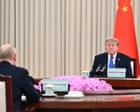
Cameras caught President Donald Trump with his eyes closed for roughly ten seconds while Chinese President Xi Jinping addressed world leaders at the Asia-Pacific Economic Cooperation (APEC) plenary session in Shenzhen on November 19, 2026. His head tilted downward, and his hands remained clasped on the table in front of him. Critics immediately accused the 80-year-old president of falling asleep during a high-stakes diplomatic address, while White House Communications Director Steven Cheung insisted Trump was simply reading briefing papers.
That ten-second clip became the defining image of the 2026 APEC summit. Yet focusing entirely on whether an octogenarian executive nodded off misses the deeper story. The viral moment happened against the backdrop of a historic, inconclusive three-way meeting between Trump, Xi, and Russian President Vladimir Putin, revealing how modern summitry has morphed into pure theater where physical stamina, media spin, and geopolitical staging carry more weight than policy breakthroughs.
The Anatomy of a Ten-Second Viral Clip
Video feeds from inside the Shenzhen International Exchange Center captured the exact sequence. As Xi delivered remarks under the summit theme of building an Asia-Pacific community, the broadcast cut to the American delegation. Trump sat motionless. His eyelids dropped for approximately ten seconds, his chin dipped slightly toward his chest, and his fingers stayed interlaced. Meanwhile, other leaders in the room—including Canadian Prime Minister Mark Carney, who was seen taking notes, and Putin, who watched the proceedings—maintained visible engagement.
The reaction online was instantaneous. Political opponents seized on the footage as proof of physical decline. George Conway, a frequent Trump critic, shared the clip with a blunt assessment: "Embarrassing, yes, But the world is safer this way".
Inside the White House press operation, the counterattack followed a familiar script. Steven Cheung posted on X dismissing the coverage as "Fake News" and claiming that Trump was looking down at documents on his desk. "You can clearly see his eyes move back and forth," Cheung wrote, attacking the press for fabricating a narrative.
Viewers watching the high-definition feed could judge for themselves whether his eyelids were open or shut. Regardless of the optical reality, the incident landed on fertile ground. Having turned 80 in June 2026, Trump is the oldest president ever inaugurated in American history. His administration has spent nearly two years battling recurring questions about his stamina, pointing to late-night phone calls with aides like Secretary of State Marco Rubio and multi-hour flights without sleep as proof of boundless energy.
The Brutal Math of Presidential Travel
Strip away the partisan warfare, and a simpler explanation emerges. Presidential diplomacy is a physiological grinder.
Before landing in southern China for the APEC Leaders' Meeting, Trump had already completed an exhausting multi-day swing through Southeast Asia, stopping in the Philippines for an ASEAN summit. Crossing multiple time zones while managing bilateral meetings, gala dinners, and domestic crises takes a measurable toll on human circadian rhythms, regardless of age.
History shows that multilateral summits are uniquely hostile to human alertness. Plenary sessions follow rigid diplomatic choreography. Leaders sit for hours listening to translated speeches filled with boilerplate rhetoric about mutual prosperity and regional stability. Anyone who has covered international conferences from the press gallery knows the heavy, warm air of a convention hall combined with simultaneous interpretation through an earpiece acts like a mild sedative.
Trump is hardly the first commander-in-chief to struggle with the physical demands of global travel. Former President Joe Biden faced relentless scrutiny over his energy levels during overseas trips, including a widely circulated moment at the 2021 COP26 climate summit in Glasgow where he appeared to doze off during opening speeches. Earlier presidents, from Ronald Reagan during a 1984 audience with Pope John Paul II to Bill Clinton during long domestic policy sessions, experienced similar camera-ready lapses.
The difference in 2026 lies in the contradiction between the image Trump projects and the reality the cameras record. Trump built his political brand on relentless vigor, frequently mocking rivals for low energy while boasting about cognitive test scores. When a leader turns stamina into a central pillar of his authority, a ten-second lapse ceases to be a relatable human moment. It becomes a direct hit to his political armor.
What Was Actually Happening in Shenzhen
While Western social media dissected Trump's posture, Beijing was executing a masterclass in geopolitical stagecraft. The 2026 APEC summit was never designed to produce sweeping trade deals. Washington and Beijing had already extended their bilateral trade truce through January 2027 during earlier meetings in May and September, removing immediate pressure to negotiate tariffs on the sidelines in Shenzhen.
Instead, Xi Jinping used the gathering to project China as the indispensable convenor of global power. The centerpiece was a rare, 90-minute trilateral sit-down between Xi, Trump, and Putin. It marked the first three-way face-to-face encounter among the leaders of the United States, China, and Russia in modern diplomatic memory.
The protocol surrounding the summit revealed Beijing's strategic priorities:
- Visual Parity: Chinese state media and party journals framed the meetings as proof that China and the United States now operate on completely equal footing. Xi personally greeted Trump upon arrival in Shenzhen and seated him beside himself at the opening gala dinner.
- Calculated Balancing: To avoid alienating Moscow while courting Washington, Chinese protocol officers carefully rotated positions during group photographs. Trump stood to Xi's right—the traditional position of higher honor in Chinese diplomacy—before the gala dinner, while Putin occupied that exact spot in the closing summit photograph.
- The Illusion of Consensus: Following their trilateral talks, the three leaders issued a joint "peace declaration" emphasizing the need to prevent nuclear war. Yet beneath the lofty language, concrete progress remained elusive. Putin used the same trip to threaten retaliation over attacks on the Crimean Bridge, and a separate 40-minute bilateral meeting between Trump and Putin yielded no breakthrough on the war in Ukraine.
In this context, the optics inside the plenary hall mattered immensely to Beijing. Chinese state television controls the primary broadcast feeds inside the venue. Having footage of the American president appearing disengaged while the Chinese president outlined his vision for global governance provided an effortless propaganda victory—no commentary required.
Why Modern Summitry Rewards Optics Over Substance
For decades, international summits operated on a predictable model. Sherpas—the senior diplomats who hammer out agreements months in advance—did the actual work behind closed doors. Presidents and prime ministers arrived at the end to sign documents, hold marathon press conferences, and take questions from an independent press corps.
That model has largely broken down. In Shenzhen, Trump departed immediately after the trilateral session without taking a single question from reporters on the ground, opting instead to announce a future press conference via social media from Air Force One. At the same time, access for working journalists inside the venue was tightly restricted, with reports of a Bloomberg reporter being barred from the Trump-Xi-Putin room after attempting to ask a question about technology exports.
When substantive negotiations are deferred and press access is curtailed, the visual feed becomes the entire story. A summit intended to address artificial intelligence guardrails, supply chain stability, and nuclear risk reduction gets reduced to a silent ten-second loop on X and TikTok.
The Credibility Trap of Automatic Denial
The White House's handling of the Shenzhen video highlights a deeper vulnerability in modern political communication. Faced with an unflattering clip, press aides face two choices. They can acknowledge human fatigue after a grueling trans-Pacific itinerary, neutralizing the story within a single news cycle. Or they can deny what millions of people just watched on their screens.
By insisting that Trump was actively scanning papers with moving eyes while footage clearly showed his eyelids shut and his head motionless, the communications team transformed a minor lapse in attention into a debate over basic honesty. Voters across the political spectrum recognize exhaustion when they see it. They are far less forgiving when told not to trust their own eyesight.
Even critics who viewed the moment as an embarrassment acknowledged a certain irony. In an era where impulsive rhetoric from world leaders can rattle bond markets or escalate military tensions overnight, a quiet ten-second pause during a scripted speech does zero damage to global stability. The real risk lies not in a tired president closing his eyes during a translated monologue, but in a diplomatic system so hollowed out by stage management and reflexive spin that nobody notices how little was actually accomplished when everyone was wide awake.
For further perspective on the footage from Shenzhen, see the broadcast coverage in President Trump Appears to Fall Asleep as Xi Jinping Speaks at APEC Summit, which captures the exact moment inside the plenary hall that sparked the international debate.