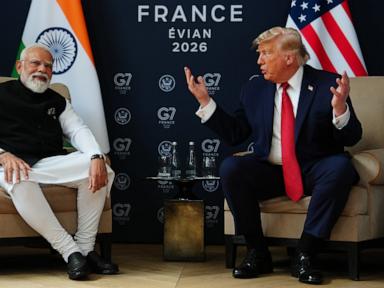
The air inside the luxury hotel in Biarritz smelled faintly of saltwater and adrenaline. Outside, the Atlantic crashed against the French coast, a restless backdrop to a meeting the world was watching with bated breath. Inside, two men sat in ornate chairs, surrounded by a small army of nervous aides clutching briefing papers that suddenly felt entirely useless.
Donald Trump turned to the cameras, his face breaking into a wide, familiar grin. He reached out and grabbed Narendra Modi’s hand.
Not just a standard handshake. A performance.
For months, the rumors had grown dark. Whispers of trade wars, retaliatory tariffs on American almonds, and deep, unspoken friction over sudden military maneuvers in the Middle East had choked the diplomatic pipelines between Washington and New Delhi. The press had spent weeks predicting a frosty encounter, a collision of two fiercely nationalist agendas. Journalists leaned forward, lenses zooming in to catch the slightest flinch, the tiniest sign of a cold shoulder.
Instead, they got a masterclass in political theater.
Trump leaned toward the Indian Prime Minister, gesturing with an open palm. He called Modi a great gentleman. He declared that India and America had never been closer. Modi laughed, a warm, resonant sound, and slapped Trump’s hand away in a gesture of intimate camaraderie that looked more like two old friends at a Sunday barbecue than the leaders of the world's most powerful nuclear states.
The tension vanished from the room. But it remained in the numbers.
The Friction Behind the Smiles
Diplomacy is often just a mask worn to hide the ledger. To understand the warmth of that handshake, you have to look at the cold friction that preceded it. Only weeks earlier, the relationship looked dangerously close to fracturing. Washington had stripped India of its special trade status, a move that hit billions of dollars in exports. New Delhi shot back, slapping retaliatory tariffs on dozens of American goods.
Imagine an American farmer in California, staring at rows of almond trees. His livelihood depends on buyers thousands of miles away in Mumbai. Suddenly, those buyers face a massive tax just to import his harvest. The spreadsheets turn red.
Now shift the focus to a tech worker in Bengaluru, wondering if new immigration restrictions will tear her family apart.
These are not abstract policy points. They are human anxieties.
The friction was not limited to commerce. The geopolitical chessboard had grown terrifyingly complex. Washington’s aggressive posture in the Middle East, particularly around critical oil shipping lanes, threatened to disrupt India’s energy security. One wrong move, one sudden military strike, and the oil prices in Delhi would skyrocket, causing a domino effect that impacts everything from the price of a ride-share to the cost of a bag of rice.
Yet, there they sat in France, laughing.
Consider what happens next when the cameras turn off. The public sees the theater, but the bureaucrats inherit the reality. The smiles in front of the press corps were a deliberate signal to the markets, a calculated message to adversarial nations, and a reassurance to voters back home.
The Art of the Public Reset
Human beings crave certainty. Markets crave it even more.
When two massive economies display public affection, it acts as a shock absorber for global volatility. Trump’s public praise of Modi was not an accident of emotion; it was a strategic choice to decouple personal chemistry from bureaucratic gridlock.
Look closely at how the interaction played out. When a reporter asked Modi about the ongoing tensions in Kashmir, Trump didn't jump in with an American demand. He stepped back. He smiled. He let Modi explain that the issue was bilateral, that India did not require outside mediation.
Trump nodded. Agreement.
This was a profound shift in tone. By validating Modi’s position on a global stage like the G7, Trump gave the Indian leader a massive domestic victory. In return, the underlying trade disputes were quietly pushed into the background, deferred to teams of negotiators who would spend the coming months hashing out details away from the glaring lights of television cameras.
It was an acknowledgment that some bonds are too big to break over a dispute about steel or agricultural imports. The strategic alignment against shared regional rivals meant that cooperation was the only real option. Friction was a luxury neither side could afford.
The Unseen Stakes
We often view global politics through the lens of ideology, but the reality is deeply transactional. The warmth displayed in Biarritz was a shield. It protected a multi-billion-dollar defense partnership, a massive tech ecosystem that bridges Silicon Valley and Hyderabad, and a shared maritime strategy in the Indo-Pacific.
The real story of that G7 meeting was not what was said, but what was deliberately left unsaid.
The trade friction did not magically disappear because of a handshake. The anxieties of the California farmer and the Bengaluru tech worker remained real. But the theatrical display of unity bought time. It provided a stable environment where solutions could be negotiated without the pressure of an impending public blowout.
Power recognizes power.
When the cameras finally stopped clicking and the journalists hurried out to file their breaking news reports, the two leaders remained in the room. The laughter died down, replaced once again by the quiet murmur of policy discussions. The performance was over, having served its purpose beautifully.
The world breathed a sigh of relief. The ledger remained complicated, but for one afternoon, the theater of friendship had kept the storm at bay.


