When ambient temperatures exceed human thermoregulatory limits, traditional macro-environmental air conditioning encounters catastrophic thermodynamic diminishing returns. Cooling an entire industrial shed, construction perimeter, or open-air loading dock requires massive energy inputs that scale exponentially with external heat flux. In response to extreme climatic baseline shifts—exemplified by seasonal tallies exceeding one hundred thousand heatstroke hospitalizations—industrial designers have pivoted away from spatial conditioning toward hyper-targeted human cooling hardware.
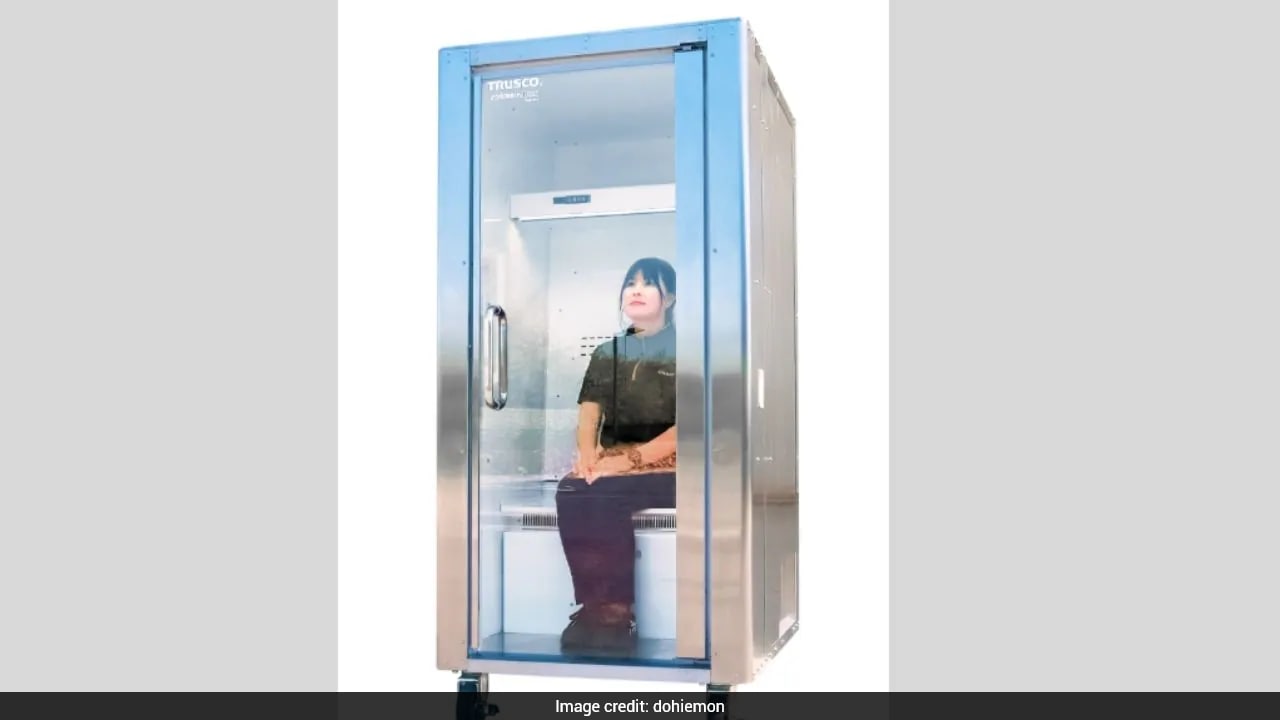
The primary embodiment of this shift is the walk-in micro-climatic cooling booth, colloquially termed the "human refrigerator" (specifically manufactured under designations such as the Do Hiemon Box by TRUSCO Nakayama and Sanden Retail Systems). Deconstructing this hardware reveals a precise intersection of applied thermodynamics, physiological heat dissipation, and micro-economic operational modeling.
The Thermodynamic Mechanics of Localized Thermal Extraction
To understand why localized cooling booths function where ambient architecture fails, one must analyze the human body's core-to-shell thermal gradient. Under hyperthermic stress, cutaneous vasodilation shifts high-temperature blood from the core to the periphery. However, high ambient humidity and temperature neutralize radiative and convective heat loss, forcing reliance on evaporative cooling through sweat. When relative humidity spikes, sweat ceases to evaporate, triggering rapid core temperature escalation and cognitive decline.
The human cooling booth short-circuits this failure mode by artificially forcing convective and conductive thermal gradients across high-sensitivity anatomical nodes.
- The Core Ambient Envelope: The interior cabin maintains a steady-state ambient temperature of fifteen degrees Celsius, dropping the immediate environmental enthalpy and halting thermal loading.
- Targeted Jet Vectors: High-velocity directional airflow chilled to five degrees Celsius is channeled specifically toward the head, neck, and shoulders.
- Vascular Intersection: The neck and head house dense networks of superficial blood vessels (such as the carotid arteries). Cooling these specific points rapidly chills the blood returning to the intracranial vault and central core, bypassing the slow systemic loop required by whole-room air conditioning.
This targeted approach produces rapid physiological stabilization. Clinical utility studies on localized micro-climates indicate that concentrated exposure to sub-fifteen-degree micro-currents drops physiological strain indicators within a five-to-ten-minute intervention window.
The Cost Function and Operational Economics
Deploying climate defense infrastructure in high-exposure commercial environments introduces a strict cost function balancing capital expenditure, energy consumption, and productivity loss.
$$\text{Total Cost of Heat Stress} = \text{C}{\text{cap}} + \text{C}{\text{energy}} + \text{C}_{\text{lost productivity}}$$
Traditional spot coolers pull immense amperage, running continuous compressors that exhaust heat back into the immediate working zone, creating a localized feedback loop of rising ambient temperatures. By contrast, micro-booths engineered from frozen-food vending machine architectures isolate the cooling cycle entirely within an insulated, IPX3-rated stainless-steel and polystyrene shell.
- Electrical Efficiency: Operating on standard one-hundred-volt circuits, these units draw roughly half the electrical load of conventional industrial spot coolers.
- Operational Expenditure: Real-world consumption metrics place running costs at approximately sixteen yen per hour.
- Capital Allocation: With base acquisition costs hovering around one point five million yen (approximately nine thousand two hundred US dollars) or monthly rental models near three hundred thousand yen, the financial outlay functions as an insurance policy against labor downtime, OSHA/industrial safety violations, and catastrophic medical evacuation expenses resulting from advanced heatstroke.
Physiological Constraints and Safety Engineering
Rapid thermal downshifts present distinct physiological risks. Plunging a severely heat-stressed worker into an environment that is too cold, too fast, can induce peripheral vasoconstriction, trapping metabolic heat in the core or triggering cardiovascular shock.
To mitigate these variables, industrial engineers programmed deterministic safeguards directly into the firmware architecture:
- Multimodal Cooling Profiles: Systems feature distinct operational modes that vary air velocity and temperature differential to match the initial core temperature of the user.
- Hardened Time Boundaries: An immutable automated shut-off timer engages at the twenty-minute mark. This hard stop prevents excessive core cooling, ensuring the user's peripheral blood vessels do not constrict prematurely before they re-enter the high-temperature work zone.
- Mobility as an Infrastructure Variable: Because the units operate on caster locking wheels without requiring fixed ductwork, plumbing, or permanent structural modification, facilities can dynamically reposition the cooling assets as construction fronts or manufacturing layouts shift.
Strategic Deployment Vector
Integrating micro-climatic cooling booths into high-risk industrial environments requires treating thermal recovery as an active operational protocol rather than an optional amenity. Facility managers must position these booths within a two-minute travel radius of high-exertion zones to ensure compliance with intermittent cooling cycles. By utilizing targeted conductive and convective extraction rather than attempting to condition open air, industrial operations can maintain continuous labor outputs even as regional heat indices breach historical baselines.
Japan's Air Conditioned Jacket
This video explores portable, wearable micro-climate tech utilized by outdoor workers in Japan to combat extreme summer heatwaves.