The tea was still warm when the metal hit the gate.
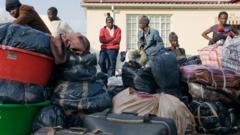
It is a quiet, devastating detail that rarely makes the official reports. When a mob forms at the end of a street, shouting slogans that turn your neighbor of seven years into a stranger, you do not pack suitcases. You do not log into your bank accounts to transfer balances. You do not file deeds or wrap family photo albums in bubble wrap. You grab the small, sticky hand of your five-year-old daughter. You open the back door. You run.
Behind you, a life dissolves into the air. A storefront that took a decade of sixteen-hour days to build. A car parked in the driveway, its keys still sitting on the kitchen counter next to a half-eaten loaf of bread. A brick-and-mortar testament to a dream that assumed the ground beneath it was stable.
For thousands of Nigerians living in South Africa during the recurring waves of xenophobic violence, this was not a hypothetical nightmare. It was Tuesday. It was a Thursday afternoon. It was the sudden, shattering end to an existence built on the promise of Pan-African brotherhood.
Now, the smoke has cleared. The headlines have drifted to other tragedies. But the silence that remains is expensive.
The Paper Trail of a Panic
When geopolitical tensions flare, the vocabulary of diplomacy immediately becomes cold, sterile, and distant. We hear terms like "bilateral relations," "repatriation," and "diplomatic interventions."
Let us strip away the jargon.
The Nigerian government’s recent announcement that it will seek formal compensation for properties abandoned by its citizens fleeing South Africa is not just a legal maneuver. It is an attempt to put a price tag on terror. It is an admission that when a person is forced to flee for their life, the theft does not end when they cross the border. The theft continues every single day their property is enjoyed, sold, or repurposed by the very forces that drove them out.
Imagine a man named Chidi. This is a composite figure, but his story is constructed entirely from the documented realities of hundreds who boarded emergency flights back to Lagos.
Chidi owned a digital printing press in Johannesburg. He paid his taxes. He employed three local South Africans. He spent years navigating the labyrinth of local business permits, investing every spare rand back into high-end machinery. When the riots peaked, his shop was looted, but the physical building—the real estate he had finally managed to purchase—remained standing.
When he fled back to Nigeria with nothing but a backpack, he didn’t stop being the rightful owner of that property. But how do you collect rent from a thousand miles away when returning means risking your life? How do you sell a building when the local market knows you are desperate, displaced, and entirely powerless to negotiate?
The answer is simple. You don't. You lose it.
The Mirage of the Shared Border
The tragedy of this economic eviction is rooted in a profound historical irony. During the dark decades of Apartheid, Nigeria was not merely a distant sympathizer; it was a frontline state in spirit. The Nigerian government issued "Apartheid passports" to South African freedom fighters, funded liberation movements with millions of dollars of public money, and taught its schoolchildren to sing songs of solidarity with their oppressed brothers and sisters in the south.
There was a collective understanding that the liberation of South Africa was the liberation of the continent.
But memory is fragile. When economic hardships hit local communities, when unemployment rises and structural promises fail to materialize, the easiest target is always the person with the slightly different accent. The shopkeeper from Imo State becomes the scapegoat for systemic failures that have nothing to do with him.
The resulting violence creates a strange, modern category of refugee: the economically erased.
Unlike refugees fleeing a civil war where entire cities are leveled, these individuals leave behind intact assets. Their homes still have roofs. Their shops still have locks, even if those locks have been broken and replaced by squatters. The wealth exists. It is tangible. It is visible on Google Maps. It has simply been confiscated by circumstance.
Counting the Uncountable
The legal mechanism Nigeria is attempting to leverage moves the conversation into uncharted, treacherous waters. Seeking compensation for state-sanctioned property damage is one thing; seeking restitution for assets abandoned due to civil unrest and a failure of state protection is far more complex.
Consider the sheer scale of the accounting nightmare.
- How do you verify the inventory of a boutique clothing store that was burned to the ground five years ago?
- What is the fair market value of a suburban home that has been illegally occupied by strangers for forty-eight months?
- How do you calculate the lost opportunity cost of a thriving logistics business that instantly ceased to exist the moment its owner stepped onto an evacuation plane?
International law recognizes the right to property, and it recognizes the responsibility of a host nation to protect foreign nationals within its borders. When a state fails to maintain the rule of law to such a degree that a specific demographic must flee in mass evacuations, that state bears a moral—and arguably financial—liability.
Yet, international courts move at the speed of shifting glaciers. Treaties are signed with expensive pens, but they are enforced with agonizing slowness.
For the families who arrived at Murtala Muhammed International Airport with empty pockets, these legal debates offer very little warmth. They are starting over in middle age. They are moving back into spare rooms of relatives, dealing with the profound psychological whiplash of being a successful entrepreneur on Monday and a penniless returnee on Friday.
The Real Cost of Fleeing
The true stakes here extend far beyond the balance sheets of Abuja and Pretoria. The real cost is the death of trust.
When a continent is trying to build a unified free trade area, the most valuable currency is not the naira, the rand, or the dollar. It is predictability. It is the absolute certainty that if an investor from Nairobi opens a factory in Accra, or a tech developer from Lagos launches a startup in Cape Town, their investment is protected by the law, not subject to the whims of a mob.
If abandonment becomes a permanent economic loss, the message sent to the entire African diaspora is chilling: Build at your own risk. Your success is temporary. Your safety is conditional.
The legal battle ahead will be ugly, bureaucratic, and fiercely contested. South Africa face its own immense internal economic pressures, and its politicians will likely view any yielding to foreign compensation claims as a domestic political liability. They will point to the actions of criminal elements rather than state policy. They will argue that the courts are open to individuals, knowing full well that an individual thousands of miles away cannot afford a Johannesburg corporate lawyer.
But Nigeria's push to institutionalize this claim changes the geometry of the conversation. It elevates the issue from a series of isolated personal tragedies into a formal state-to-state grievance. It refuses to let the matter be forgotten as mere collateral damage of urban unrest.
A Quiet Evening in Lagos
In a small rented apartment on the outskirts of Lagos, the hum of a generator fills the evening air. A man sits at a small table, smoothing out a crumpled piece of paper. It is a receipt for a commercial printing press purchased in Gauteng in 2018.
He keeps it not because he believes he will ever see the machine again. The machine is long gone, stripped for parts or humming in some other man's shop. He keeps it because it proves that he was there. It proves that his sweat mattered, that his ambition was real, and that the life he left behind was not a dream.
The politicians will argue over percentages, sovereignty, and legal precedents. They will issue press releases from wood-paneled rooms.
But the truth of the matter remains trapped in the properties themselves—in the silent storefronts, the re-keyed locks, and the homes where the tea grew cold while someone ran for their life. Justice, in this case, is not just about writing checks. It is about forcing the world to acknowledge that when you drive a person away, you do not get to keep the things they built.