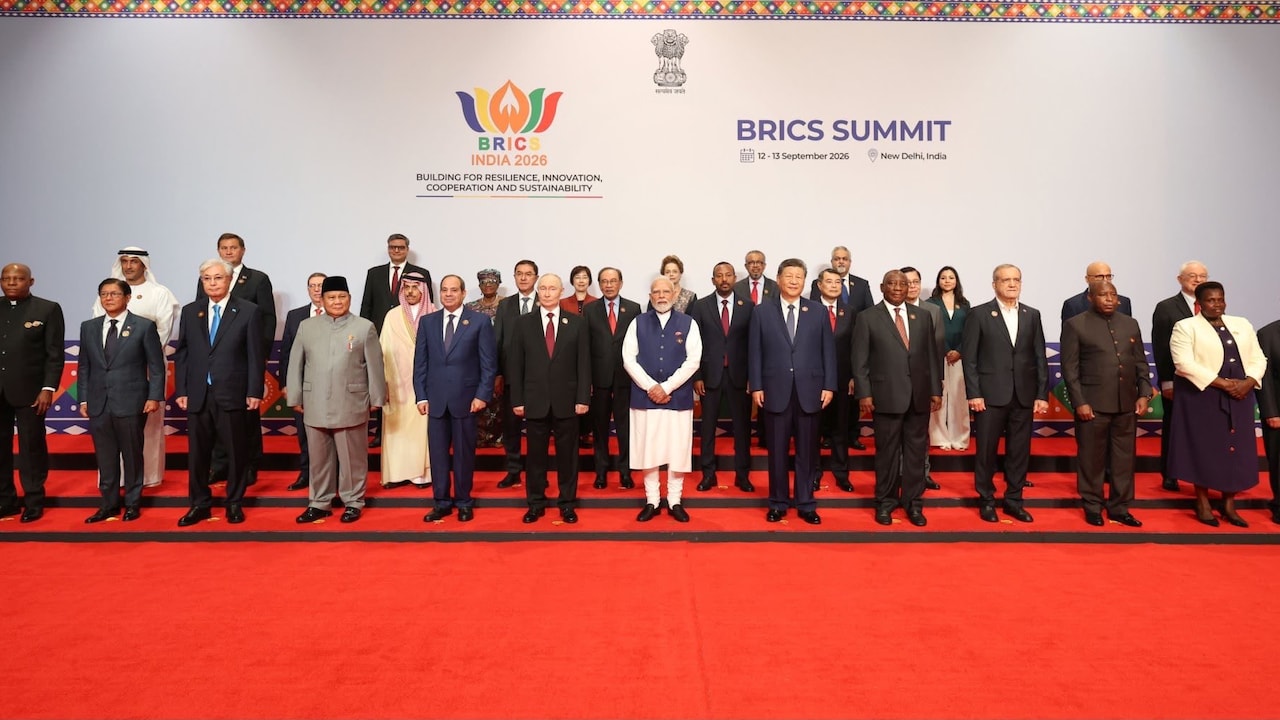
The tea in New Delhi is cooling. It sits on a dark mahogany table inside a third-floor office in South Block, ignored while the diplomats lean forward, eyes fixed on a glowing screen broadcasting the final communique from the latest BRICS summit.
Across the globe, capitals are holding their breath. Commentators on cable news channels are shouting about shifting world orders, falling dollars, and rising eastern coalitions. They talk about multipolarity as if it were a football score, a zero-sum game where points won by one side are automatically subtracted from another.
They are missing the story entirely.
To understand India’s position today, you do not look at trade spreadsheets or currency swap agreements first. You look at a man walking across a high wire, balancing a long bamboo pole. On one end of the pole sits Washington, with its deep-pocketed tech markets, defense partnerships, and decades-long security architecture. On the other end sits Moscow, a historic partner supplying heavy machinery and discounted crude, alongside Beijing, an economic behemoth that is simultaneously a fierce competitor and an unavoidable neighbor.
India is not choosing a side. India is trying to keep the pole steady while the wind howls from every direction.
The Weight Of The Room In Kazan
Picture the summit hall. Leaders in sharp suits gather under towering chandeliers for handshakes and group photographs. Smiles flash for the cameras. But beneath the polished veneer of diplomatic unity lies a quiet, intense negotiation over the shape of tomorrow.
The expansion of the BRICS bloc is no longer just a diplomatic experiment. It is a sprawling collective representing a massive share of the global population and an increasingly assertive voice in international commerce. For New Delhi, participating in this coalition is an economic necessity. Energy security demands flexible supply chains. Global South advocacy demands a unified voice against Western-dominated financial institutions like the International Monetary Fund and the World Bank.
Yet, as the ink dried on the final declarations, a different kind of calculation was happening behind closed doors.
How far can a developing superpower lean toward an alternative economic architecture without alienating its traditional, deeply integrated democratic allies across the Atlantic?
Consider the perspective of a mid-level software exporter in Bengaluru or a defense manufacturer in Hyderabad. Their supply chains, funding sources, and ultimate consumer bases are inextricably linked to Western markets. At the same time, their factories run on energy sourced through pragmatic, independent diplomatic maneuvers that bypass Western sanctions. This is the paradox of modern non-alignment, or what strategists now call multi-alignment. It is an exhausting, brilliant dance of economic pragmatism.
The Cost Of Strategic Autonomy
Non-alignment is not a neutral stance; it is an active, high-intensity sport. Every choice has a hidden price tag.
When New Delhi purchases discounted oil to shield its domestic consumers from inflation, it draws quiet, concerned glances in Washington and Brussels. When India participates in naval exercises with Western partners in the Indo-Pacific to check China's maritime ambitions, it raises eyebrows in Moscow and Beijing.
There is no safety net for a country of one point four billion people trying to chart an independent course in a fragmenting global economy. If the supply chains fracture completely, the shock waves hit every kitchen table from Mumbai to Kolkata.
This brings us to the real test that emerged from the recent summits. It is not about whether India can join a club or sign a treaty. The real test is whether a nation can remain friends with everyone while refusing to become a client state to anyone.
History warns us how hard this is. During the Cold War, non-alignment often meant diplomatic isolation or economic stagnation. Today, the rules are entirely different. Interdependence has replaced isolation. You cannot easily decouple from an economy you depend on for microchips, nor can you ignore a neighbor with whom you share a massive, contested border.
Walking The Line Without Looking Down
Step outside the ministry offices in New Delhi and walk down a bustling market street in Connaught Place. Here, the abstract concepts of geopolitics translate into daily life.
A young entrepreneur scrolls through her smartphone, funded by venture capital rooted in Silicon Valley, while the electricity powering her apartment relies on power grids stabilized by diverse energy imports. She does not care about geopolitical acronyms. She cares about opportunity, stability, and the freedom to grow.
Her future depends on the invisible diplomacy happening right now. It depends on whether diplomats can convince Western partners that an independent India is a stronger, more reliable anchor for regional stability than a subservient ally ever could be. It depends on whether BRICS can evolve into a constructive forum for development rather than an anti-Western club that forces unnecessary polarization.
The summit lights have dimmed. The leaders have flown home. The press releases have been archived.
But the tightrope remains suspended over the abyss of global uncertainty. The pole trembles slightly in the wind, shifted by shifting trade routes, technological rivalries, and competing visions of the future. The man in the middle does not blink. He adjusts his grip, shifts his weight by a fraction of an inch, and takes the next step forward, entirely alone, and entirely vital to the balance of the world.


