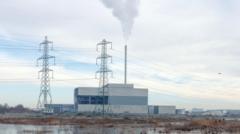
Municipalities and private waste management firms across the country are quietly pushing to expand the capacity of aging trash-burning plants, sparking a quiet war over the air quality of surrounding communities. While operators frame these expansions as green energy solutions that divert trash from landfills, the financial reality reveals a different motive. Incineration is a volume-driven business model that requires a steady, growing stream of garbage to remain profitable. This economic dependency creates a direct conflict with local recycling goals and subjects nearby residents to prolonged environmental hazards.
The Hungry Furnace Problem
Waste-to-energy plants operate on a simple mechanical principle. They burn municipal solid waste to generate steam, which spins turbines to create electricity. On paper, it sounds like an elegant way to solve two problems at once. You get rid of the trash, and you power the grid.
The business side of these operations tells a completely different story.
Modern incinerators require massive capital investment to build and maintain. To recoup these costs and generate a profit, operators sign long-term agreements with municipalities called "put-or-pay" contracts. Under these deals, a city guarantees to deliver a specific tonnage of waste to the facility every month. If the city fails to meet that quota because residents recycle more or waste less, the city must pay a financial penalty to the operator anyway.
[Image of waste to energy plant process flow]
This structure turns waste reduction into a financial liability for local governments. Instead of incentivizing conservation, it forces cities to become aggressive garbage producers. When an operator applies to expand its burning capacity, it is rarely because the local population suddenly started throwing away twice as much trash. It is usually because the facility needs to import waste from neighboring regions to maximize its profit margins and keep the boilers running at peak thermal efficiency.
The Fine Print of Flue Gas Emissions
Operators frequently point to modern scrubbing technology to reassure nervous neighborhoods. They cite compliance with federal emissions standards and highlight the efficiency of baghouses, lime scrubbers, and selective catalytic reduction systems designed to neutralize harmful gases before they leave the stack.
These assurances overlook the mechanics of monitoring and the specific nature of ultra-fine particulate matter.
Most regulatory oversight relies on periodic testing or continuous emissions monitoring systems that track a limited basket of pollutants like sulfur dioxide, nitrogen oxides, and carbon monoxide. It does not capture everything in real time. Dangerous compounds like dioxins, furans, and heavy metals like mercury and lead are often measured only a few times a year during scheduled testing windows. This creates a data gap. It assumes a plant operates perfectly every day of the year, ignoring the spikes in emissions that occur during startup, shutdown, or when the facility experiences a malfunction.
Furthermore, the filtration systems are least effective at capturing the smallest particles.
Ultra-fine particulates, known as PM2.5 or smaller, slip through standard industrial filters. When inhaled, these particles do not just settle in the lungs. They are small enough to pass directly into the human bloodstream, carrying toxic heavy metals along with them. For a community living downwind of a facility that is increasing its burn volume by thirty or forty percent, the cumulative exposure over a decade represents a severe health gamble.
The Problem with Fly Ash
Burning trash does not make it disappear. It changes its form.
For every four tons of waste fed into an incinerator, roughly one ton of ash remains after combustion. This residue is split into two categories. Bottom ash is the heavy material left at the bottom of the furnace, which is relatively benign. Fly ash is the powdery material captured by the air pollution control systems.
Fly ash contains the highest concentrations of dioxins and heavy metals stripped from the flue gas. It is a highly toxic hazardous waste that requires specialized landfill disposal. When a plant increases its capacity, it also increases its production of this concentrated poison. The material must then be trucked across public roads to specialized containment sites, shifting the environmental risk from the air of one community to the groundwater of another.
The Myth of Renewable Trash
The marketing push for expanded incineration relies heavily on branding the process as a form of renewable energy. Because the plants generate electricity, operators can often claim green energy subsidies, tax credits, and carbon offsets.
This classification ignores the basic physics of the waste stream.
A significant portion of municipal solid waste consists of plastics, synthetic fibers, and rubber. These materials are derived directly from petroleum. Burning plastic is not a renewable energy process. It is the combustion of fossil fuels in a highly inefficient, decentralized manner. Study after study indicates that per megawatt-hour of electricity produced, a waste incinerator releases more carbon dioxide into the atmosphere than a modern natural gas power plant.
Emissions Comparison (CO2 per Megawatt-Hour)
==================================================
Coal Plant:          ~~~~~~~~~~~~~~~ High
Waste Incinerator:   ~~~~~~~~~~~~~ Very High
Natural Gas Plant:   ~~~~~~~ Moderate
The energy balance looks even worse when you consider the lifecycle of the materials being destroyed. When a paper product or a piece of plastic is burned, the energy required to harvest the raw materials, manufacture the product, and transport it to the consumer is lost forever. If that same material were recycled, it would displace the need for virgin manufacturing, saving a massive amount of upstream energy. Incineration destroys that potential, locking the economy into a linear model of extraction, consumption, and destruction.
Environmental Justice and Property Values
The geographic placement of these facilities is rarely accidental. They are overwhelmingly located in low-income neighborhoods and communities of color where political resistance is historically easier for industrial developers to manage.
When an expansion is approved, it does not just bring more smoke. It brings a massive increase in heavy truck traffic. Hundreds of additional diesel-burning semi-trucks rumble through local streets every day, hauling garbage from miles away to feed the expanded boilers. This localized diesel exhaust compounds the air quality issues caused by the stack itself, driving up pediatric asthma rates and cardiovascular illnesses in the immediate vicinity.
The economic impact on the host community is equally punishing.
Industrial expansion locks a neighborhood into a cycle of economic stagnation. Property values near expanded waste facilities struggle to match broader market growth, making it impossible for local homeowners to build equity or move away. The presence of a massive, expanding waste plant deters other, cleaner businesses from investing in the area, limiting local employment opportunities to low-wage industrial work.
Breaking the Cycle of Volume Dependence
The path out of this environmental deadlock requires a fundamental rewrite of municipal waste policy. Cities must aggressively phase out put-or-pay contracts that penalize waste reduction. Instead, contract structures must reward operators based on diversion rates and the recovery of recyclable materials before combustion ever takes place.
True zero-waste policies require corporate accountability through extended producer responsibility laws. If manufacturers are forced to pay for the ultimate disposal of their packaging, they will quickly redesign products to be genuinely recyclable rather than easily combustible.
Until these systemic changes occur, allowing existing incinerators to expand their capacity is a step backward. It binds municipalities to decades of high-volume trash production and forces local communities to pay the price with their health and their environment. The true cost of burning trash is measured in the air quality of the neighborhoods downwind, and those communities have already paid more than their fair share.