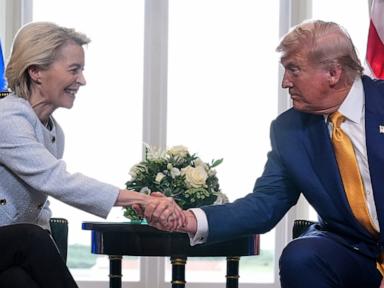
The European Union has finally capitulated to Washington, striking a provisional deal to implement a sweeping trade pact with the United States to avert Donald Trump’s threat of crippling automotive tariffs. Brussels officials are spinning the agreement as a victory for economic stability, but the reality is far grimmer. By rushing to implement the Turnberry accords ahead of a July 4 deadline, the EU has signed up for a lopsided trade structure where European exports face a blanket 15 percent tariff while American industrial and agricultural goods enter Europe entirely duty-free.
The compromise hammered out in Brussels is not a triumph of diplomacy. It is a tactical retreat under economic duress.
For months, the European Parliament and member states were locked in a bitter internal standoff over how to handle Washington’s aggressive trade maneuvers. The deal, originally sketched out at the Turnberry golf resort in Scotland, sat frozen after the White House threatened economic retaliation over European participation in NATO exercises and sparked a diplomatic crisis over Greenland. But with the clock ticking toward summer, the threat of 25 percent American tariffs on European cars and trucks broke the legislative deadlock.
To save face, European negotiators inserted an array of legal escape hatches into the final text.
The pact features a prominent safeguard mechanism allowing Brussels to unilaterally suspend tariff reductions if a sudden surge of American imports causes serious injury to European domestic industry. Furthermore, a highly contested clause gives the European Commission the power to yank back tariff preferences if Washington refuses to lower its steep duties on European steel and aluminum derivatives down to the promised 15 percent cap by December 31, 2026.
These defensive measures reveal exactly how much trust has evaporated across the Atlantic. European lawmakers are effectively building a trade agreement with one hand while holding a kill switch in the other.
The Myth of Reciprocity
The baseline architecture of the Agreement on Reciprocal, Fair, and Balanced Trade is fundamentally unequal. Under the framework, American companies secure a 0 percent tariff rate on a massive catalog of industrial goods and agricultural products entering the European single market. In contrast, European manufacturers exporting to the United States will still struggle against a standard 15 percent tariff wall on almost all goods.
This is a structural shift in global trade rules. For decades, international trade agreements aimed for a mutual reduction of barriers toward zero. The Turnberry framework throws that playbook out the window, codifying a managed trade system where the United States locks in a permanent structural advantage under the threat of worse border penalties.
The concessions extend even to highly symbolic sectors. The EU agreed to extend tariff-free access for American lobsters until 2030, reviving a niche political favor to protect New England fisheries from Canadian competition. While a lobster quota may seem trivial against the backdrop of global manufacturing, it underscores how deeply domestic political priorities in Washington dictated the terms of the European capitulation.
The Steel and Aluminum Shell Game
Nowhere is the asymmetrical nature of this deal clearer than in the industrial metals sector. While the agreement supposedly caps overall tariffs, Washington’s Section 232 duties on raw steel and aluminum remain untouched at 50 percent above established quotas.
To make matters more complex, a presidential proclamation radically overhauled how these metal duties are calculated. Previously, Washington assessed tariffs strictly on the specific metal content within an imported product. The new rules levy the tariff on the full customs value of the imported article itself.
Consider a hypothetical industrial washing machine exported from Germany. Under the old system, US customs would calculate the tariff based solely on the weight and value of the steel used to build the chassis. Under the new regime, the 25 percent or 50 percent duty applies to the total value of the entire machine, including its advanced electronics, software, and labor costs.
For European high-end manufacturing, this valuation change acts as an invisible tax hike.
The White House did offer a temporary reprieve, lowering the tariff rate on certain metal-intensive industrial and electrical grid equipment to 15 percent through 2027. This carve-out was not a favor to Brussels. It was a calculated domestic move to prevent supply chain bottlenecks from slowing down the massive factory buildout occurring within American borders. Once that window closes on January 1, 2028, the duties on those European products automatically snap back to 25 or 50 percent.
Legislative Emergency Brakes
Recognizing the vulnerability of their position, European lawmakers spent the final hours of negotiations strengthening their internal legislative defenses. The inclusion of a strict sunset clause ensures that the entire trade regulation will expire automatically on December 31, 2029.
This date was chosen with deliberate political calculation. It aligns perfectly with the conclusion of the current American presidential term, forcing a mandatory re-evaluation of the trade relationship once the political playing field in Washington resets.
The European Parliament also insisted on quarterly monitoring of import volumes. The Commission is now legally obligated to track the flow of American goods into the single market, providing a statistical early warning system to trigger the safeguard clauses before domestic European producers are overwhelmed.
Whether these mechanisms can actually protect European industry remains an open question. Initiating a trade investigation and invoking a suspension clause takes months of bureaucratic deliberation. By the time Brussels gathers the necessary data to prove economic injury, domestic market share can be permanently lost.
The provisional deal must still pass formal ratification votes in the European Parliament and across member state capitals. Given the intense pressure from industrial lobbying groups and the looming threat of the July automotive deadline, ratification is highly likely to pass. European leaders have decided that paying a 15 percent entry fee to the American market is a price worth paying to avoid an all-out trade war.
By accepting an agreement defined by imbalance and secured through economic coercion, Europe has normalized a new era of transactional diplomacy. Transatlantic commerce is no longer governed by shared rules and open markets, but by the raw leverage of the larger consumer base.