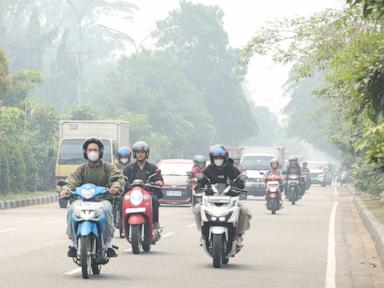
Cross-border environmental externalities expose the fundamental limitations of Westphalian sovereignty when faced with atmospheric contagion. When Indonesian agricultural clearing practices produce particulate plumes that cross sovereign boundaries into Malaysia, the resulting diplomatic friction highlights a structural failure in regional resource governance. Traditional diplomacy treats transboundary smoke as an acute emergency rather than a chronic, systemic cost of production. Resolving this crisis requires abandoning simplistic calls for voluntary compliance and instead analyzing the economic incentives driving slash-and-burn clearing, the atmospheric mechanics governing particulate transport, and the regulatory arbitrage that undermines enforcement.
The Economic Rationality Of Open Burning
To understand why traditional warnings against agricultural fires routinely fail, one must examine the cost function of land preparation. Clearing secondary forest or degraded peatland for palm oil and pulpwood plantations using heavy machinery incurs significant capital expenditure. Fuel, excavator depreciation, machine hours, and operator wages create a high cost floor per hectare. If you found value in this post, you might want to look at: this related article.
Fire remains the economically dominant alternative for smallholders and commercial concessionaires alike. By utilizing thermal energy to clear biomass, operators externalize the cost of waste removal onto the global commons. The private marginal cost of fire approaches zero, whereas the social marginal cost—manifested in respiratory illness, school closures, aviation disruptions, and lost tourism revenue—is distributed across millions of citizens in Indonesia, Malaysia, and Singapore.
This divergence between private optimization and social welfare creates a perverse economic incentive. When regional governments issue warnings against open burning without altering the underlying cost structure of mechanical clearing, they are attempting to counter a rational economic choice with moral suasion. Enforcement agencies face a structural disadvantage: thousands of remote concessions operate with limited monitoring oversight, making detection a lagging indicator rather than an active deterrent. Until the cost of mechanical clearing is subsidized or the financial penalty for burning exceeds the marginal profit of cheap land preparation, containment directives will remain ineffective. For another perspective on this development, check out the latest update from Associated Press.
Atmospheric Transport And The Spatial Distribution Of Harm
Particulate matter generated by peat and forest fires does not respect national borders. The physical transport of smoke is governed by regional wind patterns, specifically the Southwest Monsoon, which pushes air masses from Sumatra and Kalimantan across the Strait of Malacca toward the Malay Peninsula.
The spatial mechanics of this transport create a severe accountability disconnect. The geographic origin of the particulate matter lies within Indonesian jurisdiction, while the concentration thresholds of hazardous air quality indices are frequently breached downwind in urban centers such as Kuala Lumpur. This geographic separation between emitter and receptor alters the political economy of the crisis. Indonesian subnational districts benefit from the immediate agricultural productivity of cleared land, while Malaysian populations bear the immediate health externalities without exercising any regulatory jurisdiction over the source.
Furthermore, the involvement of peatlands complicates the particulate profile. Peat is essentially compressed, undecomposed organic matter accumulated over millennia. When drained for agriculture, it dries out and becomes highly combustible. Sub-surface peat fires burn at lower temperatures and emit massive quantities of fine particulate matter, carbon monoxide, and toxic gases that resist dispersion. Traditional meteorological forecasting struggles to predict the exact density and trajectory of these plumes because fire ignition points are dynamic, shifting rapidly across remote concessions before detection satellites capture the thermal anomaly.
Regulatory Arbitrage And Corporate Concession Architecture
The persistence of transboundary haze is sustained by complex corporate ownership structures designed to evade liability. Large-scale agricultural operations often utilize shell companies, opaque ownership chains, and localized registration to insulate parent conglomerates from legal action.
When an illegal fire occurs on a concession subsidiary, enforcement agencies face high legal transaction costs in piercing the corporate veil to penalize ultimate beneficial owners. Subsidiaries can be declared insolvent or abandoned, leaving no capital assets to seize for environmental remediation. This practice constitutes regulatory arbitrage, where operators exploit jurisdictional gaps between national environmental laws and international trade frameworks.
International pressure via supply chain certification schemes, such as the Roundtable on Sustainable Palm Oil, has introduced reputational risks, yet enforcement remains uneven. Independent smallholders, who account for a substantial percentage of total fire detections, operate entirely outside corporate zero-deforestation commitments. These smallholders lack access to the capital required for mechanical clearing or zero-burn agricultural technologies. Consequently, policy frameworks that target only large corporate concessions miss a major vector of ignition.
Institutional Friction In Regional Bilateral Diplomacy
Bilateral and multilateral mechanisms within the Association of Southeast Asian Nations have historically prioritized the principle of non-interference, which constrains proactive intervention. The Agreement on Transboundary Haze Pollution established monitoring frameworks and emergency response protocols, yet its enforcement architecture relies entirely on voluntary national implementation.
National sovereignty prevents regional bodies from conducting independent environmental audits within member states or deploying cross-border firefighting resources without explicit, protracted diplomatic clearance. This institutional friction introduces severe latency into crisis response. By the time diplomatic channels negotiate assistance, peat fires have often established deep subterranean burn fronts that require weeks of sustained rainfall or massive water bombing to extinguish.
The reliance on diplomatic admonitions rather than binding economic sanctions neuters regional treaties. Without a supranational dispute resolution mechanism capable of levying trade restrictions or carbon tariffs against nations that fail to enforce anti-burning laws, domestic political capture will continue to override environmental mandates. Local officials in fire-prone regions often depend on the agricultural sector for regional tax revenues and employment, creating a local political economy that actively resists strict federal enforcement.
Structural Intervention Protocols
Effective mitigation requires shifting from reactive emergency management to structural economic restructuring. Policy interventions must focus on altering the risk-reward matrix of land preparation through targeted capital deployment and strict liability frameworks.
First, governments must establish localized machinery leasing cooperatives subsidized by carbon finance or international climate funds. By lowering the operational cost of mechanical land clearing for smallholders, the state removes the economic necessity of fire.
Second, enforcement must transition from prosecuting individual field workers to targeting the corporate supply chain. Jurisdictions affected by haze should enact extraterritorial laws that penalize corporations trading in commodities linked to transboundary environmental degradation, regardless of where the concession is registered.
Third, real-time satellite monitoring must be integrated directly into automated land-use authorization systems. If thermal anomalies are detected on a concession, the land title should be automatically frozen, triggering an immediate administrative freeze on corporate export permits. Aligning financial penalties with real-time geospatial data eliminates the bureaucratic delays that currently allow bad actors to obscure liability and profit from environmental destruction.


