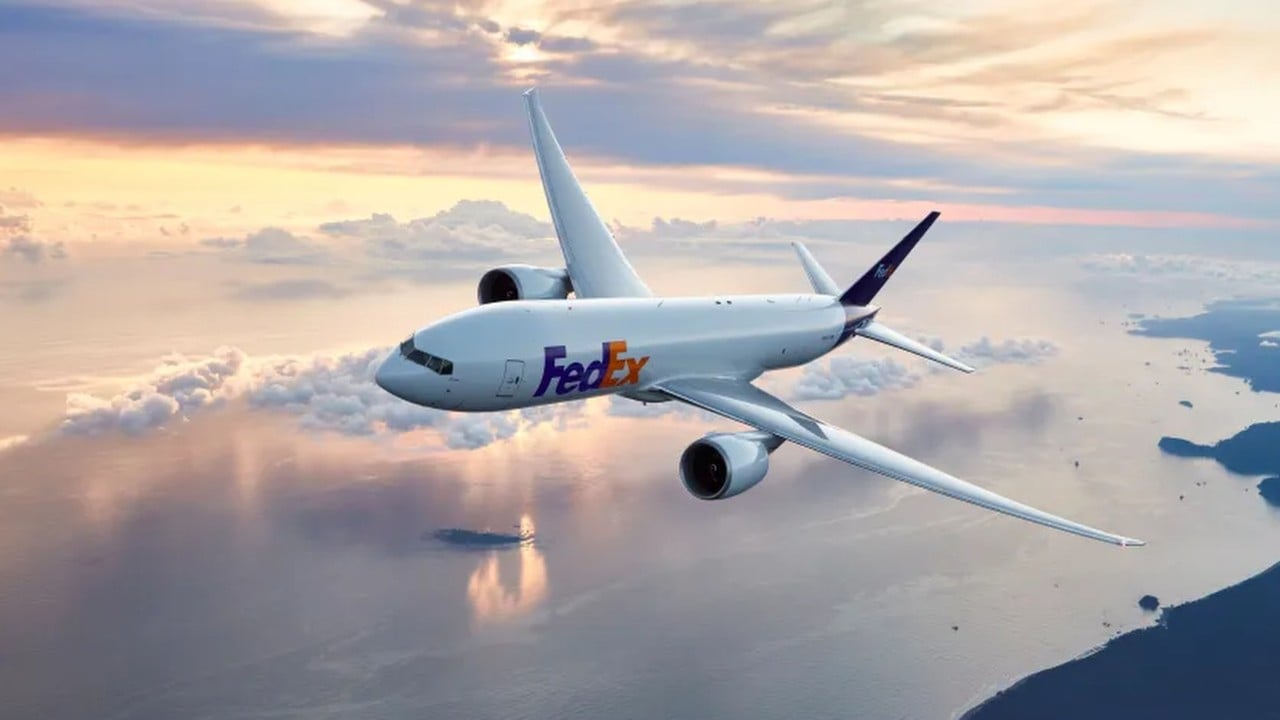
Allocating widebody freighters to transpacific routes days before bilateral trade talks is not a speculative bet on diplomacy; it is a capital-expenditure response to contractual hardware backlogs and temporary tariff windows. In early November 2026, FedEx confirmed the deployment of four new weekly Boeing 777F flights connecting Shanghai and Guangzhou to its primary North American sorting infrastructure, alongside a fifth weekly frequency routed through Clark in the Philippines. Together, these additions inject 567 metric tons of weekly upper-deck cargo capacity across the Pacific ahead of the mid-November Xi-Trump meeting at the APEC summit in Shenzhen.
Standard reporting frames this expansion as an optimistic signal ahead of high-level political negotiations. That framing reverses the causal chain. Heavy air cargo networks operate on multi-quarter asset utilization models, not short-term diplomatic sentiment. Express carriers do not reposition Boeing 777F aircraft—assets carrying roughly 102 metric tons of structural payload capacity and high hourly burn rates—unless forward freight commitments are already locked in by industrial shippers. The timing reflects a convergence of physical supply chain bottlenecks in artificial intelligence infrastructure, multi-node Asian assembly architectures, and a narrowing legal window created by the extension of the Busan trade agreement to January 10, 2027.
The Unit Economics of Widebody Freighter Deployment
To understand why FedEx committed five weekly Boeing 777F rotations to this corridor, analysts must examine the Asset-Commitment Threshold in scheduled air freight. Unlike passenger airlines that sell belly-hold space as a byproduct of ticket revenue, dedicated freighter operators must cover 100 percent of fuel, crew, maintenance, and hull depreciation solely through cargo yield per kilogram.
The operational mechanics of this specific capacity injection reveal three structural realities:
- Payload Density Over Volumetric E-Commerce: While cross-border e-commerce historically drove transpacific air volume, low-margin apparel and consumer parcels rarely justify launching dedicated Boeing 777F frequencies at the tail end of Q4 without high-yield anchor freight. FedEx explicitly designated these flights for artificial intelligence infrastructure, semiconductor components, and advanced industrial manufacturing. Server racks, optical transceivers, and power delivery units exhibit high value-to-weight ratios, allowing shippers to absorb premium express air rates that would destroy the unit economics of standard retail goods.
- The Cost of Inventory Carrying vs. Air Freight Premiums: For hyperscale data center operators in North America, the opportunity cost of an uncommissioned AI cluster far exceeds the freight differential between ocean and air transit. Ocean container shipping from East China to the U.S. West Coast requires 14 to 21 days port-to-port, excluding customs clearance and inland rail drayage. A dedicated Boeing 777F rotation compresses factory-to-hub transit to under 36 hours. When multi-billion-dollar capital expenditure schedules depend on timely delivery of custom cooling manifolds or high-bandwidth networking gear, air freight ceases to be an emergency expedient and becomes the baseline logistics mode.
- Network Synchronization at North American Hubs: The routing architecture confirms an industrial B2B orientation. All new flights terminate at FedEx's Memphis World Hub via Anchorage, while simultaneously enabling five-times-weekly service connections into Dallas-Fort Worth. Dallas-Fort Worth has emerged as a primary North American concentration zone for hyperscale data center construction and enterprise server integration. By linking Asian manufacturing origins directly to Texas integration facilities via Anchorage technical stops, FedEx eliminates domestic trucking transfers and reduces handling-induced damage risks for sensitive electronics.
The Tri-Node East Asian Consolidation Model
Superficial coverage treats the new routes as simple bilateral point-to-point flights between China and the United States. In reality, the network topology demonstrates how East Asian hardware manufacturing remains geographically fragmented across specialized national jurisdictions.
The Shanghai-Osaka-Anchorage Corridor
Three of the four primary China-origin weekly frequencies depart Shanghai Pudong (PVG) and execute an intermediate stop at Osaka Kansai (KIX) before crossing the North Pacific to Anchorage (ANC) and Memphis (MEM). In air network planning, an intermediate stop increases cycle time and adds landing and handling fees. Carriers only accept this operational friction when the intermediate node provides high-yield consolidation cargo that cannot be efficiently trucked or barged to the origin airport.
Japan occupies an irreplaceable upstream position in the semiconductor and AI hardware value chain. Japanese suppliers control global market share in critical photoresists, silicon wafers, specialty gases, and precision fabrication equipment. By routing Shanghai freighters through Osaka, FedEx creates a single-aircraft consolidation loop:
- Primary Loading in Shanghai: Freighters uplift assembled server boards, chassis, and sub-assemblies manufactured in the Yangtze River Delta.
- Upstream Consolidation in Osaka: Aircraft take on high-value Japanese semiconductor tooling, passive electronic components, and chemical inputs.
- Technical Refueling in Anchorage: Operating near maximum structural payload requires a fuel stop in Alaska before final distribution into Memphis and Dallas-Fort Worth.
This routing proves that geopolitical friction has not decoupled East Asian electronics manufacturing; rather, it has forced logistics providers to stitch together multi-country production nodes into unified transpacific air bridges.
The Guangzhou-China Southern Hub Strategy
The fourth China-origin flight operates directly from Guangzhou Baiyun (CAN) to Anchorage and Memphis, bypassing Japan entirely. This route reflects the Pearl River Delta's distinct manufacturing profile—heavier in finished consumer electronics, power supplies, and cross-border e-commerce—and executes a long-term partnership milestone. In June 2026, FedEx signed a memorandum of understanding with China Southern Air Logistics to share network resources and develop Guangzhou as an international cargo gateway.
Integrating domestic Chinese feeder networks with FedEx's transpacific trunk lines solves a persistent operational bottleneck: first-mile collection across southern China. Instead of relying solely on its own regional fleet to gather freight from Shenzhen, Dongguan, and Foshan, FedEx can ingest cargo consolidated through China Southern's domestic belly and freighter network, feeding directly into the weekly Boeing 777F departure.
The Clark Philippines Pressure Valve
The fifth weekly Boeing 777F frequency—routing through FedEx's gateway in Clark (CRK), Philippines, via Osaka to Anchorage and Memphis—functions as a structural hedge. Over the past three years, multinational hardware manufacturers have shifted final assembly and testing ("China Plus One" operations) to Southeast Asia, including the Philippines, Vietnam, and Malaysia, to mitigate tariff exposure. Routing a dedicated widebody frequency through Clark captures this decentralized output while maintaining the Osaka consolidation stop for Japanese components.
Geopolitical Arbitrage and the Busan Truce Window
Launching 567 metric tons of weekly capacity on November 9, 2026, just days before Donald Trump and Xi Jinping convened at the APEC summit in Shenzhen, appears counterintuitive if viewed through the lens of political risk. However, analyzing the legal timeline of bilateral trade agreements reveals a rational logistics strategy driven by Tariff-Window Frontloading.
During their September 2026 meeting in Washington, the United States and China extended the existing Busan trade agreement, postponing its expiration date from November 10, 2026, to January 10, 2027. That 60-day extension created a defined, finite period of tariff predictability spanning Q4 peak shipping season and the turn of the calendar year.
When importers face a hard cliff date—such as January 10, 2027—after which punitive tariffs or export controls could snap back into force, supply chain behavior shifts predictably:
- Compression of Procurement Cycles: North American technology firms accelerate Q1 2027 hardware deliveries into November and December 2026 to clear U.S. Customs before the Busan extension expires.
- Modal Shift from Ocean to Air: Any shipment booked on an ocean vessel after mid-December faces a high probability of arriving at U.S. ports after the January 10 deadline. Air freight becomes the only viable mechanism to guarantee customs entry under existing tariff schedules during the final three weeks of the truce window.
- Equities vs. Physical Freight Divergence: In early November 2026, U.S. technology equities experienced sharp volatility as institutional investors questioned the near-term return on capital for massive AI infrastructure spending. Physical air cargo bookings exposed a sharp divergence between financial market sentiment and industrial execution. Equity traders price future cash flows and can liquidate positions in milliseconds; hardware procurement teams operate on binding foundry allocations and construction timelines that cannot be paused without incurring severe contractual penalties.
Structural Constraints and Execution Risks
While adding five weekly Boeing 777F flights addresses immediate transpacific capacity deficits, the strategy carries significant operational and regulatory vulnerabilities that limit its durability beyond Q1 2027.
First, backhaul imbalance remains the chronic financial drag on transpacific air freight. Demand for westbound air cargo from Memphis and Anchorage to Shanghai and Guangzhou is structurally weaker and yields substantially lower rates per kilogram than eastbound technology shipments. If eastbound AI hardware volumes soften after the January 10, 2027 Busan deadline, weak westbound backhaul revenue will rapidly erode route profitability, forcing FedEx to redeploy aircraft to Asia-Europe or intra-Asia corridors.
Second, regulatory snapback risk sits outside the carrier's operational control. Unlike general commercial merchandise, semiconductor manufacturing equipment, high-end processors, and AI server architectures are subject to unilateral export control regimes from both Washington and Beijing. An abrupt tightening of licensing requirements or customs inspections following the Shenzhen APEC discussions could freeze high-yield cargo categories overnight, leaving widebody freighters reliant on lower-margin general freight.
Third, fleet replacement and maintenance bottlenecks constrain long-term capacity scaling. FedEx has been actively managing fleet transitions, including acquiring Boeing 777Fs to replace aging MD-11F airframes. Committing five weekly rotations to the North Pacific ties up long-range widebody hulls that cannot be easily substituted by medium-range aircraft if unscheduled maintenance occurs.
Strategic Guidance for Supply Chain and Logistics Planners
Enterprise procurement leaders and freight forwarders operating across the Pacific corridor should treat FedEx's November capacity injection as a temporary tactical buffer rather than a permanent expansion of baseline airlift.
- Lock In Block Space Agreements Through January 10, 2027: Shippers moving server hardware, industrial electronics, or high-value components out of the Yangtze River Delta or Pearl River Delta should secure fixed allocations on the Shanghai-Osaka and Guangzhou rotations immediately. Spot market rates will spike sharply in late December as importers race to clear U.S. Customs ahead of the Busan agreement expiration.
- Utilize the Osaka and Clark Nodes for Multi-Origin Assembly: Organizations sourcing sub-assemblies from both mainland China and Japan or Southeast Asia should restructure consolidation workflows to leverage the Osaka (KIX) and Clark (CRK) technical stops. Consolidating multi-origin components onto a single transpacific waybill reduces customs brokerage friction and shortens total cycle time to North American integration hubs.
- Prepare Contingency Routing for Post-January Tariff Scenarios: Do not build Q1 and Q2 2027 inventory models assuming uninterrupted transpacific air capacity at current tariff rates. If bilateral negotiations fail to extend the Busan framework past January 10, carriers will swiftly reallocate widebody freighters toward Southeast Asian hubs—such as Clark, Penang, and Bangkok—and Asia-Europe lanes to follow shifting manufacturing flows. Procurement teams must qualify secondary air freight gateways outside mainland China before the current truce window closes.