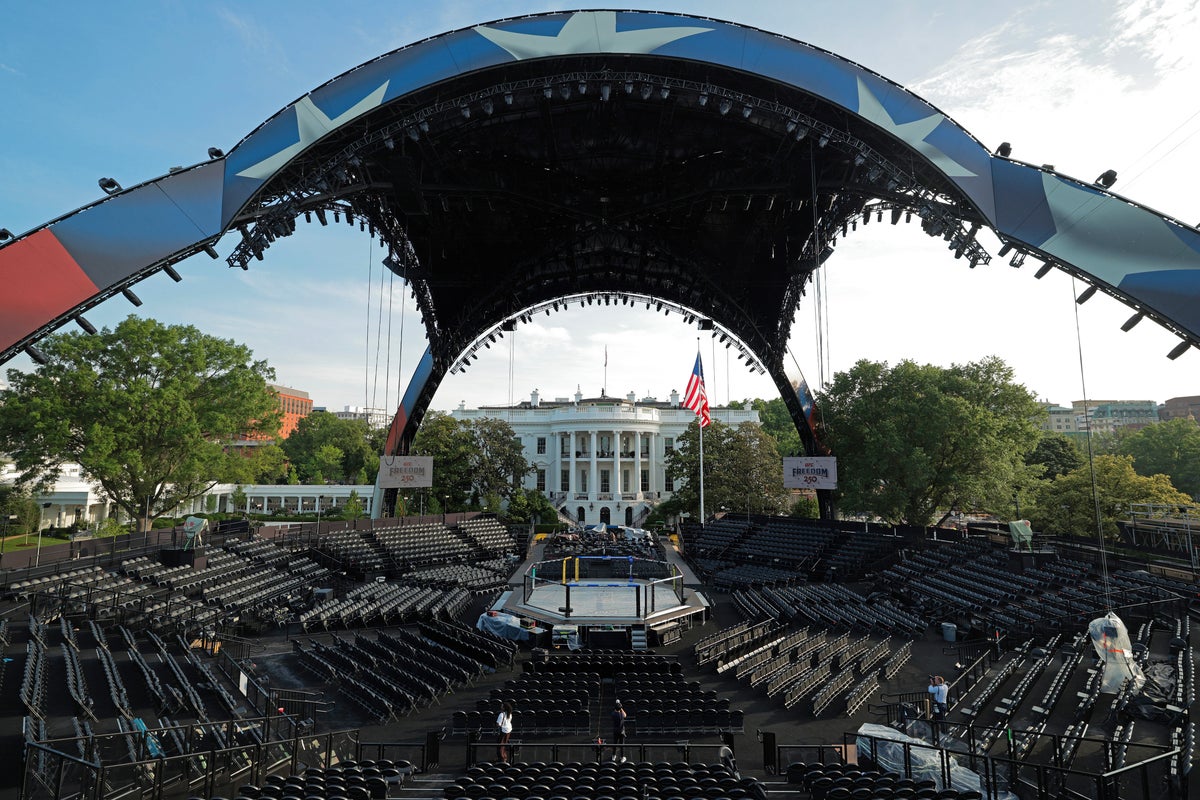
The South Lawn of the White House is currently covered by a 92-foot-tall steel structure known as "The Claw." Underneath it sits a fully branded, eight-sided mixed martial arts fighting cage. If you think that sounds like a bizarre fever dream, you aren't alone. But it's entirely real, and it's happening this weekend.
US District Judge Amit Mehta just handed Donald Trump a massive legal victory by throwing out a last-minute lawsuit that tried to shut down "UFC Freedom 250." The decision ensures that on Sunday, June 14, the executive mansion will host its first-ever private, commercial sporting event. It just so happens to fall on Trump's 80th birthday.
Critics are furious, calling it a blatant monetization of public property. Supporters view it as the ultimate celebration of American grit, tied into the country's upcoming 250th anniversary. Love it or hate it, the octagon is built, the corporate logos are up, and the fights are legally cleared to begin. Here is exactly how this unprecedented event survived the courts, what it costs, and why the opposition's strategy completely fell apart.
The Legal Flaw That Killed The Blockade
The Public Integrity Project filed a lawsuit on behalf of two Virginia residents, a civic activist and a Vietnam War veteran, attempting to get an 11th-hour injunction. They argued that the administration bypassed mandatory environmental reviews and violated National Park Service rules that ban commercial sporting events on federal parkland.
Judge Mehta didn't even rule on whether hosting a cage match on the president's lawn is legal. Instead, he dismissed the case because the plaintiffs lacked "standing."
In plain English, standing means you have to prove a specific, concrete injury to sue. You can't just file a lawsuit because you think an event is tacky or dislike how a politician spends his weekend. Mehta pointed out that nobody is holding the plaintiffs in a jiu-jitsu lock forcing them to watch the event. Because they couldn't show direct, personal harm, the judge threw the case out without diving into the broader statutory arguments.
Timing also ruined the opposition's chances. The Trump administration argued that the lawsuit arrived far too late. Crews began setting up the equipment back on May 20. Waiting until June 6 to file a lawsuit against an event that had been publicly teased for two years is a textbook example of waiting until the clock runs out, and judges hate last-minute emergencies that could have been handled months prior.
Follow The Sixty Million Dollars
If you want to understand why this event was never going to be canceled by a judge at the final hour, look at the finances. The UFC and its parent organizations have already spent over $60 million putting this together.
Stopping an event of this scale on a Friday afternoon creates a massive financial disaster. Judge Mehta explicitly noted that the potential loss of tens of millions of dollars could not be ignored in equity balancing.
The event is built around hyper-lucrative corporate tie-ins. The octagon itself is plastered with ads for companies like Bud Light, Polymarket, Crypto.com, and Dodge. VIP ticket packages that include cage-side seats under The Claw reportedly cost as much as $1.5 million. The broadcast rights belong to Paramount+, a streaming platform run by Trump allies, which expects a massive pay-per-view windfall.
While the UFC insists it's footing the bill for the physical infrastructure, public resources are heavily involved. Seven federal agencies, including the Department of Homeland Security, the Secret Service, and the Federal Aviation Administration, have spent thousands of hours preparing for the logistical nightmare of bringing an arena crowd to the executive mansion. The Secret Service alone has been screening 20 to 30 supply trucks and up to 900 production staff members every single day.
The Semantics Of A Birthday Party
The core of the political fight stems from a clever piece of regulatory maneuvering by the administration. To bypass standard National Park Service permitting restrictions, officials tied the UFC event to America's upcoming 250th anniversary celebrations. Federal rules grant wide exemptions for events honoring the nation's founding.
The plaintiffs argued this was a bad-faith trick. They claimed the fight has nothing to do with 1776 and everything to do with celebrating Trump's 80th birthday, which hits the exact same day.
It's a valid critique. The UFC press materials don't lean heavily on constitutional history. Instead, they focus on the spectacle: seven high-profile mixed martial arts bouts, a massive fan festival at the nearby Ellipse expecting 65,000 people, and a concert by the Zac Brown Band. Even the "Octagon girls" are getting custom outfits that press releases claim will "align with the overall theme" of American history.
What Happens Right Now
With the legal hurdles officially cleared, the weekend schedule is locked in. If you're following the event or trying to navigate Washington DC, here is how the timeline rolls out:
- Saturday Weigh-Ins: The public festivities start at the Ellipse with the official fighter weigh-ins. This is where the 14 athletes will face off after weeks of brutal weight cuts involving extreme saunas and hot Epsom salt baths to shed up to 20 pounds.
- Sunday Main Card: The seven-fight broadcast starts Sunday evening on the South Lawn. Expect roughly 4,300 high-paying spectators inside the custom arena, while another 120,000 lottery ticket winners watch from jumbo screens at the Ellipse.
- The Clean-Up: As soon as the fights end, Trump departs for the G7 summit in France. Crews will begin tearing down The Claw on Monday morning, with a hard deadline to return the South Lawn to its original state by June 23.
The opposition has exhausted its immediate legal options. If you're a local resident, avoid the National Mall area entirely unless you have a ticket. The security perimeter spans multiple federal agencies, and gridlock will be severe. For everyone else, the event will stream live on Sunday night, permanently changing the boundaries of how public executive space can be used for commercial entertainment.


