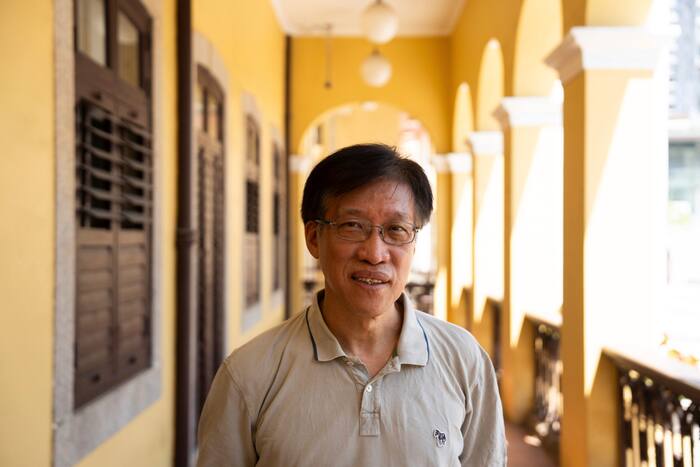
Au Kam-san will spend the next twelve and a half years in prison. The 68-year-old former pro-democracy lawmaker was convicted in Macao’s first national security trial, marking a definitive end to public political dissent in the world’s largest gambling hub.
For decades, Beijing held up Macao as the compliant sibling to defiant Hong Kong. That narrative just shattered. By sentencing a veteran legislator under its amended national security law, the Macao Special Administrative Region (SAR) has demonstrated that quiet obedience is no longer enough to spare a critic from the full weight of the state apparatus. Building on this topic, you can find more in: What Most People Get Wrong About Nithya Raman Winning the Los Angeles Mayor Race.
The Anatomy of a Historic Conviction
The verdict did not happen in a vacuum. It is the culmination of a fifteen-year legal tightening that began quietly and accelerated rapidly after the 2019 protests in neighboring Hong Kong.
Macao actually passed its original national security law—enacting Article 23 of its Basic Law—way back in 2009. At the time, the legislation sat largely dormant on the books, functioning more as a symbolic compliance box ticked for Beijing than an active prosecutorial weapon. Nobody was charged under it for over a decade. The city’s casinos were printing money, the local population was largely apolitical, and the small pro-democracy camp operated within predictable, tightly managed boundaries. Analysts at BBC News have shared their thoughts on this trend.
Everything changed in May 2023. The Macao Legislative Assembly unanimously passed sweeping amendments to the 2009 law, expanding the definition of treason, subversion, and sedition to align directly with the draconian National Security Law Beijing imposed on Hong Kong in 2020.
The updated statute introduced vague, elastic concepts like "subversion of state power" through non-violent means and criminalized collusion with foreign organizations or individuals. Crucially, it gave authorities the power to conduct closed-door trials, restrict defendants' access to lawyers of their own choosing, and detain suspects without bail for extended periods.
Au Kam-san became the first high-profile test case for this upgraded legal machinery. Arrested and tried under these newly sharpened provisions, his prosecution centered on years of political commentary, public advocacy, and contact with overseas groups—activities that were entirely legal when he performed them as an elected member of the legislature.
Who Is Au Kam-san
To understand the shockwaves this sentence sends through Macao’s civic life, you have to understand who Au Kam-san actually is. He was never a radical firebrand throwing petrol bombs or calling for violent revolution.
A former schoolteacher, Au co-founded the New Macau Association in 1992, seven years before Portugal handed the territory back to China. He served in Macao’s Legislative Assembly from 2001 until 2021, winning five consecutive elections. Throughout his twenty-year legislative career, his brand of politics was methodical, institutional, and focused heavily on bread-and-butter local issues.
He campaigned against government corruption. He demanded transparency in how casino concessions were awarded. He fought for better housing policies and labor protections for local workers squeezed by the influx of imported labor.
Yes, he organized the annual June 4 vigils in Senado Square to commemorate the 1989 Tiananmen Square crackdown—the only place on Chinese soil besides Hong Kong where such gatherings were permitted. And yes, he routinely criticized Beijing’s encroachment on local autonomy. Yet he operated strictly within the constitutional framework of "One Country, Two Systems." He was the loyal opposition, the safety valve that allowed Macao to claim it possessed a functioning pluralistic society.
In 2021, election authorities disqualified twenty-one pro-democracy candidates from running for the legislature, citing a failure to uphold the Basic Law and bear allegiance to the SAR. Au did not run that year, effectively ending his formal political career. Many observers assumed that forcing him out of office would satisfy the authorities. They were wrong.
Why Beijing Turned the Screws on the Compliant City
The conventional wisdom among regional analysts was that Macao did not need a national security crackdown. Unlike Hong Kong, which saw millions take to the streets in 2019 and 2020, Macao remained entirely calm. There were no mass riots, no airport occupations, and no widespread calls for independence.
Why deploy a sledgehammer when there is no nail sticking out? The answer lies in how Beijing views systemic risk and ideological uniformity across the Greater Bay Area.
First, national security in the current Chinese political doctrine is preventative, not reactive. Authorities do not wait for an organized movement to materialize before dismantling its potential nodes. Leaving a veteran organizer like Au Kam-san free to write, speak to foreign journalists, or mentor younger activists represented an unacceptable latent risk.
Second, Macao’s economic survival depends entirely on Beijing’s goodwill. The city’s gaming revenue—which accounts for roughly eighty percent of government income—collapsed during the pandemic zero-COVID border closures. As the casino operators renegotiated their ten-year licenses in 2022, the central government made it unmistakably clear that Macao must diversify its economy away from VIP junkets and integrate seamlessly into the Guangdong-Hong Kong-Macao Greater Bay Area. Political total alignment is the non-negotiable price of economic life support.
Third, the judicial synchronization between Hong Kong and Macao had to be absolute. If Hong Kong’s pro-democracy figures—like Jimmy Lai, Benny Tai, and Joshua Wong—were facing decades in prison under national security statutes, allowing a former lawmaker just forty miles across the Pearl River Delta to remain untouched would create an intolerable ideological contradiction. Both SARs had to be brought to heel simultaneously.
The Mechanics of Erasure
The prosecution of Au Kam-san reveals a specific, methodical playbook used to neutralize political opposition without triggering widespread public backlash.
Retroactive Criminalization in Practice
While legal officials maintain that the national security amendments do not apply retroactively, prosecutors routinely use a defendant’s past statements, historical associations, and pre-2023 advocacy as evidence of ongoing "criminal intent" or established networks. A speech given in 2018 or a meeting with a foreign diplomat in 2019 becomes the evidentiary foundation for proving a post-2023 conspiracy. For any former activist, their entire life archive becomes a minefield.
The Chilling Effect of Opacity
Unlike standard criminal trials in Macao, which historically followed Portuguese civil law traditions of public transparency, national security proceedings operate behind a curtain. Media access is heavily restricted. Court filings are sealed. Defense lawyers are bound by strict confidentiality orders. When the public cannot see the specific evidence used to convict a man to more than a decade in prison, every citizen is forced to self-censor aggressively, assuming that almost any critical remark could cross an invisible red line.
Financial and Social Isolation
Before a verdict is even reached, the state apparatus moves to sever the target’s support network. Associates are summoned for "chats" by national security police. Local media outlets—already heavily subsidized by the government and owned by pro-Beijing business elites—erase the target’s name from public discourse. By the time the judge reads the sentence, the defendant has already been effectively disappeared from public consciousness.
The End of the Macao Model
For years, diplomats and academics spoke of the "Macao Model" as a distinct alternative to Hong Kong’s tumultuous path. The theory suggested that if a semi-autonomous territory prioritized economic cooperation, avoided direct confrontation with Beijing, and maintained social harmony, the central government would respect its distinct legal traditions and tolerate a modest degree of political dissent.
Au Kam-san’s twelve-and-a-half-year prison sentence proves the Macao Model never actually existed. It was merely a temporary phase dictated by Beijing’s broader strategic timeline.
Consider the reality on the ground in Macao today. There is not a single pro-democracy lawmaker left in the thirty-three-seat Legislative Assembly. The annual June 4 vigils are permanently banned, with police threatening arrest for anyone attempting to gather in public squares. Independent civil society groups have disbanded en masse, their leaders either in exile, under surveillance, or behind bars. Local journalists operate under strict self-censorship, knowing that investigative reporting into government corruption or mainland business interests carries existential legal risks.
Even the Catholic Church and labor unions—traditional pillars of community organizing in the former Portuguese enclave—have retreated entirely from political commentary, focusing strictly on charitable work and non-controversial social services.
What Twelve Years Means for a 68-Year-Old
Numbers in legal reporting often blur into abstraction. Twelve and a half years is a statistic on a page until you measure it against a human lifespan.
Au Kam-san is sixty-eight years old. Assuming he serves the majority of his sentence, he will be over eighty when he walks out of Coloane Prison—if he survives the incarceration at all. In practical terms, a twelve-and-a-half-year sentence for a man approaching seventy is a life sentence.
The severity of the punishment is the entire point. The court did not hand down a suspended sentence or a symbolic two-year term to signal displeasure. It imposed a punitive, crushing term designed to extinguish any lingering illusions among Macao’s younger generation. The message to every university student, civil servant, and casino worker in the city is brutally clear: the cost of challenging the state is your entire remaining life.
The Illusion of Stability
Authorities in Macao and Beijing will point to the absence of street protests following Au’s sentencing as proof of social stability and public support for the national security framework. On the surface, the neon lights of the Cotai Strip still flash, the baccarat tables remain crowded, and the ferry terminals hum with weekend tourists from the mainland.
Yet beneath that glittering surface lies a profound institutional hollowing out. By criminalizing peaceful, institutional dissent, Macao has eliminated its own early warning system. When lawmakers cannot criticize government waste, when journalists cannot expose regulatory failures, and when citizens fear prison for voicing grievances, systemic problems do not disappear—they simply fester unseen until they rupture.
Au Kam-san spent twenty years inside the legislature trying to make Macao’s system work transparently for ordinary residents, believing that constructive criticism made the city stronger. For that belief, the state has locked him away until he is eighty.