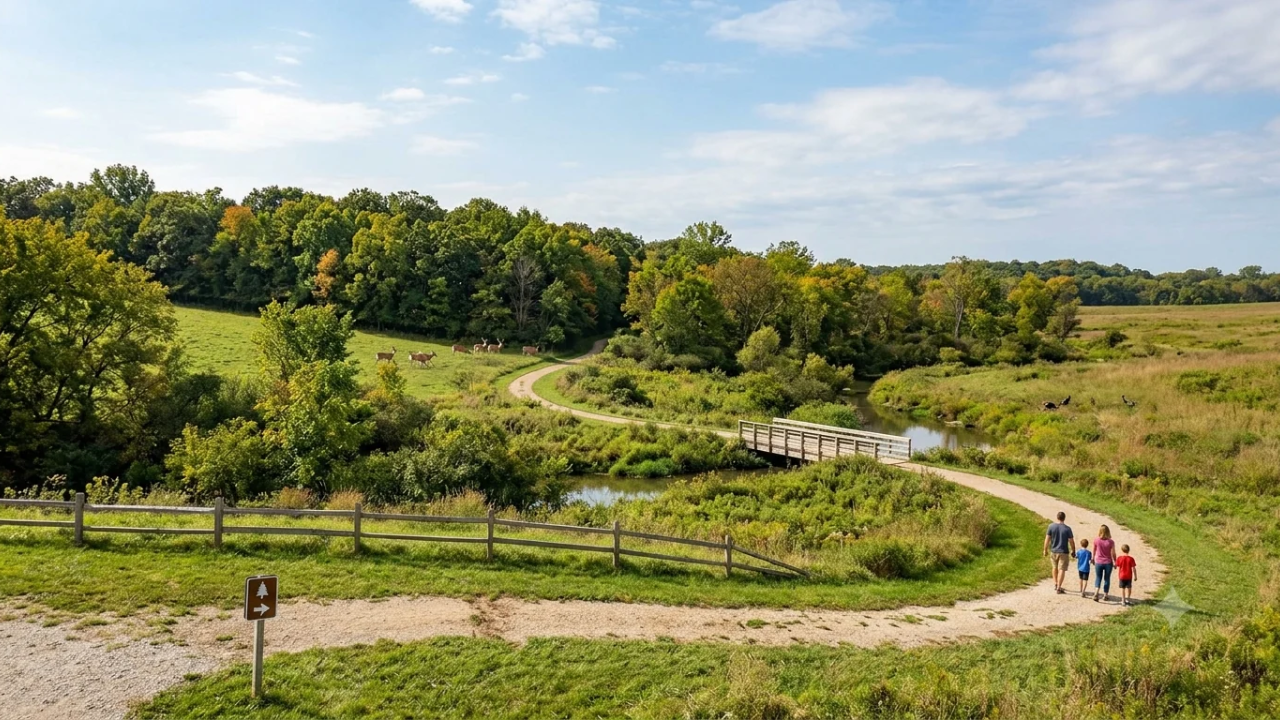
Walk down a gravel road in rural Iowa just before dawn, and you will hear the state breathing.
It is not a loud sound. It is the dry rattle of big bluestem grass shaking off the night chill, the sudden, metallic clatter of a ring-necked pheasant bursting from a ditch, and the low hum of wind moving unchecked across miles of black dirt. If you stand there long enough, watching the sun bleed amber over the horizon, it is easy to believe this openness is permanent. It feels infinite.
It is an illusion.
Across the American Midwest, the wild edges are quietly vanishing, plowed under by economic necessity or carved into neat, sterile rectangles for suburban expansion. In Iowa—a state where roughly 97 percent of the native tallgrass prairie has already been converted to agriculture or development—every remaining pocket of untamed timber, wetland, and pasture is an island shrinking in a rising tide. We tend to think of conservation as something massive, something executed by federal agencies drawing borders around millions of acres of Rocky Mountain peaks or desert canyons. We rarely think of it happening twenty-one acres at a time, decided over kitchen tables with chipped ceramic coffee mugs.
Yet, when two Iowa families recently chose to donate twenty-one acres of their land for permanent wildlife habitat and public recreation, they did something far more radical than sign a deed. They drew a line in the black soil and said: Enough.
The Weight of Twenty-One Acres
To understand why twenty-one acres matters, you first have to unlearn the modern obsession with scale. In an era of billion-dollar valuations and mega-farms stretching to the horizon, twenty-one acres sounds like a rounding error. A footnote. You can walk the perimeter of a twenty-one-acre parcel in less than half an hour without breaking a sweat.
So why make a fuss?
Imagine a hypothetical traveler—let’s call her Sarah—driving from Des Moines to Minneapolis during a blizzard. If every gas station, rest stop, and town between the two cities suddenly vanished, Sarah wouldn't make it. Even though she only needs a tiny fraction of the highway's total square footage to pull over, refuel, and wait out the storm, without those small, spaced-out sanctuaries, the entire journey becomes fatal.
Wildlife lives by the exact same rule.
Biologists refer to small, protected parcels of land as "stepping-stone habitats." For migrating monarch butterflies, neo-tropical songbirds, and native pollinators, the modern agricultural grid is a vast, monochromatic desert. A twenty-one-acre patch of timber, native grasses, and creek bed isn't just a pretty view; it is an emergency refueling station. It is the difference between a species surviving a grueling migration and collapsing halfway there.
More than that, it is a lifeline for the human spirit. In a state where roughly 98 percent of the land is privately owned—one of the highest percentages in the nation—the simple act of walking into the woods without trespassing is becoming a rare privilege. When two families hand over the keys to their private sanctuary so that strangers can hunt morel mushrooms in April, teach a daughter how to cast a spinning reel in June, or track white-tailed deer in November, they are giving away something money can no longer easily buy: access.
The Arithmetic of Letting Go
I grew up believing that land was the ultimate scoreboard. In rural communities, you don't ask a neighbor what their net worth is; you look at their fence lines. You count their quarters—a quarter-section being 160 acres—and you calculate their legacy in bushels per acre and soil suitability ratings. Land is security. Land is identity. Holding onto it is a religion passed down through generations of calloused hands.
Which is why giving it away feels, at first glance, like heresy.
Consider the sheer financial gravity of what these two Iowa families did. Depending on the county and the soil quality, twenty-one acres of Iowa land isn't pocket change. Even timber and recreational ground, once considered "wasteland" by row-crop standards, commands staggering prices on the open market today, driven up by out-of-state hunting syndicates and urban investors looking for a weekend escape. Selling those twenty-one acres to the highest bidder could have paid off a mortgage, funded a grandchild’s college tuition, or cushioned a retirement account against inflation.
To appreciate the quiet heroism of a land donation, you have to sit with the temptation of the alternative.
Let’s step into a fictionalized—yet entirely realistic—scenario that plays out in farmhouses across the state every single week. Picture an aging couple, Arthur and Evelyn, sitting at their dining table with a stack of tax assessments and a real estate broker’s glossy brochure. The broker has a cash buyer ready to close in thirty days. No inspections, no contingencies, just a wire transfer with a lot of zeros. All the buyer wants to do is clear the brush, put up a locked gate, and build a private hunting lodge.
Arthur looks out the window at the timber line where he shot his first squirrel in 1962. Evelyn remembers the spring their kids brought home tadpoles from the creek in a rusted coffee can. If they take the cash, that history is erased by a bulldozer before the ink on the check is dry. If they donate it to a county conservation board or a land trust, they get no windfall—just a tax deduction that barely scratches the surface of the market value, and the quiet certainty that the land will remain wild long after their names are forgotten.
It is an agonizing, deeply unglamorous choice. There are no cameras flashing when you sign a conservation easement or a charitable deed transfer. There is no ribbon-cutting ceremony with a giant pair of gold scissors. There is just a notary public, a blue ballpoint pen, and the profound, terrifying finality of letting go.
Why Public Land Is the Great Equalizer
There is a persistent myth in America that the outdoors belongs to everyone. The truth is much more complicated.
Over the last two decades, outdoor recreation has quietly gentrified. As public lands in the Midwest have become overcrowded, those with means have bought their way out of the problem. They lease thousands of acres of private hunting ground. They buy up riverfront cabins. They join exclusive shooting clubs. Meanwhile, the single mother working double shifts in Cedar Rapids, or the retired mechanic living on Social Security in Waterloo, is left competing for space on the shrinking slivers of public ground—places so heavily pressured by foot traffic that the wildlife has long since fled to the safety of private, posted property.
When private citizens donate land for public recreation, they disrupt that quiet erosion of democracy.
Public land is one of the last truly egalitarian spaces left in modern life. On public ground, a millionaire and a minimum-wage worker stand on the exact same trail, get bitten by the exact same mosquitoes, and stare up at the exact same canopy of bur oaks. Nobody gets VIP access to a sunset. Nobody can buy a faster pass to hear a barred owl calling across a ravine at dusk.
I remember the first time I truly understood this. Years ago, during a particularly bleak stretch of my twenties when money was tight and the future felt suffocatingly narrow, my sanctuary was a forty-acre public wildlife area tucked behind a soybean field twenty minutes outside of town. It wasn't Yosemite. There were no dramatic granite cliffs or glacial waterfalls. It was mostly scrub brush, a muddy creek, and a few stands of shaggy-bark hickory.
Yet, walking those trails saved my sanity. It was the only place in my life where I wasn't being asked to buy something, produce something, or prove my worth. The dirt didn't care what my bank balance was. That tiny patch of public ground existed only because, decades earlier, a local family had decided that their neighbors deserved a place to breathe.
The Invisible Mechanics of a Land Gift
People often wonder how a donation like this actually works behind the scenes. Does the family just hand over a deed and walk away? Or is it tangled in bureaucratic red tape?
The reality is a fascinating blend of legal precision and ecological stewardship. When families decide to donate land in Iowa—whether to the Iowa Department of Natural Resources, a local County Conservation Board, or a nonprofit like the Iowa Natural Heritage Foundation—they are entering into a permanent covenant.
First comes the ecological triage. Conservation biologists walk the twenty-one acres, taking inventory of what is already there and what has been lost. Often, neglected timber in the Midwest is choked with invasive species like multiflora rose, bush honeysuckle, and garlic mustard—aggressive botanical bullies that crowd out native wildflowers and starve local wildlife of nutrition. Before the public ever sets foot on the trails, crews often have to spend months cutting, spraying, and conducting prescribed burns to wake up the dormant native seed bank sleeping beneath the soil.
Then comes the legal armor. A standard property deed can be changed by future owners, and even government agencies can occasionally be pressured by lawmakers to sell off assets during budget crises. To prevent this, land donations are frequently paired with strict deed restrictions or conservation easements. These legal instruments strip away the "development rights" from the property forever. Even if a hundred years pass and a sprawling metropolis grows right up to the fence line, those twenty-one acres cannot be paved, subdivided, or stripped for commercial gain.
And what about the tax implications? While no one donates prime Iowa real estate purely to get rich, the federal and state tax codes do offer a vital lifeline to make the sacrifice survivable. By donating land to a qualified conservation organization or government entity, families can often claim a charitable income tax deduction based on the fair market value of the property, and in Iowa, they may also qualify for the state's Charitable Conservation Contribution Tax Credit. It doesn't replace the cash value of a sale, not by a long shot—but it softens the blow enough to turn an impossible dream into a viable legacy.
The Ripple Effect of Quiet Generosity
Skeptics will always shrug at news like this. Twenty-one acres, they will say. It’s a drop in the bucket. What difference does it make when thousands of acres of wetlands are still being tiled and drained every year?
That cynicism is understandable, even tempting, when you look at the macro-statistics of habitat loss. Watching environmental decline in real time can make anyone feel small and powerless. It is easy to throw up your hands and assume that unless you have the wealth of a tech billionaire, your actions are meaningless.
But conservation in the Midwest has never been won by billionaires. It has always been won by stubborn, ordinary people refusing to let their corner of the world go gray.
Think of those twenty-one acres not as an isolated island, but as a seed crystal dropped into a super-saturated solution. In chemistry, a tiny crystal introduced into a liquid triggers a chain reaction, causing the surrounding molecules to lock together into a solid structure. In rural communities, generosity works the exact same way.
When one family makes the bold, counter-cultural decision to gift their land to the public, the neighbors notice. At the local grain elevator, over breakfast at the town diner, at high school basketball games, people talk. The idea stops being an abstract concept read about in a magazine and becomes a tangible reality right down the road. Suddenly, the farmer three miles west starts wondering what will happen to his own creek bottom when his kids move out of state. The retired schoolteacher on the edge of town realizes she doesn't have to sell her five-acre oak savanna to a developer.
The twenty-one acres become proof of concept. They prove that legacy isn't measured by how much you hoard, but by how much you leave behind for people whose names you will never know.
A Place Where Time Slows Down
Picture that twenty-one-acre parcel fifty years from now.
The families who signed the papers are gone. Their names might be etched on a small bronze plaque bolted to a limestone boulder near the gravel parking lot, weathered green by decades of rain and snow. Most visitors will walk right past it without stopping to read the inscription.
And that is the true beauty of the gift.
In May of 2076, a ten-year-old boy who hasn't been born yet will crouch beside a vernal pool on that land, watching wood frog tadpoles wriggle through the clear water. In October of that same year, a bowhunter will sit motionless twenty feet up in a white oak, listening to the crisp crunch of dry leaves as a buck steps out of the shadows at twilight. In January, a cross-country skier will glide silently through the timber, the only sound the rhythmic swish of fiberglass over fresh powder.
None of them will owe a dime to enter. None of them will have to ask permission. They will simply step off the road, cross the threshold, and enter a small, fiercely protected piece of the world that still looks, smells, and breathes the way it was meant to.
Twenty-one acres isn't the whole world. Not even close.
It is just enough.


