The alarm clock doesn't care about your noble intentions. At 5:00 AM on a rainy Tuesday in Southport, the noble intention of running a marathon feels like a fever dream or a lapse in judgment. For Mark and Ste, it wasn't just about the rain hitting the windowpane. It was about the quiet, heavy realization that they were no longer the young men they once were. Their knees creaked like old floorboards. Their breath came in ragged bursts.
Most people see a marathon as a race against a clock. They see the distance—26.2 miles—as a mathematical problem to be solved with pacing and hydration. But for these two dads, the distance was a secondary character. The real story was written in the mundane, grueling months leading up to the London Marathon. It was written in the skipped pints at the pub, the early nights, and the shared glances of exhaustion during long training runs along the coast. If you enjoyed this post, you might want to read: this related article.
The Weight of the "Why"
Running for yourself is easy to quit. When your lungs feel like they’re filled with hot sand and your hamstrings are screaming for mercy, a self-centered goal evaporates. You go home. You take a bath. You order a pizza.
Mark and Ste didn't have that luxury. They carried the weight of something much heavier than their own fitness. They were running for a cause that sat at the dinner table with them. They were running for the North West Air Ambulance Charity. Every step they took in the cold North West wind was a payment toward a debt of gratitude for a service that saves lives when every second is a jagged edge. This wasn't a hobby. It was a mission. For another look on this event, refer to the latest update from Glamour.
Consider the hypothetical runner who trains in isolation. He has the best shoes, the perfect playlist, and a heart rate monitor that tracks every twitch of his muscle. He is technically proficient. Yet, when the "Wall" hits at mile twenty, he is alone with his pain. Now, consider Mark and Ste. When one faltered, the other was a mirror. They didn't just share a pace; they shared a psychological burden. If one’s rhythm broke, the other provided the beat.
The logistics of training as a parent are a chaotic puzzle. You aren't just managing your own time; you are negotiating with the lives of your children and the patience of your partner. It’s a delicate dance of school runs, work deadlines, and finding a ninety-minute window to disappear into the pavement. There were days when the road felt like an enemy. There were days when the Southport coastline felt endless, a flat, grey ribbon of endurance that tested their resolve more than any hill could.
The Concrete Canyon
London on marathon day is a sensory explosion. It is a far cry from the quiet streets of Southport. There are a million voices. There is the smell of deep heat and nervous sweat. There is the relentless, rhythmic thud of thousands of sneakers hitting the asphalt, a sound like a giant heart beating in the center of the city.
For Mark and Ste, the start line wasn't a beginning. It was the climax of a story that started months ago in the dark. They stepped off together. Side by side.
In the early miles, the adrenaline is a liar. It tells you that you are invincible. It whispers that the pace is easy, that the crowd will carry you forever, and that the pain is a myth. You see the landmarks—Cutty Sark, Tower Bridge—and they feel like movie sets. The two dads kept their eyes on each other. They checked in with nods and short, economical sentences. Efficiency was the only currency that mattered now.
Then comes the middle. The "Grey Zone." This is where the novelty wears off and the reality of human biology takes over. Your body begins to cannibalize its glycogen stores. Your brain starts sending frantic signals to stop this madness. This is where the physical meets the metaphysical. The crowd becomes a blur of color and noise, a distant roar that you can no longer process.
The Invisible Stakes
Why do we do this to ourselves?
We live in a world that prioritizes comfort. We have apps to bring us food, cars to take us blocks, and climate-controlled environments to keep our skin at a perfect temperature. We have engineered the struggle out of our daily lives. But something in the human spirit atrophies when it isn't tested. Mark and Ste weren't just running for a charity; they were reclaiming a version of themselves that knew how to suffer for something meaningful.
The psychological concept of "social facilitation" suggests that we perform better in the presence of others. But this wasn't just performance. This was brotherhood. When the cramps started to set in for Ste around mile eighteen, Mark didn't push ahead to grab a personal best. He slowed. He adjusted. He became the pacer, the anchor.
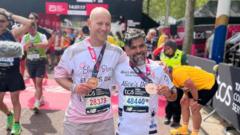
They reached the final stretch—The Mall. The red pavement. The palace in the background. Most runners at this stage are ghosts of themselves. They are swaying, their forms broken, their faces masks of agony. But as Mark and Ste approached the finish line, there was a shift. They didn't just cross it. They crossed it together. Two dads from Southport, three hundred miles from home, finishing exactly as they had started.
The Silence After the Roar
The medal is a heavy piece of metal on a ribbon. It’s a nice souvenir. But the real trophy isn't something you can hang on a wall. It’s the silence that follows the race. It’s the walk back to the hotel, leaning on each other, feeling every single one of the 50,000 steps in your bones.
They raised thousands of pounds. They proved that ordinary men can do extraordinary things if they refuse to do them alone. They showed their kids that a promise made in the dark of winter is a debt that must be paid in the light of spring.
As they sat on a curb in London, clutching foil blankets and water bottles, the city continued to swirl around them. The crowds cheered for others, the music blared, and the clocks kept ticking. But for a moment, the world was perfectly still. The mission was complete. They weren't just runners anymore. They were survivors of their own ambitions.
They didn't break any world records. They won't be in the history books of elite athletics. But in the quiet suburbs of Southport, two families looked at these men differently. They saw the grit behind the smile. They saw the man who stayed when he wanted to run away from the pain.
Sometimes, the greatest victory isn't beating the person next to you. It’s making sure they get to the end with you.
The soreness will fade in a week. The medals will eventually collect dust on a shelf. But the memory of that shared mile—the one where neither spoke because the effort was too great, yet both knew exactly what the other was feeling—that is permanent. It is etched into the marrow. It is the reason we keep showing up at 5:00 AM when the rain is hitting the window.
We run to find out who we are. We stay to find out who our friends are.