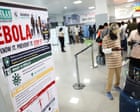
Two travelers. Thousands of miles apart. One question that makes every disease detective in the room go quiet.
When health authorities investigate whether the first Ebola cases in Kenya and Nigeria crossed paths, the headline sounds like a dry bureaucratic check. A box to tick on a surveillance spreadsheet. Yet anyone who has stood inside an emergency operations center at two in the morning knows what that question actually means. It means a boarding pass might be a clue. It means a handshake in a departure lounge or a shared cab in an unfamiliar city could carry a chain of transmission that has not yet shown its teeth.
Ebola does not announce itself with a siren. Early symptoms look like malaria, typhoid, or simple exhaustion from a long flight: a fever rising quietly behind the eyes, a muscle ache that feels like a bruise from the inside out, a throat that starts to scratch. By the time a patient looks unmistakably ill, days have already passed, and days in outbreak response are measured like water leaking through a cupped hand.
How a Single Crossing Changes the Math
Consider what happens next when two separate nations report index cases around the same window. Public health teams immediately face a fork in the road. Are these two independent sparks—a spillover event in one country and an unrelated introduction in another—or are they two embers blown from the same fire?
To understand why that distinction matters, picture a pair of compass needles on a map. (This is a metaphor for how epidemiologists track exposure windows and movement, not a literal instrument.) If the cases are unrelated, each country fights a localized brush fire with its own containment perimeter, contact tracers, and isolation wards. If their paths crossed, the fire is not local. It has wings. A single shared transit hub, a crowded bus, a clinic waiting room, or a family gathering becomes a bridge between two populations that might otherwise have remained separate.
I have spent years working alongside public health teams during infectious disease alerts, smelling the sharp sting of chlorine disinfectant in temporary triage tents and watching exhausted data analysts stare at flight manifests until the letters blurred. Nothing ages a room faster than an unlinked case. You can trace a chain when you see the links. When a line stops in midair—when a traveler in one country and a traveler in another might share a timeline, a route, or a social circle—the unknown becomes its own hazard.
It is terrifying to admit how fragile human memory is under pressure. Ask someone where they ate lunch four days ago, who sat next to them on a minibus, or which restroom they used during a two-hour layover, and watch how quickly details slip away. When fear enters the room, people also remember selectively. Nobody wants to be the reason a neighbor gets quarantined or a clinic gets shut down. That hesitation is human, not malicious, yet every hour of silence gives a virus more room to move.
The Detective Work Behind Every Timeline
Tracking whether two early cases crossed paths is rarely a movie moment with a single dramatic clue. Usually it is painstaking, unglamorous work: comparing timestamps, checking customs records, reviewing clinic intake logs, and interviewing relatives who are grieving, frightened, or exhausted.
To see how these pieces fit together, imagine a hypothetical reconstruction of a typical cross-border investigation. Suppose investigator Amina sits at a folding table in Nairobi with a notebook and a wall map, while her counterpart in Lagos reviews patient movement histories over an encrypted line. Neither has the whole picture at first. Amina has a departure date and a vague mention of a colleague visiting West Africa; the team in Nigeria has symptom onset dates and a list of people who cared for the patient before isolation.
On paper, two timelines can look almost aligned while still missing the crucial overlap. Ebola has an incubation period that typically ranges from two to twenty-one days, most often around eight to ten days. That three-week window is both a blessing and a curse. It gives responders time to find contacts before they become infectious—because a person cannot spread Ebola until symptoms begin—yet it stretches the detective work across weeks of calendars, receipts, and phone call logs.
Investigators look for concrete intersections:
- Shared travel corridors, layover airports, or regional flights connecting East and West Africa.
- Overlapping dates in hotels, guesthouses, conference halls, or healthcare facilities.
- Mutual contacts—friends, family members, drivers, or coworkers who moved between both itineraries.
- Distinct viral lineages identified through genomic sequencing, which can reveal whether two cases share a close evolutionary branch or come from different origins.
Genomic sequencing, when available, acts like a family tree written in RNA. Even if two people never spoke a word to each other, a closely matched viral sequence tells scientists that their infections belong to the same lineage, narrowing down where and how transmission could have occurred. Conversely, two distinct viral signatures can rule out a direct link even when dates and destinations look suspiciously close.
Still, science only moves as fast as sample transport, cold-chain logistics, and laboratory capacity allow. In the hours and days before lab confirmation catches up to field rumors, rumors travel faster than airplanes. A whisper in a market or a post in a group chat can spark panic or stigma long before officials confirm a single link.
Why Fear Makes Every Question Harder
Let me be honest: even for people trained in outbreak response, Ebola carries a heavy psychological weight. The name alone triggers memories of past West African and Central African outbreaks where hospitals were overwhelmed and communities bore unimaginable loss. You do not have to feel ashamed if reading about a potential cross-border link makes your chest tighten. Uncertainty is uncomfortable because it reminds us how interconnected we are.
We live in a world of constant motion. Trade, family ties, medical care, business, and migration knit cities together across vast distances. That connectivity brings vitality, opportunity, and warmth. It also means an infectious pathogen does not respect national borders or passport stamps.
When authorities ask whether early cases in Kenya and Nigeria crossed paths, they are not pointing fingers. They are trying to draw an accurate map before the territory changes. Every time public health teams answer that question clearly—whether the answer is yes, no, or not yet proven—they help communities separate real risk from noise.
What Separates Panic From Preparedness
Outbreaks are won or lost in the quiet habits built long before an emergency begins. Surveillance systems that catch fevers early at clinics. Border health teams trained to screen calmly without humiliating travelers. Laboratories that share data openly. Communities that trust health workers enough to report illness early rather than hiding it out of fear of isolation.
When investigators trace possible links between early cases, their goal is to shrink the circle of uncertainty as fast as possible. If two cases did not cross paths, resources can stay focused on each local response while maintaining vigilance across regional transit hubs. If they did cross paths, every contact on both sides of that intersection gets checked, monitored, and supported before another link forms.
Watch how the tension shifts once a link is either ruled out or mapped cleanly. A faceless threat turns into a concrete set of actions: specific flights reviewed, specific contacts traced, specific clinics briefed. Action is the antidote to helplessness.
The next time a headline speaks of health officials checking whether two distant cases crossed paths, do not read it as a dry footnote. Read it for what it truly is: a race against time, pieced together from human memory, lab data, and quiet courage, to keep a spark from becoming a fire.
If you are following along on a personal device right now, signing in to a Google Account can make it easier to save threads like this and pick them back up later whenever a story develops.
Two travelers moving through the world on separate errands, bound for a single fateful minute where their shadows might have touched.