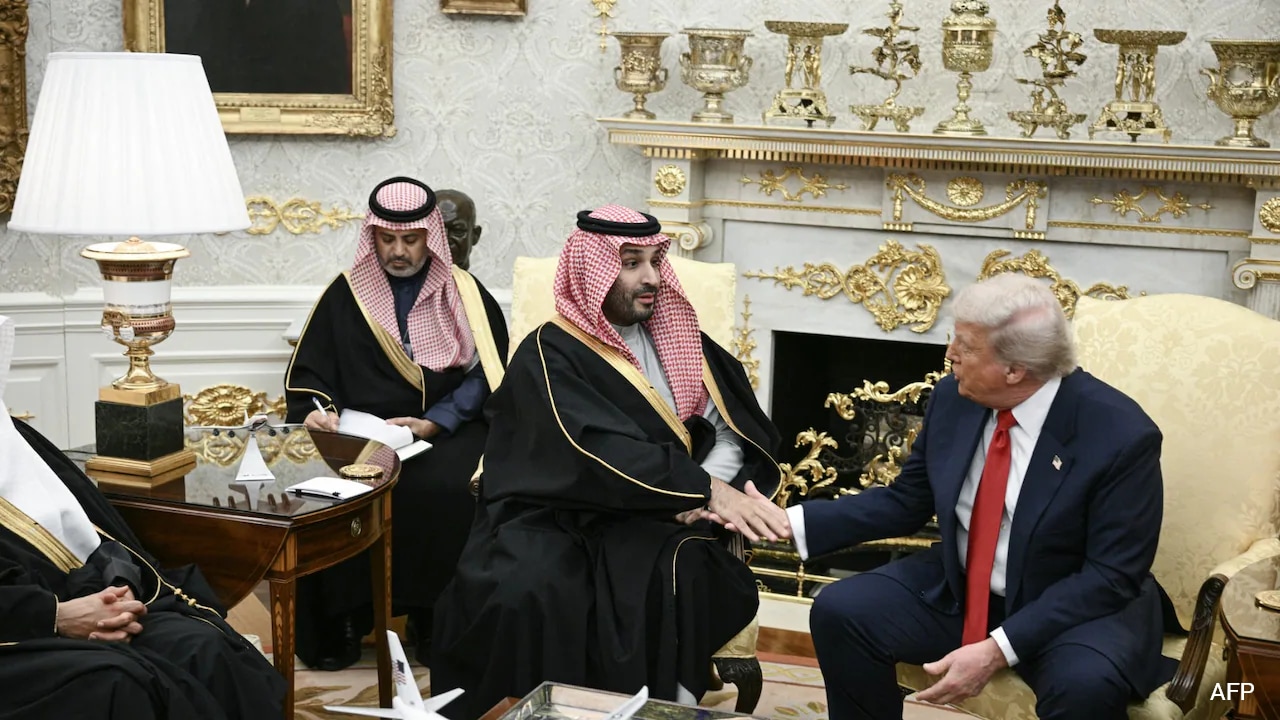
Deep beneath the polished marble floors of Washington and the sun-bleached expanse of the Rub' al Khali, a quiet transformation took root. For decades, the global order ran on a simple, greasy truth: black gold pumped from Arabian sands kept Western engines humming, while American firepower kept the kingdom's borders secure. It was a cold, transactional marriage built on barrel counts and arms shipments.
Then came the signature.
When news broke that Washington and Riyadh had finalized a landmark civil nuclear agreement, observers scanned the press releases for familiar geopolitical buzzwords. They found technical jargon about uranium enrichment restrictions, non-proliferation protocols, and grid diversification. But technical jargon misses the hum of human ambition that got us here.
To understand why a nation sitting atop 17 percent of the world's proven oil reserves wants nuclear reactors, you have to stand in the heat of a Riyadh afternoon.
Picture an engineer named Tariq.
He is thirty-four, educated in London, and works for the ministry overseeing energy transition. Tariq grew up in a city where air conditioning is not a luxury; it is life support. During the blistering summer months, when temperatures breach 115 degrees Fahrenheit, Saudi Arabia burns up to a million barrels of its own crude oil every single day just to keep the lights on and the water chillers running.
Think about that math.
Every barrel burned to cool a living room in July is a barrel that cannot be exported to fuel global commerce. It is a barrel turned directly into smoke, carbon, and lost potential. For an economy attempting to construct futuristic cities and pull itself into a post-hydrocarbon future, burning your primary asset just to survive your own climate is a recipe for long-term decay.
Tariq knows this. His supervisors know this. And in the corridors of power in Washington, strategists know something else entirely: if the United States did not build those reactors, someone else would.
Foreign policy often looks like a high-stakes chess match played by men in tailored suits. In reality, it resembles a frantic game of musical chairs played on a melting ice cap.
For years, the negotiations stalled over a single, terrifying element: enrichment.
Uranium is a double-edged sword. Enrich it to three or five percent, and you have fuel for a light-water reactor that powers medical equipment and lights up cities. Enrich it past ninety percent, and you have the core of a weapon that can flatten a metropolis. The debate was never really about power plants. It was about trust.
Washington demanded strict guardrails—the gold standard of nuclear non-proliferation, requiring the kingdom to forego indigenous uranium enrichment and rely on foreign supply chains. Riyadh pushed back, insisting on national sovereignty and economic self-reliance.
The impasse felt permanent.
Until the ground shifted.
Across the Persian Gulf, regional rivals accelerated their own programs. Meanwhile, foreign envoys from competing global superpowers began arriving in Riyadh with attractive proposals, offering turnkey nuclear facilities with fewer geopolitical strings attached. American negotiators faced a stark reality: walk away and lose influence in the Middle East for a generation, or compromise and construct a framework that keeps international monitors inside the facility doors.
They chose the table.
What emerged from those closed-door sessions was not just a bilateral contract, but an entirely new blueprint for regional security.
Under the terms of the agreement, the United States agreed to assist in developing Saudi Arabia’s civil nuclear energy infrastructure, providing advanced reactor designs and commercial expertise. In exchange, the kingdom agreed to stringent oversight mechanisms, including enhanced inspections by the International Atomic Energy Agency and commitments regarding the handling of spent fuel.
The agreement serves as a massive bet on stability.
By anchoring the kingdom's energy future to American technological standards, Washington binds two economies together for the next sixty to eighty years. A nuclear reactor is not like a squadron of fighter jets that can be re-exported or re-flagged; it is a permanent commitment. It requires decades of specialized maintenance, fuel rod delivery schedules, regulatory compliance, and joint scientific safety protocols.
It is a concrete anchor dropped straight into the bedrock of international diplomacy.
Consider the sheer scale of what comes next.
In the desert north of Jeddah, surveyors are laying out grid lines across empty sand dunes. Where wind once shifted barren dust, massive containment domes will soon rise against the horizon. Inside, cooling towers will draft sea water from the Red Sea, converting nuclear fission into megawatt-hours of clean, baseload electricity.
For the regional power grid, the shift is seismic.
Every megawatt generated by splitting atoms is a megawatt freed from the furnace of crude oil combustion. It means cleaner air over Middle Eastern urban centers and a dramatic reduction in regional carbon footprints. More importantly, it signals to global markets that the world's chief oil exporter is hedging its bets against the very commodity that built it.
Yet, lingering doubts remain.
Critics in Congress and non-proliferation advocacy groups point out the inherent risks. Any domestic nuclear capacity, no matter how heavily monitored, creates a baseline of technical expertise. Engineers trained to operate civil reactors learn the same core physics required for dangerous enrichment techniques. If political tides turn decades down the road, can international safeguards truly guarantee that peaceful power stays peaceful?
It is a valid, uncomfortable question.
And it is precisely why the agreement contains emergency clauses—mechanisms that allow for the immediate cutoff of nuclear fuel and technical support if safety protocols are breached or inspection access is restricted.
The true legacy of this deal will not be measured in press releases or diplomatic handshakes. It will be measured in the quiet, mundane moments of daily life decades from now.
It will be measured when Tariq's children grow up in a Riyadh powered by carbon-free energy, watching solar arrays and nuclear domes supply the baseline energy for a nation that once lived purely off the liquid fossils beneath its boots.
It will be measured in the quiet control rooms where American and Saudi operators sit side-by-side before bank after bank of monitoring screens, tracking neutron flux and coolant temperatures with meticulous precision.
The world did not suddenly become safer the day the ink dried on this treaty. The Middle East remains a region crisscrossed by fault lines, deep rivalries, and uncertain tomorrows. But in choosing a shared, highly monitored energy future over an unregulated scramble for power, two long-time partners decided that calculated cooperation was far better than unpredictable drift.
Out in the quiet desert night, as wind sweeps across the dunes where the first foundations will soon be poured, the hum of the future is already beginning.