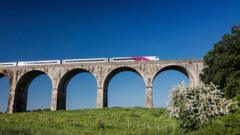
The rain in Belfast doesn’t fall; it crowds the air. On a Tuesday morning at Lanyon Place station, the platform smells of damp wool, diesel fumes, and the specific, metallic tang of brake dust. Commuters stand with shoulders hunched, watching the digital departure board with a practiced, cynical patience. Among them is a hypothetical traveler we will call Aoife—a consultant who splits her week between corporate offices in Belfast and Dublin.
Every week, Aoife plays a game of high-stakes geography. The distance between the two cities is just over a hundred miles. By modern rail standards, that should be a swift, negligible hop. Instead, it is a weekly test of endurance. The current Enterprise service, which has linked the two major cities of the Irish island since 1947, often feels like a rolling relic of that post-war era. It vibrates. It groans. Above all, it takes its time—roughly two hours and fifteen minutes on a good day, and considerably longer when the signaling systems south of the border refuse to cooperate. For another perspective, see: this related article.
For decades, the rail line connecting Dublin and Belfast has been more than just steel and sleepers. It has been a barometer of political weather. During the worst years of the twentieth-century conflict, the line was bombed, disrupted, and threatened so frequently that the journey became an act of minor defiance. Today, the threats are different. They are bureaucratic. They are financial. The line suffers from the slow, choking friction of underinvestment, leaving two major economic hubs tethered together by an infrastructure that belongs in a museum.
But a massive shift in gravity is underway. The Irish government recently confirmed a massive funding injection of 197 million pounds sterling—part of a broader 800 million euro Shared Island investment package—specifically earmarked to transform the Dublin-to-Belfast rail corridor. Related coverage on the subject has been provided by TIME.
This is not just a spreadsheet victory. It is an attempt to fundamentally alter how the island breathes.
To understand why a nearly 200 million pound investment matters, you have to look at the geometry of the current system. Right now, the Enterprise operates on a two-hour frequency. If you miss the 8:00 AM train, you are stuck until 10:00 AM. For anyone running a business, that gap is an eternity. The new funding aims to slice that interval in half, introducing an hourly service that shifts the train from an event you must meticulously plan around into a utility you can simply trust.
Consider what happens next when that hourly clock begins to tick. The goal isn't just frequency; it is velocity. The investment funds the purchase of new, modern rolling stock and extensive track upgrades designed to eventually bring the travel time down to a clean, crisp ninety minutes.
Think about that transition through an analogy of human attention. A two-hour-and-fifteen-minute trip is a dead zone. It is too long for a casual commute, yet too short to properly settle into deep work without the constant interruption of stops like Portadown, Newry, and Dundalk. It hangs over your day like an awkward chore. Reduce that to ninety minutes, and the psychological distance evaporates. Belfast and Dublin effectively become suburbs of one another. The border, already invisible on the map, becomes irrelevant to the clock.
The money originates from the Shared Island Fund, a financial mechanism set up by Dublin to back projects that bring tangible, cross-border benefits to people living in both jurisdictions. For the cynical observer, it is easy to view this as a political gesture—a wealthy southern state flexing its economic muscles to curry favor or signal unity. The reality on the ground is far more pragmatic. Dublin’s capital city is bursting at the seams. Housing prices are astronomical, hotel rooms are a luxury commodity, and the infrastructure is under intense strain. Meanwhile, Belfast possesses space, talent, and a lower cost of living, but remains cut off by a slow-motion transport link.
The investment is an economic pressure valve.
If you sit in the dining car of the current Enterprise, you can hear the island's economic engine sputtering. You hear the frustrations of tech workers from the Silicon Docks in Dublin who need to meet teams in Belfast’s Titanic Quarter. You hear students who attend Queen’s University Belfast but whose families live in County Wicklow, balancing the math of bus routes versus unreliable trains.
The current system forces a choice between two evils. You either sit on a train that feels like an afterthought, or you take the M1 motorway. Anyone who has attempted to drive into Dublin via the M1 on a weekday morning knows the particular despair of the West-Link toll bridge or the creeping paralysis of the North Circular Road. The road network is full. The sky cannot handle more short-haul emissions. The only direction left to look is down at the tracks.
The logistics of this upgrade are incredibly complex. This isn't just about buying shiny new locomotives and painting them a fresh color. The Dublin-Belfast line is a shared asset, split between two different operators: Translink in Northern Ireland and Iarnród Éireann in the Republic. They operate under different regulatory frameworks, answer to different political masters, and use signaling systems that require constant technological translation at the border.
The 197 million pounds will be funneled into replacing the aging fleet of trains, which are rapidly approaching the end of their operational life. The current locomotives are heavy, thirsty diesel beasts. The future requires a shift toward sustainable, fleet-footed hybrid or electric models that can accelerate quickly away from stations and maintain high speeds without burning through rivers of fossil fuel.
But the real problem lies elsewhere, hidden beneath the gravel and the ties. You can buy the fastest train in the world, but it will still get stuck behind a slow-moving commuter service if you don't fix the bottlenecks. The line north of Dublin is one of the busiest corridors on the island, shared by the Enterprise, local DART commuter trains, and freight traffic. Without major signaling overhauls and track quadrupling in key bottlenecks, adding more Enterprise trains would be like trying to run a marathon through a crowded shopping mall.
This investment is the first serious attempt to clear that track.
The historical context here is heavy. The railway line was split ideologically by the partition of Ireland in 1921. For decades, customs checks at Goraghwood and Dundalk turned a simple journey into an interrogation. During the Troubles, the line was targeted by paramilitary groups with an exhausting regularity. There is a generation of travelers who remember sitting in stalled carriages in the middle of the Armagh countryside, waiting for army bomb disposal teams to check a suspect device on the line.
To those who lived through that era, the idea of the southern government spending hundreds of millions of pounds to improve infrastructure in the north is nothing short of miraculous. It represents a profound shift from a relationship defined by security and suspicion to one defined by logistics and mutual survival.
The stakes extend far beyond the business community. Better connectivity reshapes the entire cultural geography of the island. It means someone in Belfast can attend a concert at Dublin's 3Arena and actually catch a train home afterward. It means a family in Drogheda can easily spend a Saturday exploring the Ulster Museum without enduring a logistical nightmare. It knits the social fabric tighter in a way that speeches and treaties never can.
The transformation will not happen overnight. The introduction of the hourly service is slated as an incremental process, requiring patience from commuters who will undoubtedly face weekend closures and bus substitutions as tracks are replaced and overhead lines are adjusted. There will be complaints. There will be columns written about delays and budget overruns. Infrastructure projects on this scale are rarely tidy, and they are never cheap.
But the cost of doing nothing is far greater. Without this intervention, the Enterprise would continue its slow slide into obsolescence, eventually becoming so slow and unreliable compared to road transport that it would die a natural death. The two largest cities on the island would drift further apart psychologically, even as they grew closer economically.
The rain continues to beat against the windows of the train as it finally pulls out of Lanyon Place, gathering speed as it passes through the damp green fields of County Down. Aoife settles into her seat, opening a laptop while the carriage sways with a familiar, rhythmic clatter. For now, the journey remains long. The Wi-Fi is spotty. The coffee is lukewarm.
But the future is already written into the budget lines and the engineering blueprints. Within a few short years, this same journey will look entirely different. The hum of the old diesel engine will give way to the clean whistle of electric power. The long, empty gaps in the timetable will fill with choices. The distance between two cities, two histories, and two distinct communities will shrink down to ninety minutes of smooth, uninterrupted steel.
The train speeds south, crossing the invisible border near Newry, moving toward the light.