The desk is too large. It is designed to make men feel small, to remind them that history is written by those who occupy chairs of state while the rest of us merely live out the margins.
Imagine, for a moment, the heavy silence that falls across a room when two superpowers look each other in the eye. On one side sits a leader whose political survival has always depended on the roar of the crowd, the sharp jab of a social media post, and the relentless promise of American economic dominance. On the other stands a quiet architect of century-long strategies, a man who views time not in electoral cycles of four years, but in dynasties and decades.
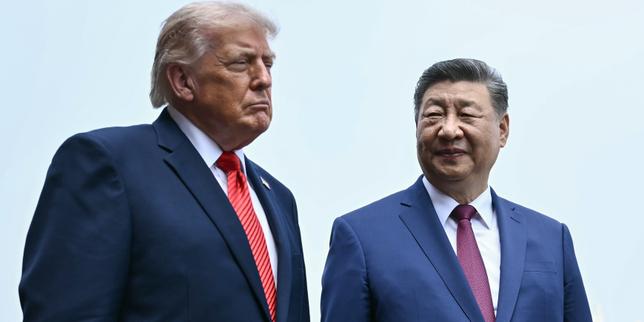
This week, that room is in the United States. Xi Jinping has arrived.
We forget, wrapped in our daily routines of commute and coffee, that the friction between Beijing and Washington is not just a headline on a glowing screen. It is the tectonic pressure beneath our global economy. Every shipping container docked in Long Beach, every rare earth mineral welded into a smartphone motherboard, every fluctuation in the cost of borrowing money is tied to the weather in these high-level summits.
When Xi Jinping steps off his aircraft and into the sterile glare of tarmac lights, he does not come merely as a guest. He comes as a rival holding a mirror.
For years, the script between these two nations was predictable. Trade deficits were argued over, stern letters were exchanged, and diplomats spoke in the coded, bloodless language of communiqués. But the world has grown too fragile for polite fictions. Supply chains snapped during the pandemic and never quite healed the same way. Technology has become a battleground where microchips carry the same strategic weight that ironclad warships did a century ago.
Consider what happens when trade becomes a weapon.
Prices rise at the corner grocery store. Factories in the Midwest pause assembly lines because a single chemical component is stuck in customs. Investors bite their fingernails down to the quick. This is the invisible architecture of globalization, and when the two architects-in-chief meet, they are arguing over the blueprints of our daily lives.
Donald Trump approaches this summit with the transactional swagger of a real estate developer who believes every deal has a winner and a loser. To him, tariffs are not just economic levers; they are moral instruments, a way to settle scores and bend reality to the will of American muscle.
Xi Jinping, by contrast, brings the stoic patience of a civilization that has watched empires rise and fall like seasonal crops. He understands that America wants a quick win, a television-ready handshake, a headline that reassures the markets. But China is playing a game measured in generations.
So why this week? Why now?
Because gravity pulls them together. Neither nation can afford a complete decoupling without tearing its own financial fabric to shreds. The United States needs Chinese manufacturing to keep inflation from swallowing its middle class whole. China needs American consumers to keep its massive industrial machine from stalling out and triggering social unrest at home.
They are bound together in a bitter, brilliant embrace. Two titans locked in a dark room, each desperately trying to find the light switch while hoping the other trips first.
Walk down the main street of any mid-sized town in Ohio or Guangdong, and you will see the physical manifestation of this abstract diplomacy. In Ohio, an abandoned factory gate rusts in the rain, a monument to industrial jobs that crossed an ocean. In Guangdong, a neon-lit dormitory hums with young workers assembling the very devices that illuminate American living rooms.
The summit in the United States is the theater where these two realities collide.
We are told by pundits that diplomacy is about compromise. But at this level, diplomacy is often just a high-stakes game of chicken. It is about who blinks first when the cameras roll away and the doors lock.
The danger is not that they will fail to reach an agreement. The danger is that they will pretend to succeed while planting the seeds of the next crisis. A handshake in Washington does not rewrite the fundamental contradiction between a reigning superpower and a rising one. It merely pauses the clock.
As the motorcades roll through the heavily guarded streets, sirens wailing against the autumn chill, remember what is actually at stake. It is not just trade balances or intellectual property rights. It is the peace of a world that has grown too small for misunderstandings.
The engines cut. The doors open. Two men step out into the light.
And somewhere out there, the rest of us wait to see what kind of morning we will wake up to tomorrow.


