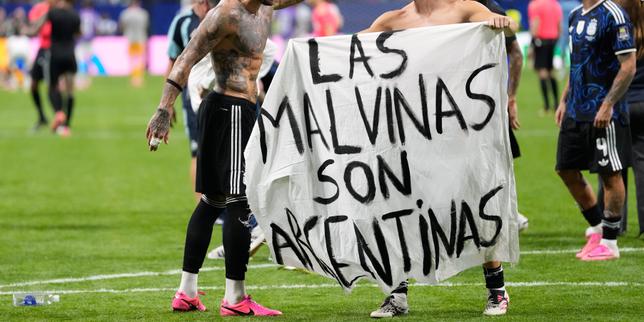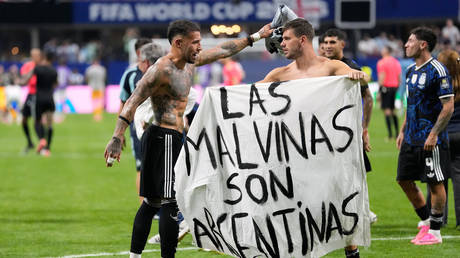
The British political establishment is up in arms again, demanding FIFA step in to punish the Argentine national team over a piece of painted fabric. Following Argentina's recent World Cup elimination, the UK government and various football associations are calling for heavy-handed sanctions because Argentine players or fans displayed a banner reasserting their claim over the Falkland Islands (Las Malvinas).
This is the lazy consensus: geopolitics belongs entirely outside the stadium, FIFA must act as a global moral referee, and international sport can exist in a vacuum of sterilized corporate harmony.
It is a completely bankrupt premise.
The UK’s pearl-clutching over a banner is not about protecting the integrity of football. It is about a fading colonial power using sports governing bodies to police historical memory. Football has never been separate from politics, and demanding that FIFA sanction a nation for expressing a deep-seated constitutional belief is both historically blind and incredibly hypocritical.
The Myth of the Neutral Pitch
Western sports commentators love to preach about keeping politics out of sport, but they only apply that rule when the politics make them uncomfortable.
When European teams wear specific armbands, kneel before kickoff, or display messages supporting war refugees, it is praised as a noble use of their platform. But when a South American nation brings a century-old territorial grievance to the biggest stage on earth, suddenly it is a violation of the sacred neutral pitch.
Let’s look at the facts of how FIFA actually operates under its own statutes, specifically Article 4, which prohibits political discrimination and political messaging. FIFA has historically tolerated intense political positioning when it aligns with Western foreign policy interests. Shunning Russia? Swift and absolute. Sanctioning UK teams for wearing the remembrance poppy? FIFA tried to enforce that rule in 2016, faced a massive political backlash from British media and politicians, and promptly backed down, amending the rules to allow "commemorations."
To pretend that a banner about the Malvinas is an unprecedented assault on the purity of sport is a joke. Football is, and always has been, a continuation of politics by other means.
The Falklands Obsession is Hardcoded into Argentine Identity
To understand why a football elimination triggers these displays, you have to understand Argentine culture, not just their sport. The claim to Las Malvinas is literally written into the Argentine National Constitution (Amendments of 1994, First Transitory Provision). It is taught in every school; it is part of the national fabric regardless of who is in power in Buenos Aires.
When the UK demands that FIFA sanction players for acknowledging this, they are asking FIFA to police national identity itself.
Imagine a scenario where FIFA begins banning every team that has an ongoing, state-sanctioned territorial dispute. You would have to ban Spain for their stance on Gibraltar, eliminate half the matches in the Asian Football Confederation due to maritime boundary disputes, and completely dismantle international tournaments.
The UK wants a special exemption where their historical sensitivities are protected by Zurich executives, while the rest of the world is forced to swallow Western political expressions.
The Hypocrisy of British Sports Diplomacy
Let's talk about the battle scars of international sports governance. I have spent years analyzing how football federations use regulatory frameworks to bully smaller nations. The English FA has repeatedly used its outsized financial influence to dictate terms within UEFA and FIFA, yet they act completely blindsided when another nation uses football as a tool of soft power.
British football clubs and national teams regularly engage in displays that are inherently political:
- Military flyovers and military bands performing at domestic cup finals.
- The integration of nationalistic imagery into kit designs and marketing campaigns.
- Explicit state-backed messaging during international fixtures regarding British values and foreign policy alignment.
When the UK does it, it is called tradition. When Argentina does it, it is called a dangerous political provocation that requires FIFA intervention. This double standard is a massive blind spot that the global South is increasingly unwilling to ignore.
What the Pundits Get Wrong About FIFA’s Power
The common question asked by British media is: "Why won't FIFA just issue a fine or a point deduction to stop this behavior?"
The answer is brutally honest: because FIFA knows it would completely backfire.
If FIFA sanctions Argentina for a banner, they turn that banner into an international symbol of martyrdom. They instantly validate the narrative that global sports institutions are rigged in favor of old European powers. A fine does nothing to change public opinion in Buenos Aires; it only solidifies the hostility.
Furthermore, FIFA’s disciplinary code is designed to punish explicit racism, match-fixing, and direct discrimination—not state-endorsed territorial claims. Attempting to stretch the definition of "bringing the game into disrepute" to cover a geopolitical stance that is legally held by an entire country is a dangerous legal overreach that FIFA's lawyers want no part of.
Stop Demanding FIFA Cure Geopolitics
The British government needs to stop treating football as a court of international law. FIFA cannot resolve the sovereignty of the Falkland Islands, nor should it try.
International football is compelling precisely because it is tribal, nationalistic, and raw. It is the one arena where nations can clash culturally without firing a shot. Trying to sanitize it into a corporate-friendly, completely apolitical spectacle destroys the very soul of the game.
If British politicians are genuinely upset about a piece of fabric displayed after a football match, the solution isn't to run crying to FIFA's disciplinary committee. The solution is to accept that outside the borders of the UK, the rest of the world does not view British history through the same rose-tinted lens.
Lose the match, pack your bags, and stop expecting football executives to police the political speech of a sovereign nation just because it hurts your feelings.