The wind off the Aegean Sea carries a persistent grit, the fine, sugary dust of Pentelic marble. If you stand on the high limestone plateau of the Acropolis for more than an hour, that dust settles into the lines of your palms. It tastes faintly of salt and deep time.
For fifty years, the skyline of Athens was defined by a different kind of grid: a dense, metallic cage of iron pipes and industrial netting. It grew so familiar that two generations of Greeks grew up believing steel scaffolding was a permanent architectural feature of the 2,500-year-old temple. Visitors from across the globe accepted the compromise, squinting through a matrix of construction bars to glimpse the ghost of Classical antiquity.
Then, the iron came down.
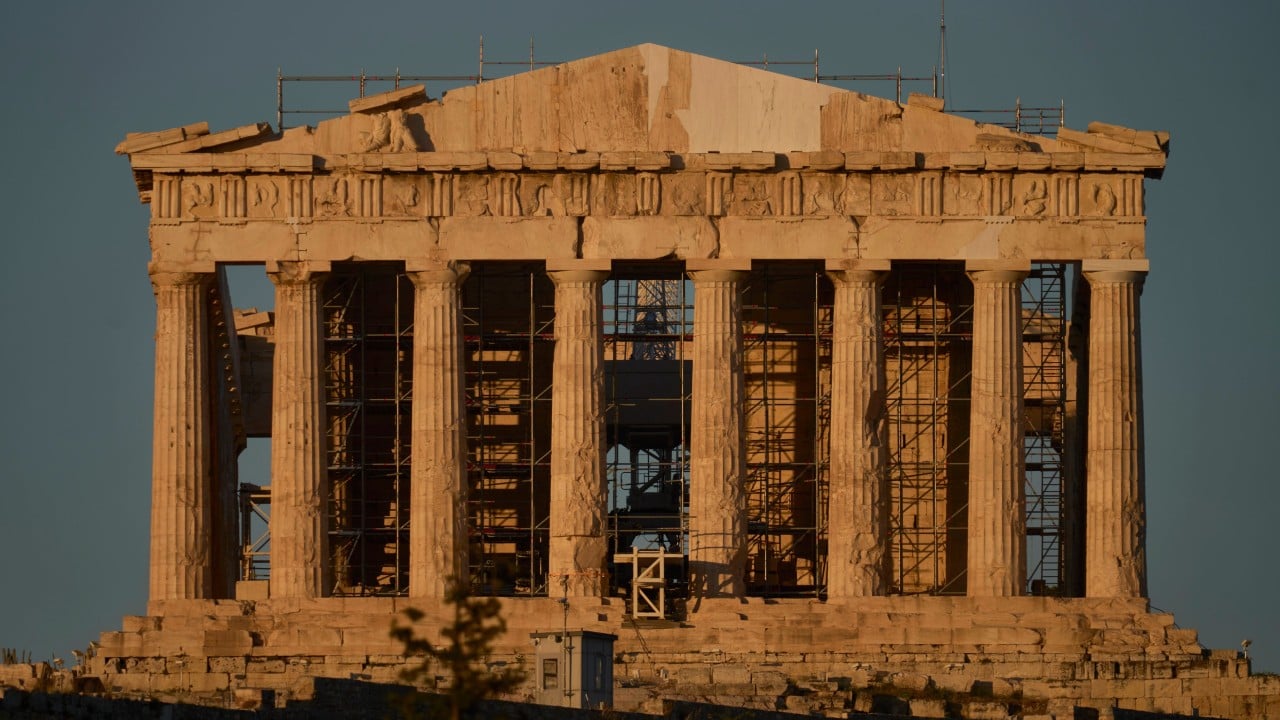
The Greek Ministry of Culture quietly completed the removal of the external scaffolding from the Parthenon’s western facade. For the first time in roughly 220 years, the monumental western face of the temple stands entirely whole, its geometric symmetry restored to a state not seen since the early nineteenth century.
To understand why this matters, one must look past the dry engineering press releases and into the quiet obsession of the people who spent their lives making it happen.
Consider Nikos, a composite figure representing the dozens of master marble carvers who have populated the site since the current scientific restoration program began in 1975. For decades, Nikos climbed the wooden planks of the Acropolis before dawn. His hands are thick, calloused, and permanently stained with the grey slurry of wet stone. He uses tools that are virtually indistinguishable from those wielded by Pheidias’s stonemasons in 447 BC: iron chisels, wooden mallets, and an uncanny, intuitive sense of how a block of stone will split under a single, precise blow.
The problem Nikos and his colleagues faced was not just the slow decay of time. It was the catastrophic weight of human history.
In 1687, a Venetian mortar shell struck the Parthenon, which the occupying Ottoman forces were using as a gunpowder magazine. The resulting explosion tore the heart out of the building, collapsing fourteen columns and shattering the delicate walls. Then came the early 1800s, when Thomas Bruce, the 7th Earl of Elgin, used crowbars and saws to hack away the finest surviving sculptures from the pediments, leaving jagged, weeping wounds in the marble facade.
But perhaps the most insidious damage occurred during a well-intentioned rescue attempt in the 1920s. Engineers used iron clamps to bind the fracturing ancient stones back together. They did not account for the moisture in the Athenian air. Over the decades, those internal iron bars rusted, expanded, and acted like slow-motion dynamite, cracking the pristine Pentelic marble from the inside out.
The modern restoration team had to undo all of it. They became historical detectives, dismantling thousands of misplaced stone fragments, removing the destructive iron, and replacing it with non-corrosive titanium fixtures.
The climax of the western facade project hinged on two missing blocks known as orthostats—the massive vertical stones that form the base of the triangular pediment. One was a puzzle of ancient fragments, painstakingly bonded back together with new marble; the other had to be carved entirely from scratch out of a virgin block hauled from the same ancient quarries of Mount Pentelicus.
The precision required was maddening. The ancient Greeks did not use straight lines. The Parthenon is a masterpiece of optical illusion. Every column leans slightly inward; the floor swells upward in a gentle curve; the corner pillars are slightly thicker to combat the thinning effect of the bright Mediterranean sun. If you build it perfectly straight, it looks broken. You have to carve the curves into the stone.
When the final block was winched into place by modern cranes operating with millimeter precision, the visual tension of the building snapped back into equilibrium. The open wound that had gaped at the sky since the days of Napoleon was finally closed.
Standing on the rocky summit today, the effect is instantaneous. The light changes everything. As the afternoon sun dips toward the Peloponnese, the restored western face catches the amber glow. The new, white marble inserts contrast sharply with the honey-colored patina of the ancient stone, a deliberate choice by the restorers to ensure the modern repairs remain honest, never pretending to be older than they are.
It is a strange feeling to look at something that has been invisible for two centuries. It forces an admission of our own brevity. The generations who saw this facade whole were reading by candlelight and traveling by horse; the generations who will see it next are entirely unknown to us.
The heavy external iron cages are gone, leaving only the bare, ancient monument holding its breath against the sky. The work on the interior chambers will quietly continue for decades more, hidden from view. But for now, the temple has its face back.
Nikos packs his chisels into a worn canvas bag. He brushes the white dust from his trousers and looks up at the western pediment one last time before the site gates close. The marble dust remains under his fingernails. It belongs there. He, like the temple, is bound to the stone.