The ceramic mug on the kitchen counter still holds a faint ring of coffee residue, drying under a pale shafts of morning light. Beside it lies a half-broken loaf of sourdough bread. In a normal world, this is just the quiet aftermath of a rushed Tuesday morning, the messy proof of a young couple hurrying out the door to beat the metropolitan traffic.
But the traffic in Kyiv did not stop Daniil and Anna that morning. A Russian Kh-101 cruise missile did.
When we read the official military dispatches, war sounds like a ledger. The reports are sterile. They speak of air defense interception rates, structural damage to civilian infrastructure, and casualty counts reduced to single digits. "Two civilian fatalities," the morning brief noted. It is a data point. It is a cold fact designed to be digested by analysts, categorized by historians, and forgotten by the rest of a preoccupied world.
The ledger completely misses the point.
War does not just kill people. It assassinates the mundane, beautiful future they were actively building with their bare hands. Daniil was twenty-four. Anna was twenty-three. They had been married for exactly fourteen months. To look at their apartment before the strike was to look at a physical manifestation of hope. There were color swatches taped to the living room wall—a debate between sage green and warm beige. There was a crib assembly manual tucked inside a drawer, hidden away because they were superstitious but terribly excited to start a family.
Consider the sheer amount of energy it takes to build a life from scratch in a country under siege. It requires a stubborn, almost defiant level of optimism. While the sirens wailed outside their window over the past year, Daniil and Anna chose to talk about names. They argued gently over whether a boy should be named after Daniil’s grandfather. They saved hryvnias in a small wooden box labeled Our House.
Then, in a fraction of a second, the air pressure changed.
A missile traveling at five hundred miles per hour does not care about sage green paint. It does not care about the delicate, fragile plans of twenty-somethings who still believed the world had a place for them. The blast wave shattered the concrete walls, collapsing the ceiling of their top-floor apartment inward. When the rescue crews finally dug through the smoking plaster and twisted rebar, they found them together. Daniil had thrown his body over Anna. A final, instinctive, utterly futile act of protection.
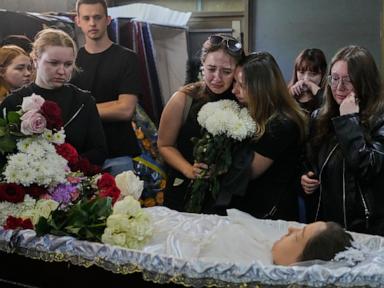
At the funeral three days later, the air smelled of cheap wax candles, damp earth, and the sharp, chemical stench of a city still burning in places. The mourners did not look like characters in a grand geopolitical drama. They looked exhausted. They were classmates in oversized winter coats, elderly aunts with shaking hands, and young men in military uniforms who looked far too old for their skin.
A friend of the couple, a young woman named Kateryna, stood near the edge of the open trench. She wasn’t crying. Her eyes had the vacant, glassed-over look of someone who had witnessed too many explosions, both literal and emotional.
"They were supposed to have a registry," Kateryna whispered, her voice barely carrying over the sound of a distant air siren beginning its mechanical moan across the city. "We were supposed to be buying them blenders and baby blankets this summer. Instead, we are buying lilies."
This is the invisible tax of modern conflict. The global news cycle tracks the front lines. We watch the maps shift by millimeters. We debate the strategic value of a ruined village or the delivery timeline of a new anti-missile battery. But the true frontline isn't just a trench in the Donbas; it is the kitchen table in every apartment block in Ukraine. It is the terrifying lottery of sleeping in your own bed and wondering if the ceiling will become your tomb before sunrise.
The statistics tell us that over ten thousand Ukrainian civilians have died since the full-scale invasion began. Try to visualize ten thousand people. It is an abstract crowd. It is an arena. It is too large for the human brain to process with genuine empathy, so we shut down. We treat it like a natural disaster—an unavoidable act of God, a tragic weather event.
But missiles are not lightning bolts. They are manufactured, targeted, and launched by human hands. Every single one of those ten thousand deaths represents a severed thread, a family tree abruptly pruned, an unwritten book. When you multiply Daniil and Anna’s unfinished breakfast by ten thousand, the scale of the theft becomes staggering.
The tragedy is compounded by how quickly the world moves on. A headline appears on a smartphone screen. A user scrolls past it to look at a meme, a stock market update, or a restaurant review. The dead are left behind in the digital dust, buried under a mountain of fresh content. We have become consumers of distant trauma, developed a high tolerance for other people's ruin.
But for those who knew them, the silence left behind by the couple is deafening.
In the wreckage of the apartment building, amidst the gray dust and shattered glass, someone found a small, waterlogged notebook. It belonged to Anna. It wasn't a diary of wartime terrors or a political manifesto. It was a grocery list mixed with a budget plan. Milk, eggs, laundry detergent, save for the stroller.
The stroller was never purchased.
As the sun began to dip below the jagged, broken skyline of the neighborhood, the last of the mourners drifted away from the cemetery. The city of Kyiv, bruised but stubborn, kept moving. Cars honked in the distance. A tram rattled down the tracks. People hurried home before the curfew, carrying groceries and talking on their phones, trying to pretend that the sky above them was just the sky.
Back in the ruined apartment, the dust finally settled on the kitchen counter. The ring of coffee inside the ceramic mug dried completely, turning into a dark, permanent stain. The sourdough bread remained on the counter, slowly hardening in the cold air, a tiny, terrible monument to a Tuesday morning that never ended.