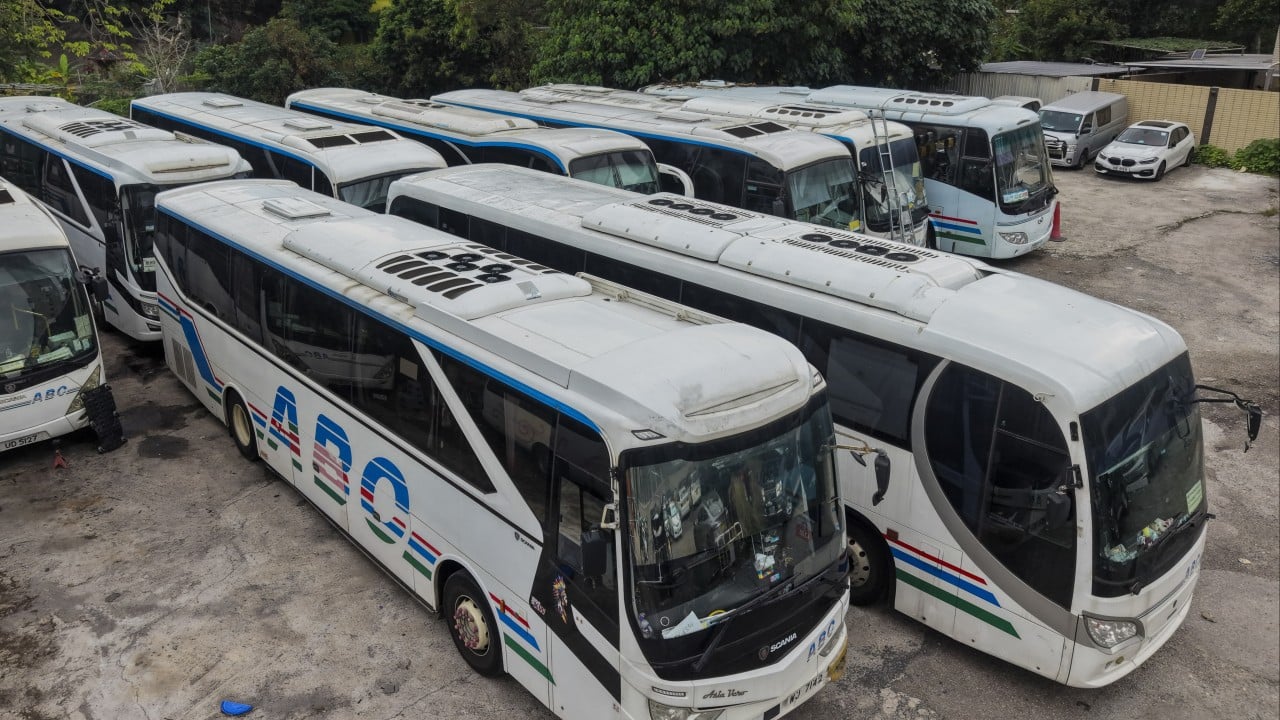
The recent wave of service cancellations across Hong Kong’s franchised bus networks is not a transient operational hiccup; it is the manifestation of a fundamental breakdown in the sector’s cost-revenue equilibrium. Lawmakers’ warnings of a "tip of the iceberg" scenario reflect a failure to account for the compounding pressures of fuel volatility, labor scarcity, and the rigidities of a regulated fare regime. When fuel costs escalate beyond a specific threshold, the margin of safety for private operators—who bear 100% of the financial risk without direct government subsidies—collapses, forcing a contraction in service frequency to preserve solvency.
The Triad of Operational Instability
To understand the current crisis, one must dissect the three primary variables that dictate the viability of urban transit operations in a high-density environment like Hong Kong.
1. The Variable Cost Floor: Energy and Labor
The cost structure of a bus franchise is heavily weighted toward variable inputs that are currently experiencing synchronized inflation. Fuel typically accounts for 15% to 20% of total operating expenses. Because Hong Kong operators purchase diesel at market-linked prices, they lack a buffer against geopolitical shocks that drive crude oil surges. Simultaneously, the labor market for heavy vehicle drivers is near total saturation. To retain staff in a competitive logistics environment, operators must increase wages at a rate that outpaces general inflation, effectively raising the "floor" of what it costs to run a single kilometer of service.
2. The Revenue Ceiling: Fare Elasticity and Regulation
While costs are dynamic, revenue is static. The Fare Adjustment Mechanism (FAM) in Hong Kong is a lagging indicator; it requires legislative review and Executive Council approval, often taking 12 to 18 months to reflect economic reality. This temporal gap creates a "liquidity trap" where operators are forced to fund current high-cost operations with yesterday's low-revenue pricing.
3. The Asset Utilization Mismatch
Bus networks are designed for peak-hour capacity. Outside of those 4-5 hours a day, the capital equipment (double-decker buses costing upwards of $3 million HKD) and the labor are underutilized. When fuel costs rise, the marginal loss of running an under-filled bus during off-peak hours becomes unsustainable.
The Mechanical Failure of the Current Subsidy Model
Hong Kong’s "user-pays" principle for public transport distinguishes it from many global peers where 30% to 50% of operating costs are covered by the taxpayer. While this ensures efficiency, it creates a fragile system during black swan events.
The current government intervention strategy—primarily the $2 Fare Scheme reimbursement and various fuel subsidies—functions as a temporary bandage rather than a structural solution. The $2 scheme, while supporting ridership among the elderly, replaces full-fare revenue with a government-calculated rate that may not fully reflect the real-time cost of service delivery. This creates a hidden deficit. If the government reimbursement rate fails to keep pace with the $C_{op}$ (Operational Cost per Passenger), the operator loses money on every senior citizen they transport.
$$C_{op} = \frac{(F_c + V_c)}{R}$$
Where:
- $F_c$ = Fixed costs (depreciation, insurance, licensing)
- $V_c$ = Variable costs (fuel, wages, maintenance)
- $R$ = Ridership volume
When $V_c$ rises due to fuel spikes and $R$ remains stagnant or shifts toward lower-yield passenger demographics, the operator’s only lever to prevent a negative $C_{op}$ is to reduce the total number of kilometers driven—hence, the service cuts.
The Crowding-Out Effect of the MTR Expansion
The expansion of the railway network (MTR) acts as a structural headwind for bus franchises. As new lines open, the bus network's role shifts from a primary carrier to a feeder service. Feeder services are inherently less profitable because they involve shorter trips with higher turnover, increasing the wear and tear per revenue kilometer.
The "iceberg" lawmakers fear is the realization that many bus routes have reached a point of "negative marginal utility." In this state, even if fuel prices were to stabilize, the route would never return to profitability because the passenger base has permanently migrated to the rail network. The operators are effectively running a legacy system with modern-day cost pressures.
The Labor Constraint as a Non-Linear Risk
Focusing solely on fuel costs ignores the more terminal threat: the demographic collapse of the driver pool. The average age of a franchised bus driver in Hong Kong is now over 50.
The mechanism of service failure here is non-linear. It is not a gradual decline; it is a "cliff edge" effect. When a certain percentage of the workforce retires or leaves for the less stressful "light goods vehicle" (LGV) sector, the remaining drivers must work overtime. This leads to burnout, increased accident rates, and further resignations. Eventually, the operator cannot fulfill its "Schedule of Service," leading to the unauthorized cancellations that have drawn legislative ire. Penalizing these operators with fines—the current regulatory response—further depletes the cash reserves needed to raise wages, creating a feedback loop of decline.
Strategic Reconfiguration of the Franchised Model
To prevent a systemic collapse of urban mobility, the logic of the Hong Kong bus franchise must be re-engineered from a "profit-and-loss" center to a "contracted-service" model.
Transition to Gross Cost Contracting
The government should consider shifting from the current "Net Cost" model (where operators keep the fare and take the risk) to a "Gross Cost" model. Under this framework, the government collects the fare revenue and pays the operator a fixed fee per kilometer of service provided. This removes fuel price volatility and ridership risk from the operator’s balance sheet, allowing them to focus on operational excellence and safety rather than survival-based service pruning.
Implementation of a Dynamic Fuel Surcharge
A more immediate fix is the introduction of a transparent, formula-based fuel surcharge. Similar to the aviation industry, this would allow fares to fluctuate within a narrow band based on the monthly average of diesel prices.
- Threshold Trigger: If diesel exceeds $X$ price per liter, a $0.20 HKD surcharge is added.
- Sunset Clause: The surcharge automatically expires when prices dip below the threshold for 30 consecutive days.
This mechanism would provide the immediate liquidity needed to maintain service frequencies during energy spikes without waiting for the lengthy FAM process.
Strategic Route Rationalization (The "Hub and Spoke" Pivot)
The current "point-to-point" long-haul bus routes that parallel MTR lines are inefficient. A data-driven overhaul of the network must prioritize "Hub and Spoke" connectivity. This involves:
- Reducing long-haul redundancies that compete directly with the MTR.
- Repurposing those buses to increase frequency on "last-mile" feeder loops.
- Utilizing smaller, single-decker electric buses for off-peak periods to lower the $V_c$ (Variable Cost) per kilometer.
The Risk of Regulatory Inertia
The danger of the current legislative stance—which often leans toward "demanding" better service while "rejecting" fare increases—is that it ignores the physics of the balance sheet. If an operator is forced to run at a loss, the quality of maintenance will be the first casualty, followed by the frequency of service, and finally, the safety of the network.
The "iceberg" is not just the cost of fuel; it is the reality that the 20th-century model of a self-sustaining, private bus franchise is no longer compatible with a 21st-century urban environment dominated by rail and plagued by volatile energy markets.
The final strategic move for the Transport and Logistics Bureau is the integration of bus and rail into a single "Transit Fund." By pooling a portion of the MTR’s property development profits—which are significant—into a subsidy pool for bus operations, the city can maintain a diverse and resilient transport ecosystem. Without this cross-subsidy, the bus network will continue to atrophy, leaving the city vulnerable to any disruption in the rail network and further marginalizing those who live in areas not yet reached by the MTR.
The priority must shift from penalizing operators for failing to meet schedules to providing the structural financial stability that makes those schedules possible. The market has signaled that the current equilibrium is broken; the policy response must now move beyond rhetoric and address the underlying unit economics of the sector.