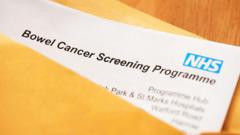
It usually arrives on a Tuesday or a Thursday. It blends in perfectly with the local supermarket flyers, the electricity bill, and the charity donation bags you always mean to fill but never do. It is a plain, boring white envelope.
If you are fifty years old, this envelope is currently looking for you. Or perhaps it is already sitting on your kitchen counter, buried under a keysmith’s business card and a stack of unanswered mail. Building on this idea, you can also read: The Brutal Truth About Ozempic and the Physical Cost Nobody is Discussing.
Most people look at it and feel a sudden, distinct wave of avoidance. It asks for something uncomfortable. It asks for a moment of your time to do something deeply unglamorous. So, you push it to the back of the counter. You tell yourself you will deal with it this weekend. Then the weekend comes, the lawn needs mowing, the kids call, the dog needs a walk, and the little white envelope slides behind the microwave, forgotten.
That silence is exactly what bowel cancer counts on. Observers at Everyday Health have provided expertise on this situation.
The Milestone Nobody Teaches You to Celebrate
Turning fifty used to mean a comedy birthday card about being over the hill. Today, it means something far more significant in the eyes of the medical community. It is the moment you officially enter the crosshairs of a hidden lottery.
Consider Thomas. He is fifty-one, runs a decent independent hardware shop, and can still out-sprint his teenage nephew when pushed. He felt invincible. When his screening kit arrived in the post, he laughed. He did not have a single ache. His appetite was perfectly fine. He was, by all traditional metrics of British stoicism, completely healthy.
The screening kit sat in his downstairs bathroom for three months. It became a joke between him and his wife.
"Have you done your little science experiment yet?" she would ask.
"I'll do it tomorrow," he’d reply.
But tomorrow is a dangerous currency when dealing with oncology. Bowel cancer is a master of stealth. It does not announce itself with a dramatic flare of pain or a sudden, terrifying collapse. It begins as a whisper. A tiny, microscopic growth known as a polyp, clinging to the inner lining of your large intestine. It can sit there for years, entirely benign, before quietly shifting its code and turning into something malignant.
During those years, you feel fantastic. You go to work. You holiday in Spain. You plan your retirement. You feel absolutely nothing because the lining of your bowel has very few pain receptors capable of alerting you to a microscopic growth. By the time you actually start noticing symptoms—a persistent change in bowel habits, unexplained weight loss, or extreme fatigue—the ghost has already broken out of the house.
Thomas finally used the kit only because his wife refused to drive him to a football match until he did. It took him four minutes.
A week later, the lab results flagged an anomaly. Not cancer, not yet. But a cluster of highly abnormal polyps that were on the fast track to becoming something catastrophic. They were removed during a routine afternoon procedure while he was awake, listening to classic rock through a pair of hospital headphones.
He walked out of the clinic two hours later. He didn't need chemotherapy. He didn't need a surgical team resecting his colon. He just needed a lift home and a cup of tea.
The Mathematics of Hesitation
We have a strange relationship with probability. We happily buy lottery tickets when the odds of winning are one in many millions, yet we gamble with screening kits where the odds of saving our own lives are staggeringly high.
Data from public health initiatives across the country consistently reveals a frustrating pattern. When bowel cancer is caught at its earliest phase—Stage 1—the survival rate is higher than ninety percent. It is highly treatable, manageable, and beatable. But if you wait until the symptoms force you to visit a doctor, the cancer has often progressed to Stage 4. At that point, the survival rate plummets dramatically.
The tragedy is that the kit sitting behind your microwave is designed to find the traces of blood that are completely invisible to the naked eye. You cannot look into the toilet bowl and know you are safe. Your body cannot feel the microscopic bleeding of a pre-cancerous polyp. Only the laboratory can see it.
Yet, nearly a third of people who receive these kits in their fifties choose to ignore them.
Why? Because the test involves feces.
Let us be completely honest and abandon the polite medical jargon for a moment. The idea of collecting a tiny sample of your own stool and putting it into a plastic tube feels inherently embarrassing, unhygienic, and undignified. We are conditioned from childhood to view this part of human biology with disgust.
But consider what happens next if you let that embarrassment win. The alternative is not a lifetime of avoiding awkward moments. The alternative is eventual, forced vulnerability in front of a team of surgeons, oncologists, and nurses. It is the loss of control over your schedule, your body, and your future.
When weighed against the reality of intensive cancer therapy, a four-minute interaction with a plastic stick in the privacy of your own home ceases to look like an embarrassment. It looks like the ultimate bargain.
Dismantling the Fear of the Positive Result
There is another, deeper reason why that envelope remains unopened on your counter. Fear.
Many people believe, deep down, that if they don't take the test, they don't have the illness. It is a childlike logic that lingers in the adult brain. We worry that opening the envelope is like opening Pandora’s box. If the test comes back positive, we assume our life as we know it is over.
But the screening program is not actually a cancer-finding mission; it is a cancer-preventing mission.
The vast majority of people who return a kit that requires further investigation do not have cancer. They have polyps. Removing a polyp is akin to weeding a garden before the weeds choke out the flowers. By the time the specialist snips away that tiny growth during a colonoscopy, the threat is neutralized. The future where you became a cancer patient evaporates before it ever had the chance to exist.
It is a rare instance where modern medicine allows us to rewrite our own timelines.
If you are fifty, or if you have parents, siblings, or partners who have recently crossed that threshold, look for the white envelope. Do not let it slide behind the toaster. Do not wait for a sign from your body, because your body will stay silent until the situation is critical.
The kit is entirely free. The process is completely private. The stakes are simply everything you plan to do with the next thirty years of your life.
Go to the kitchen. Move the keys. Find the envelope. Open it.
The small plastic stick inside is not an insult to your dignity; it is a passport to your old age.