The air in an international terminal has a specific, recycled weight. It smells of expensive duty-free perfume, burnt espresso, and the low-frequency hum of collective anxiety. Most travelers are locked in a private battle with their own logistics—the weight of a carry-on, the fading battery of a smartphone, the hunt for a charging port. We move through these halls like ghosts in a machine, assuming the mechanics of the airport are purely functional, designed to sift us through gates and into the sky.
But lately, the machinery has changed.
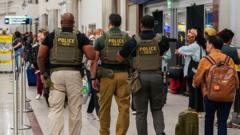
If you look past the neon signs for overpriced neck pillows, you might notice them. They aren't wearing the standard-issue blue of the Transportation Security Administration. Their presence is sturdier, their stance more observational. These are agents from Immigration and Customs Enforcement (ICE), and they are no longer confined to the windowless processing rooms of the border or the industrial landscapes of detention centers. They are standing next to your boarding line.
They are there to "assist" with the surge of travelers. That is the official line. But the reality of a badge is that it never just assists; it alters the gravity of the room.
The Friction of the New Normal
Consider a traveler we will call Elena. She is a naturalized citizen, her passport tucked safely in a leather breast pocket. She has done everything right. She has the stamps, the history, and the legal right to be exactly where she is—standing in line for a flight to visit her mother. Under normal circumstances, the TSA check is a nuisance of shoes and belts.
When Elena sees an ICE jacket near the metal detector, the air changes.
The integration of ICE into the domestic airport flow isn't just a logistical shift; it is a psychological one. For decades, the division of labor was clear. TSA handled the safety of the aircraft. ICE handled the integrity of the border. By blurring these lines, the government has turned the airport into a hybrid space—a zone where your safety is being checked at the same time as your right to exist within the country.
This isn't a conspiracy theory whispered in dark corners. It is a calculated deployment. As the TSA faces staffing shortages and record-breaking travel volumes, the Department of Homeland Security has pulled the lever on "cross-component" support. It sounds like corporate jargon. In practice, it means the person watching you put your laptop in a grey bin might be an agent trained for high-stakes deportations and federal investigations.
The Invisible Stakes of Efficiency
The argument for this move is rooted in the cold math of the queue. If there are 30,000 people moving through a terminal and only ten lanes open, the math fails. By bringing in ICE agents to manage "non-sensitive" tasks—crowd control, document verification, and line management—the TSA claims it can keep the wheels turning.
Efficiency is a powerful sedative. Most passengers, desperate to make their connection, won't care who is directing them to the shorter line as long as the line moves. We trade a little bit of the "why" for a lot of the "when."
But the "why" matters.
ICE agents are not trained in the same customer-service-oriented security protocols as TSA officers. Their institutional DNA is different. When you put an enforcement-heavy agency into a civilian-heavy environment, the culture of the space shifts. The "assistance" provided isn't just a helping hand; it is an increase in surveillance capacity. Every agent on the floor is a set of eyes trained to look for anomalies, for hesitation, for the minute tells of someone who doesn't belong.
A Geometry of Fear
The impact isn't distributed equally. For the average business traveler with a Global Entry card and a fleece vest, the presence of extra uniforms is a footnote. For immigrant communities, it is a flashing red light.
Imagine the mental gymnastics required for a mixed-status family heading to a wedding. Even if every person in that group is documented, the history of ICE—the raids, the separations, the suddenness of it all—creates a physical reaction. The heart rate climbs. The palms sweat. Suddenly, the airport isn't a gateway to a celebration; it’s a gauntlet.
This is the hidden cost of "logistical support." We are redesigning our public squares into checkpoints. When we use enforcement agencies to fix administrative delays, we signal that the priority isn't just moving people—it’s filtering them.
The Creep of the Border
There is a legal concept known as the "border search exception." It essentially states that within a certain distance of the border, the Fourth Amendment's protection against unreasonable searches and seizures is significantly diluted. Traditionally, this applied to the physical line between nations.
By placing ICE agents in domestic terminals across the interior of the country, we are effectively stretching the border. We are creating a "border-lite" experience in Denver, in Atlanta, in Chicago.
The technicality is simple: ICE has the authority. The TSA has the need. The marriage is one of convenience, but the offspring is a new kind of domestic scrutiny. You are no longer just a passenger; you are a data point in a broader enforcement strategy. If an ICE agent "assisting" at a TSA line notices a discrepancy in a travel document, they don't just call a supervisor. They initiate a federal process.
The stakes are no longer just a missed flight.
The Silent Terminal
We often talk about "security theater"—the idea that much of what we do at the airport is for show, to make us feel safe without actually making us safer. The deployment of ICE is the opposite. It is "security reality." It is the hardening of a space that used to feel, however briefly, like a common ground.
The long-term effects of this are hard to measure in a spreadsheet. You can't quantify the feeling of a grandmother who decides not to fly because the risk of a "random" check feels too high. You can't put a price on the erosion of trust between the public and the agencies meant to serve them.
The lines will move faster. The TSA will report shorter wait times during the holidays. The numbers will look good on a slide deck in a Washington D.C. briefing room.
But as you stand in Gate B12, watching the light catch the heavy gold of a badge that wasn't there last year, you realize that the distance between "traveling" and "being processed" has vanished. We are all moving through a sieve now.
The plane will take off. The cabin will pressurize. We will look out the window at the clouds, trying to recapture that sense of wonder that flight used to promise. But back on the ground, the gate has changed. The uniform is different. The air is heavier than it used to be.
The badge is watching, even when you aren't looking back.