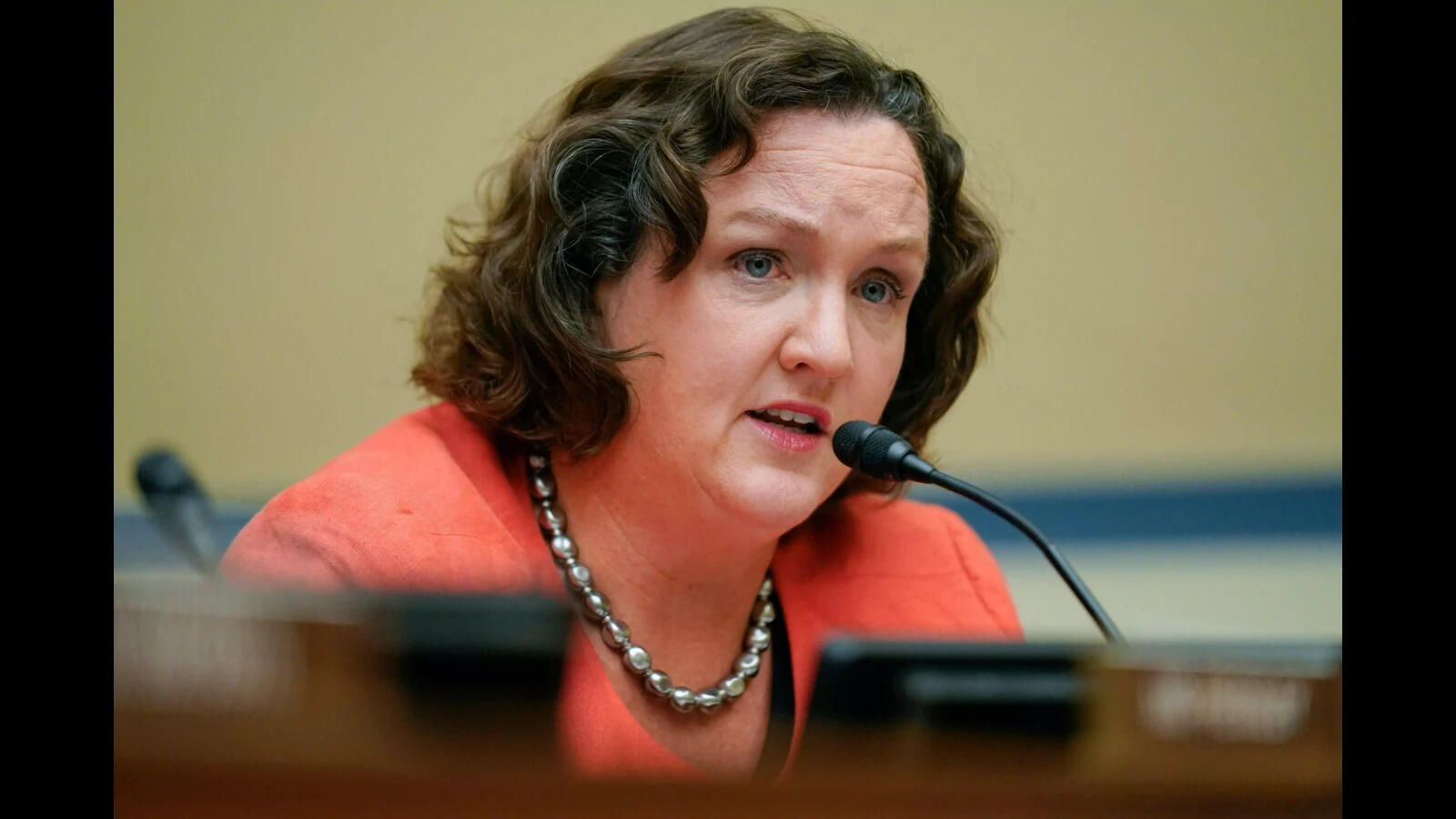
The air in a Congressional hearing room is thick with the scent of old paper and expensive wool, a stark contrast to the blue-light glow of a smartphone screen in a darkened bedroom. On one side of the divide, you have the practiced, rhythmic cadence of political survival. On the other, the frantic, high-speed pulse of the attention economy. When these two worlds collide, the debris doesn't just settle on the floor of the House; it stains the very idea of public trust.
The headlines tried to capture it in dry, clinical shorthand: a congresswoman answering questions about a social media influencer. But the reality is far more visceral. It is a story about how the machinery of power has learned to speak the language of the algorithm, and what happens when the people behind the screens realize they are being spoken for, but not spoken to.
The Architect and the Echo
Katie Porter has built a brand on the whiteboard. It’s a tool of precision. She uses it to deconstruct complex corporate greed into something a fifth-grader—or a distracted voter—can understand. It’s effective. It’s sharp. It feels authentic in a city where authenticity is often a manufactured commodity. But even the most skilled architect of public image eventually has to account for the shadows cast by their own light.
The shadow in this instance is Cheyenne Hunt. To the casual observer, Hunt is a "Gen Z influencer," a term that older generations often use with a hint of condescension, as if it implies a lack of substance. In reality, Hunt represents a new kind of political currency. She is a bridge. She translates the dense, often impenetrable jargon of Washington into 60-second bursts of moral clarity for an audience that doesn’t watch C-SPAN.
When Eric Swalwell found himself entangled in a controversy involving a suspected Chinese intelligence operative, the traditional media went into a frenzy. It was a classic DC scandal, complete with high stakes and national security implications. Hunt, however, became a vocal defender, a digital shield-bearer who framed the narrative for a million scrolling thumbs.
Then came the question that hung in the air like a storm cloud: What was the nature of the connection between the veteran lawmaker from California and the digital firebrand?
The Distance of the Record
"I have not spoken to any women."
Porter’s response was clipped, a linguistic defensive maneuver. It wasn’t just a denial; it was a wall. In the world of high-stakes politics, words are chosen not just for what they reveal, but for what they exclude. By framing the denial through the lens of direct communication, Porter sought to sever the tether between her office and the digital vanguard that often does the heavy lifting of narrative shaping.
But the digital age has rendered the "direct conversation" almost obsolete as a measure of influence. We live in a world of lateral connections. You don't need to speak to someone to align with them. You don't need a phone call to coordinate a vibe. The "vibe" is the coordination. It’s a subterranean river of shared interests, shared enemies, and shared aesthetics that flows beneath the surface of official press releases.
Consider the hypothetical life of a young staffer in a congressional office. They spend ten hours a day monitoring mentions, tracking engagement, and feeding the beast of the algorithm. They know which influencers are "friendly" and which are "hostile." They know that a positive video from a creator like Hunt is worth more than ten op-eds in the local paper. They don't need an explicit directive from the member of Congress to foster these relationships. They just need to know the goal.
The goal is always the same: control the story before the story controls you.
The Invisible Stakes of Influence
The danger of this new ecosystem isn't necessarily the content of the message, but the erosion of the source. When a politician can claim distance from an influencer while simultaneously benefiting from their advocacy, a gray zone is created. It’s a space where accountability goes to die.
If a campaign pays for an ad, the law requires a disclaimer. We know who is speaking. But if an influencer—driven by personal conviction, or perhaps a more subtle form of proximity—launches a defense of a politician, where does the boundary lie?
Hunt isn't just a fan; she’s a former law clerk for the Senate Judiciary Committee. She’s an insider who speaks with the casual authority of an outsider. That’s a potent combination. It creates a sense of grassroots support that feels organic, even if it’s nurtured in the same hothouse environment as the rest of the political elite.
The skepticism aimed at Porter wasn’t just about a specific conversation. It was a reaction to the feeling that we are being managed. It’s the nagging suspicion that the "authentic" moments we see on our feeds are just another layer of the whiteboard, wiped clean and rewritten for a different demographic.
The Friction of Reality
Washington is a town built on the "need to know" basis. But the internet is built on the "want to share" basis. These two philosophies are currently in a head-on collision.
When Porter stood her ground, she was performing a traditional political ritual. She was protecting the perimeter. But the perimeter has moved. It’s no longer the walls of the Rayburn Building; it’s the comment section of a viral video. You can’t protect that perimeter with a simple denial.
The human element here isn't just the politicians or the influencers. It’s the people watching. It’s the voter in Irvine or the student in Des Moines who sees these interactions and feels a growing sense of vertigo. They see the polished surfaces of the political machine and the high-energy output of the digital creators, and they wonder if there is anything solid left in the middle.
We are witnessing the birth of a new kind of political theater. In this play, the scripts aren't written in backrooms; they are crowdsourced through engagement metrics. The actors aren't just the ones under the bright lights of the committee room; they are the ones holding their own ring lights in suburban apartments.
The Weight of the Unsaid
There is a specific kind of exhaustion that comes from trying to parse the truth in a world of curated transparency. Porter’s whiteboard was supposed to be the antidote to that exhaustion. It was supposed to be the "just the facts" approach that cut through the noise.
But facts are lonely things. They need context to breathe. When the context involves the messy, tangled web of digital influence and political survival, the facts start to look like props.
The connection between Porter, Swalwell, and Hunt may never be defined by a single, recorded phone call. It doesn’t have to be. The connection is the system itself. It is a system that rewards the bold, the fast, and the visually striking. It is a system that values the "win" over the process.
As the hearing ended and the cameras were packed away, the real conversation continued elsewhere. It continued in the private messages, the group chats, and the algorithmic feeds that don't care about congressional records.
The whiteboard remains. It is clean, white, and waiting for the next set of figures. But the ink being used is no longer dry-erase. It’s digital, permanent, and spreading in directions that no one in that room can fully control.
The silence between a congresswoman and an influencer isn't a void. It’s a frequency. And if you listen closely enough, you can hear it humming through every screen in the country, a low-voltage reminder that in the modern world, the most important conversations are the ones we’re told never happened.