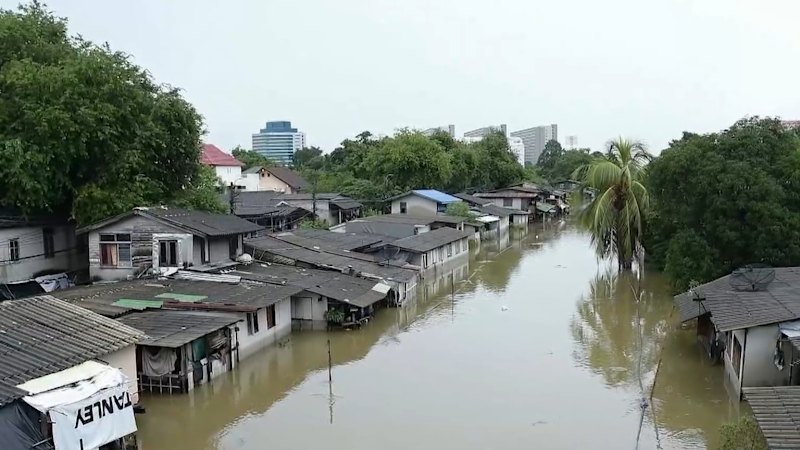
Urban water management systems fail when seasonal precipitation volumes systematically outpace engineered coefficients of discharge. When the Bangkok Metropolitan Administration designated all fifty municipal districts as disaster-affected zones following severe rainstorms that delivered upwards of three hundred millimeters of rainfall within a single operational cycle, the crisis exposed profound vulnerabilities in modern mega-city infrastructure. This event was not merely an act of meteorological severity; it was a demonstration of a hydraulic ceiling where urban density, topography, and drainage velocity intersect in a zero-sum contest against gravity.
The Topographical Trap of the Chao Phraya Basin
Bangkok occupies a geographic bowl situated in the low-lying delta of the Chao Phraya River. Much of the metropolitan footprint sits at or marginally above mean sea level. This topography creates an intrinsic drainage deficit. Under normal conditions, surface water runoff flows through an intricate network of canals, locally designated as khlongs, discharging directly into the river and subsequently into the Gulf of Thailand.
However, this gravity-fed system operates under tight physical constraints. When intense pluvial events coincide with seasonal high tides in the Gulf, the hydraulic gradient reverses. The ocean pushes upward into the river channel, while inland floodwaters press downward from the north. Canals reach absolute capacity, transforming the urban waterways from conduits of relief into containment barriers. Water accumulates in low-lying depressions because the fundamental physics of elevation differential no longer function.
The Volumetric Disconnect in Municipal Engineering
Cities engineered for lower population densities and historical weather patterns struggle to accommodate rapid urbanization paired with shifting climate volatility. Impermeable surfaces—concrete, asphalt, and high-rise commercial structures—prevent natural soil absorption. When rainfall intensity exceeds the infiltration threshold of the soil and the volumetric capacity of the drainage pipes, surface pooling becomes inevitable.
The Bangkok metropolitan drainage network relies heavily on a combination of underground drainage tunnels and mechanical drainage pumps. These pumps are rated for specific cubic meters per hour. When downpours surpass these design thresholds, the system experiences total hydraulic saturation. Water velocity drops to zero, and urban streets convert into stagnant, waist-deep reservoirs.
Compounding this volumetric mismatch is long-term land subsidence. Decades of heavy groundwater extraction combined with the sheer weight of high-density construction have caused sections of the city to sink at rates varying between one and three centimeters per year. As the ground level drops relative to sea level, historical flood protection barriers lose their designed freeboard, rendering previous engineering projections obsolete.
Logistical Friction and Consumer Market Fractures
Urban flood emergencies generate immediate ripples across commercial supply chains, transforming a physical water crisis into an economic friction event. When the disaster zone declaration was enacted, consumer reaction followed a predictable behavioral arc characterized by panic hoarding and supply chain constriction.
Supermarkets and convenience stores experienced rapid inventory depletion. Ready-to-eat meals, bottled water, and non-perishable staples disappeared from shelves within hours. This phenomenon does not stem from an absolute national food scarcity; rather, it reflects a distribution bottleneck. Last-mile logistics vehicles cannot navigate roads submerged under waist-high water. Retail restocking schedules break down entirely when delivery fleets face immobilized transit networks.
Simultaneously, motorists crowded service stations to secure fuel reserves, driven by the anticipation of prolonged transport paralysis. This surge in localized demand creates artificial fuel shortages at the pump, even when refinery stockpiles remain adequate. The core vulnerability is not production capacity, but the spatial distribution network's extreme sensitivity to localized inundation.
Institutional Fragmentation and Coordination Lag
Managing a municipal emergency across fifty distinct districts requires administrative agility that often clashes with legacy bureaucratic structures. In metropolitan governance models where responsibility is partitioned between national agencies, municipal authorities, and district offices, operational delays emerge during the critical window between weather forecasting and ground-level response.
The formal declaration of a disaster zone serves a specific legal and operational function. It bypasses routine bureaucratic procurement protocols, empowering local administrators to authorize emergency expenditure, mobilize heavy machinery, and deploy emergency personnel without procedural friction. Yet, the existence of these legal mechanisms highlights a reactive rather than proactive posture.
Coordination failures typically manifest in resource allocation disparities. Wealthy commercial districts often secure private flood barriers and industrial pumps independently, while densely populated residential alleyways rely entirely on municipal intervention. This asymmetric protection exacerbates social vulnerability, as lower-income communities residing in low-lying back-of-canal zones absorb the heaviest environmental and economic costs.
Strategic Blueprint for Urban Resilience
Resolving recurrent mega-city flooding requires a structural shift from reactive crisis management to systematic hydrological redistribution. Municipal authorities must implement specific engineering interventions to alter how water moves through the urban fabric.
First, urban planners must transition from centralized drainage reliance to decentralized retention architecture. This involves retrofitting public parks, sports fields, and underground parking structures to double as temporary retention basins during extreme downpours. By intentionally flooding non-critical public spaces, engineers can relieve pressure on critical transit arteries.
Second, building codes must mandate strict limits on net-zero runoff for new commercial developments. Every new square meter of impermeable surface must be offset by mandated subterranean water storage or permeable paving materials that restore local soil infiltration capacity.
Third, canal management must be modernized through automated, telemetry-driven sluice gate systems. Rather than relying on manual operation schedules, dynamic gate adjustments guided by real-time radar telemetry and predictive tidal modeling can optimize drainage discharge windows before peak storm surges arrive.
Finally, supply chain resilience must be institutionalized through designated municipal distribution hubs located on elevated topography outside the immediate river basin. These hubs ensure that essential goods maintain a viable pathway to urban retail points even when primary arterial roads remain impassable.
Without these structural adaptations, disaster zone declarations will transition from rare emergency protocols into routine administrative acknowledgments of an unmanaged hydrological reality.