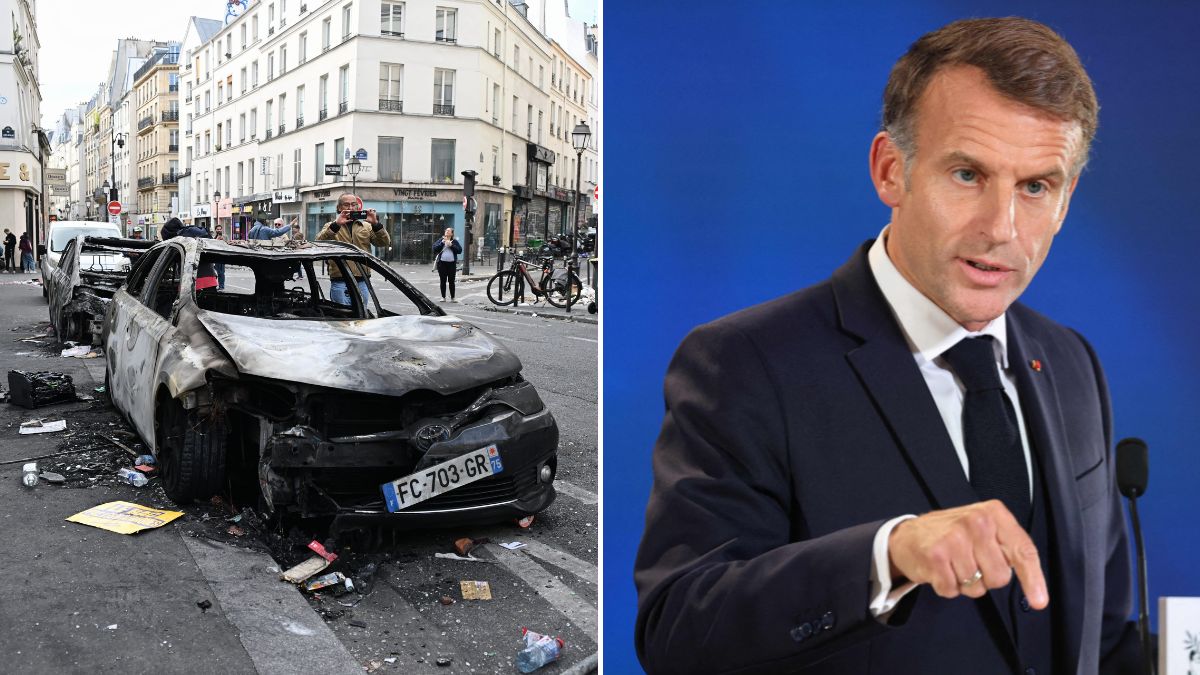
Headline reports describing Paris after violent protests as a "war zone" misdiagnose what actually happens during urban civil disorder. A war zone implies organized military fronts between two armed states with clear territorial objectives. Urban street disorder in a major European capital operates on a completely different mechanism: decentralized crowd dynamics layered onto distinct behavioral cohorts that temporarily overwhelm fixed policing capacity.
When readers and policymakers rely on war-zone metaphors, they conflate political grievances, confrontational street tactics, and opportunistic property crime into a single monolithic event. Understanding why cities erupt—and why containment fails on some nights while succeeding on others—requires separating the underlying mechanics of mobilization, tactical escalation, and municipal vulnerability.
Deconstructing the Competitor Narrative
Conventional breaking-news coverage of Parisian unrest typically follows a predictable sequence: dramatic street imagery, shocked quotes from residents or tourists, a tally of arrests and injuries, and a political condemnation from officials. That structure captures immediacy, yet it leaves three analytical gaps that obscure how the disorder actually functions.
First, standard reporting treats "protesters" as a single actor even when events on the ground show sharply divergent behaviors. Peaceful marchers advocating over wages, education, or cost-of-living pressures operate under completely different incentives than confrontational groups throwing projectiles at police or opportunistic crews smashing retail windows. Lumping all three together makes the crowd look irrational and hides the operational divide between grievance expression and predatory opportunism.
Second, event-driven articles rarely explain spatial displacement. When police concentrate forces around a major square or marching route, lower-cost targets in adjacent commercial corridors or transit hubs become more attractive to small, mobile groups. A headline about a city "waking up to a war zone" treats damage as evenly distributed, when in reality it clusters around specific choke points, commercial arteries, and symbolic buildings.
Third, reactive coverage compresses cause and effect into a single evening. Street clashes rarely start from zero on a Saturday afternoon; they build on accumulated economic strain, institutional friction, prior protest cycles, and real-time information feedback loops across social networks. Without mapping those links, readers see explosions without seeing the pressure vessel.
Three Behavioral Cohorts in Urban Disorder
To analyze major protest waves rigorously, it helps to separate the street population into three functional cohorts: Grievance Demonstrators, Confrontational Agitators, and Opportunistic Predators. In practice, individuals can shift roles across a day or night, yet treating the cohorts analytically prevents false equivalence.
- Grievance Demonstrators are motivated by measurable material or policy pressures—such as inflation, stagnant real wages, housing costs, public service strain, or educational bottlenecks. Their primary objective is visibility, collective leverage, and policy concessions. Large turnouts give this cohort political weight, which is why unions, students, and civic coalitions mobilize mass marches.
- Confrontational Agitators focus on direct friction with state authority, symbolic infrastructure, or policing perimeters. Rather than seeking compromise during the event, their tactics—barricades, projectiles, fireworks, or attacks on public buildings—aim to disrupt routine order and force a visible state response.
- Opportunistic Predators optimize for short-term material gain or thrill-seeking under conditions of reduced enforcement density. Small, agile groups look for distracted patrols, unguarded glass storefronts, and rapid exit routes. Their presence does not require deep ideological commitment; it requires perceived low arrest probability in the immediate moment.
A known fact across documented urban riots is that these three cohorts often share overlapping geography during large demonstrations. What remains an educated hypothesis in many individual incidents—because attribution requires post-event investigation—is the exact ratio of ideological coordination to pure copycat opportunism within any given street crew. When reporters conflate the cohorts, policy debates stall between "addressing root grievances" and "enforcing law and order," treating two distinct operational problems as if only one were real.
The Escalation and Containment Mechanics
Large-scale street disorder follows a non-linear escalation curve rather than a steady climb. Small sparks can produce outsized disruption once four structural conditions align.
Crowd Density and Enforcement Bandwidth
Policing a dense urban demonstration is a resource-allocation problem under uncertainty. When tens or hundreds of thousands of people gather across multiple nodes, police units face a trade-off between containment (holding a perimeter or clearing a junction) and patrol coverage (protecting dispersed commercial streets).
Every officer committed to a high-intensity standoff at one intersection reduces available mobile capacity elsewhere. Looting and vandalism frequently spike not because police have vanished from the city, but because their attention and forces are concentrated on crowd control or processing arrests. Conversely, when authorities significantly expand deployment numbers and shift toward early containment and perimeter control, repeat waves of large-scale looting can drop sharply even when underlying political anger remains high.
Real-Time Feedback and Copycat Acceleration
Modern unrest spreads faster than traditional municipal response cycles because visual proof travels instantaneously. Clips of broken storefronts, clashes, or unchallenged departures circulate on messaging apps and social feeds within minutes, lowering the perceived risk for nearby onlookers or secondary groups.
Two cause-and-effect loops amplify this dynamic:
- The Visibility Loop: Dramatic footage attracts both curious spectators and opportunistic participants toward flashpoints, increasing street density and complicating crowd separation.
- The Exhaustion Loop: Extended clashes stretch police shifts, detention facilities, and judicial processing pipelines. When processing bottlenecks slow down turnaround or when consecutive nights of unrest test fatigue limits, operational friction rises across the entire response system.
Cost Functions for Businesses, Residents, and the State
Every actor in a period of unrest faces a shifting cost function. For small and mid-sized retailers, the immediate cost includes shattered plate glass, stolen inventory, cleanup downtime, and potential insurance deductibles or coverage friction. Even shops that escape direct damage lose foot traffic when transit stops, tourists leave early, or neighborhoods gain a reputation for instability.
For residents and commuters, the cost appears as delayed transit, blocked streets, acrid air from tear gas or fires, and sudden closures of everyday services. That everyday friction matters politically: citizens who sympathize with economic grievances can still turn sharply against prolonged street disruption when it impairs basic mobility or safety.
For the government, the cost function is asymmetric. Under-reacting early risks visible loss of control, property destruction, and accusations of state weakness. Over-reacting—or relying heavily on forceful crowd-control munitions—risks severe injuries, accusations of heavy-handedness, and deeper polarization that fuels future mobilization.
What Readers Usually Ask Next About Protest Riots
People following major Parisian or European protest waves typically want clear answers to practical questions that headline summaries gloss over.
Why do peaceful protests turn into looting and property damage?
Peaceful marches create large crowds and media attention, which lowers individual anonymity thresholds and draws police resources to main routes. Once confrontation starts or police focus on a flashpoint, opportunistic groups exploit the diversion to hit nearby commercial targets. Peaceful intent by the majority does not immunize adjacent streets against predatory opportunism.
How do economic grievances connect to street violence?
Economic strain—such as high living costs, housing pressure, or strained public budgets—creates a broad reservoir of frustration. That frustration explains why large numbers of ordinary citizens turn out. It does not automatically force someone to throw a stone or break a window; rather, broad discontent lowers social tolerance for the status quo and enlarges the crowd around which violent or opportunistic actors can operate.
Why do authorities sometimes appear caught off guard on a second or third day?
Initial deployments are often calibrated around planned march routes and historical protest patterns. When disorder shifts from a predictable march route to dispersed commercial looting or secondary neighborhoods, forces positioned for linear crowd control must redeploy laterally. A second wave often catches local businesses and precincts off guard because participants test where enforcement was thinnest the previous night.
Operational Playbook for High-Risk Urban Environments
Whether you manage retail operations, advise municipal leadership, or analyze political risk during periods of heightened civil unrest, reacting ad hoc is expensive. A disciplined four-step operating sequence reduces exposure without pretending any single measure solves everything.
- Map Exposure by Corridor, Not Just City Name. Treat a metro area as distinct micro-zones based on proximity to major transit hubs, protest assembly squares, flagship retail streets, and government buildings. A storefront two blocks off a march route faces a very different risk profile than one inside a containment zone.
- Pre-Stage Physical and Operational Defenses Before Peak Hours. Establish clear triggers tied to union strike calls, student walkouts, or scheduled demonstrations. Pre-staging protective shutters, removing high-value window displays, backing up point-of-sale systems, and setting early closing thresholds works far better before crowds form than mid-incident.
- Separate Crowd-Control Signals from Property-Risk Signals. Monitor two distinct indicators: clashes around barricades or public buildings (signaling confrontational escalation) and reports of unguarded commercial corridors or transit disruptions (signaling opportunistic spread). Treating both as the same signal leads to misallocated staff and delayed closures.
- Pair Immediate Order Maintenance with Credible Policy Channels. Purely coercive responses can suppress street disorder in the short term while leaving underlying grievances unaddressed. Conversely, purely rhetorical appeals without visible protection for residents and merchants erode public trust. Durable de-escalation requires both reliable baseline order and concrete movement on solvable friction points.
Where These Measures Hit Limits
Every operational playbook has hard boundaries. Hardening storefronts and increasing police presence can deter casual opportunism and protect specific blocks, yet they cannot resolve structural macroeconomic pressures, real-income squeezes, or deep political alienation. Heavy security deployments also carry reputational and civil-liberties costs if misapplied or prolonged without clear off-ramps. In addition, predictive precision is inherently limited in fluid street environments: small, fast-moving groups can still create localized damage even when overall crowd numbers are contained.
Strategic Recommendation for Decision-Makers
Stop treating protest waves and commercial looting as a single phenomenon requiring a single response. For municipal leaders and risk managers facing recurring waves of street mobilization, the highest-leverage move is decoupled containment: ring-fence high-risk commercial and civic nodes early with mobile rapid-response units while keeping communication channels open with legitimate grievance representatives so peaceful mobilization has a clear outlet and does not merge into generalized street confrontation. Disorder in a major city rarely ends because a speech condemns it; it subsides when opportunistic payoff drops, enforcement coverage adapts to displacement, and visible grievances get tangible institutional traction.