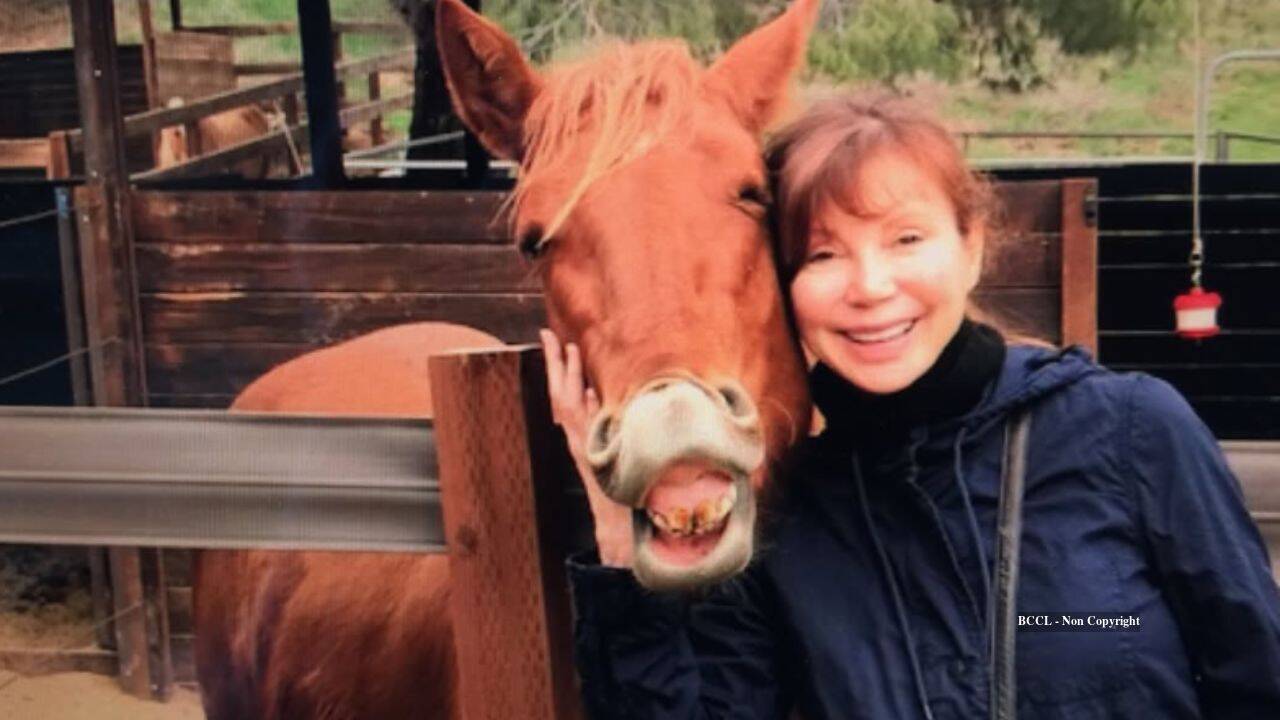
At 76, former Dallas icon Victoria Principal has completely abandoned the Hollywood spotlight to run a private animal rescue sanctuary in California, dedicating her days to rehabilitating neglected livestock and sharing the recovery of a miniature horse named Halo. While standard entertainment coverage treats this as a charming retirement hobby, the reality is far more deliberate. Principal executed one of the smartest, quietest exits in television history—walking away from acting, liquidating a multi-hundred-million-dollar skincare empire, and funneling her wealth and labor into the grueling, unglamorous work of large-animal rehabilitation.
She didn't fade out. Most actors cling to relevance until the phone stops ringing, taking smaller parts in worse movies just to stay on a call sheet. Principal did the exact opposite, systematically dismantling her public persona over two decades so she could shovel manure in peace.
The Myth of the Celebrity Retirement Hobby
When an aging television star posts a video of a miniature horse on social media, the entertainment press defaults to a predictable script. They call it a "passion project" or a "quiet life." That framing completely misunderstands what running an equine and livestock sanctuary actually entails.
Rescuing large animals is not a pastoral fantasy. It is a relentless, physically punishing operation governed by strict veterinary protocols, zoning laws, and staggering overhead costs. A single miniature horse with metabolic issues or neglected hooves—common ailments in animals like Halo who arrive from situations of severe neglect—requires specialized farrier work every four to six weeks, custom dietary management, and constant monitoring for founder and laminitis.
For a woman in her mid-seventies, choosing this lifestyle over the climate-controlled comfort of Beverly Hills galas signals a fundamental rejection of celebrity culture. Principal isn't posing with rescued animals for a magazine spread; she is managing an active rehabilitation facility where the work begins before dawn and rarely ends on schedule.
The Financial Architecture Behind the Exit
To understand how Principal affords to run a private rescue without constant public fundraising, you have to look at what she built while the cameras were rolling. During the peak of Dallas in the 1980s, when she played Pamela Barnes Ewing, Principal recognized something most of her peers missed: acting is a precarious gig, even at the top.
She founded Principal Secret in 1989. While other celebrities slapped their names on perfumes or clothing lines for quick licensing checks, she retained ownership and control, turning the skincare brand into a direct-response juggernaut on television shopping networks. By the time she stepped down and transferred the brand to Guthy-Renker in 2019, Principal Secret had generated more than $1.5 billion in revenue.
That liquidity bought her total autonomy. Most animal sanctuaries live and die by the donor cycle, spending half their energy begging for grants and the other half fighting burn-out. Principal bypassed the nonprofit industrial complex entirely. By self-funding her ranch operations through her own foundation and personal capital, she eliminated the need for boards of directors, publicists, or fundraising dinners.
Inside the Reality of Miniature Horse Rehabilitation
The focus on Halo, the miniature horse whose recovery Principal recently documented, highlights a specific and often overlooked crisis in animal welfare. Miniature horses occupy a strange blind spot in American agriculture and pet ownership. Because they stand under 38 inches tall, buyers frequently treat them like oversized dogs rather than equines with complex digestive and orthopedic needs.
When novelty buyers realize a miniature horse lives 25 to 35 years and requires specialized pasture management, the animals often end up abandoned, starved, or dumped at livestock auctions.
Rehabilitating a neglected miniature horse involves navigating several high-stakes medical hurdles:
- Refeeding Syndrome: Starved equines cannot simply be given unlimited hay and grain. Introducing calories too quickly triggers a massive insulin spike, shifting electrolytes like phosphorus and magnesium out of the bloodstream and causing fatal organ failure. Recovery requires micro-meals fed every few hours for weeks.
- Hoof Deformities: Without regular trimming, miniature horse hooves curl upward like slippers, tearing the internal laminae and rotating the coffin bone. Correcting this takes months of gradual, painful realignment by a therapeutic farrier.
- Hyperlipemia: Unlike full-sized horses, miniature horses are uniquely prone to a fatal condition where stress or brief fasting causes the liver to dump massive amounts of fat into the bloodstream. Even a minor illness can trigger a cascade that shuts down liver and kidney function within days.
When Principal shares updates on Halo's progress, she is documenting the tail end of a meticulous medical intervention. Getting a compromised miniature horse back to sound movement and a healthy weight is a triumph of veterinary discipline over sentimentality.
Why Hollywood Stars Abandon the Industry for Animal Welfare
Principal’s trajectory mirrors a broader, quiet migration among legacy actors who reached the summit of television fame in the 1970s and 1980s. Figures like Doris Day, Tippi Hedren, and Loretta Swit all eventually traded scripts for sanctuaries.
There is a psychological reason this specific transition happens so often among veteran performers. Hollywood is an industry built entirely on artifice, external validation, and transactional relationships. Every interaction is filtered through an agent, a manager, or a publicist. You are only as valuable as your last ratings share or box office gross.
Animal rescue operates on the exact opposite currency. A traumatized horse or an abused dog does not know who Pamela Barnes Ewing was. It does not care about syndication residuals or Golden Globe nominations. Trust has to be earned slowly, through consistency, physical presence, and quiet competence. For someone who spent decades being scrutinized under studio lights, the stark honesty of working with animals offers a rare form of sanity.
The Gray Areas of Private Sanctuaries
While Principal’s commitment is undeniable, the model of the wealthy, private celebrity sanctuary isn't without complications. In the broader animal welfare sector, privately funded rescues operate with far less public transparency than traditional 501(c)(3) organizations that rely on public donations and file detailed Form 990 disclosures with the IRS.
When a rescue is closed to the public and funded internally, outsiders have to take the owner's word regarding the quality of care, veterinary oversight, and long-term succession planning. The critical question facing any sanctuary run by an individual in their seventies is simple: what happens to the animals when the founder can no longer physically manage the property?
Horses routinely live into their thirties. A miniature horse rescued today could easily outlive a 76-year-old caretaker by two decades. Responsible private sanctuaries solve this by establishing irrevocable trusts and endowments specifically earmarked for the lifetime care of the resident herd, ensuring the ranch doesn't get liquidated by heirs or estate attorneys. Given Principal’s history of shrewd business planning, her estate likely accounts for this, though the specifics remain tightly guarded behind her private ranch gates.
The Discipline of Disappearing
What makes Principal’s current chapter compelling isn't nostalgia for Dallas. It is the sheer discipline required to walk away from fame when you still have leverage.
Modern celebrity culture is built on the algorithmic treadmill. Today’s stars are terrified of silence; they manufacture controversies, launch podcasts, and document every waking breath to keep their engagement metrics alive. Principal looked at that entire apparatus, realized she had already won the game, and simply unplugged the machine.
She used the capital generated by her fame to buy land, build infrastructure, and take on the unglamorous responsibility of keeping broken animals alive. Watching a 76-year-old former television icon celebrate the steady, unhurried recovery of a miniature horse named Halo isn't a story about aging gracefully—it is a masterclass in knowing exactly when to leave the party and build something that actually lasts.