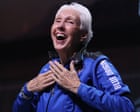
Wally Funk spent her entire life hearing the word no. NASA told her no because she was a woman. Commercial airlines told her no for the exact same reason. Yet when she passed away this week at 87 years old in Grapevine, Texas, she didn't leave us as a victim of systemic bias. She left us as an astronaut, a record-breaker, and a fierce reminder that your dreams don't come with an expiration date.
Most people only know Funk from her 2021 flight on Jeff Bezos’s Blue Origin rocket. She was 82 then, grinning like a kid, and stealing the spotlight from a billionaire. It made for a great feel-good news cycle. But treating her life like a cute human-interest story completely misses the point. Funk wasn’t just a passenger who got lucky in old age. She was one of the most skilled aviators America ever produced. Her death marks the end of an era, as she was the last surviving member of the Mercury 13. Her story is a masterclass in how to handle gatekeeping without letting it crush your spirit.
The Brutal Reality of the Mercury 13
Let's correct a massive misconception right out of the gate. People often think the Mercury 13 was an official NASA program that just happened to get cut. It wasn't. NASA wanted absolutely nothing to do with women in space during the 1960s.
The program was a privately funded project started by Dr. William Randolph Lovelace II. He helped design the medical tests for NASA’s official male astronauts, the Mercury 7. Lovelace wondered if women could handle the physical stress of spaceflight just as well, or maybe even better. He recruited 25 elite female pilots.
Funk was the youngest of the group at just 21 years old. She underwent grueling physical and psychological testing. Doctors poked, prodded, and tested her limits. They injected ice water into her ears to induce vertigo. They locked her in a sensory deprivation tank with no light and no sound. Most people hallucinate or panic within an hour or two. Funk stayed in that tank for ten hours and forty minutes. She scored at the absolute top of her class. Some of her scores beat the men who actually went to space.
The reward for her excellence? Total rejection.
The US military refused to let the women use their facilities for the next round of testing. Without military backing, the program evaporated. Funk and her peers took their fight all the way to Congress in 1962. They argued that qualified pilots shouldn't be barred from space just because of their gender. NASA astronauts like John Glenn testified against them. Glenn literally stated that the fact that women weren't in the space program was a reflection of our social customs. The gate closed. NASA chose social conformity over talent.
Building an Unstoppable Career in a Rigid World
If you get barred from your ultimate dream before your 25th birthday, you might give up. Nobody would blame you. Funk did the opposite. She poured her energy right back into the skies.
She flew. She taught. She broke barriers because she literally had no other choice if she wanted to stay in the air.
In 1971, she became the first female flight inspector for the Federal Aviation Administration. Think about the room she had to walk into every day. Aviation in the 1970s was an aggressive boys' club. Male pilots didn't want a woman evaluating their skills or checking their aircraft. She had to be flawless. She couldn't afford a single mistake because her detractors were waiting for her to fail.
Three years later, she jumped to the National Transportation Safety Board as their first female air safety investigator. She didn't just sit behind a desk. Funk investigated 450 plane crashes. She climbed through wreckage, analyzed mechanical failures, and figured out exactly why people died in the sky. It was brutal, exhausting work that required a brilliant technical mind and nerves of steel.
During all of this, she kept trying to get into space. When NASA finally started accepting female astronauts in the late 1970s, Funk applied. She applied four separate times. NASA turned her down every single time. Why? Because despite her thousands of hours of flight time, she didn't have an engineering degree or experience as a military test pilot. Of course, she couldn't get military test pilot experience because the military didn't allow women in those roles back then. The system created a perfect loop of exclusion.
What True Resilience Looks Like
You don't accumulate 19,600 flight hours by waiting for permission. Funk simply loved the act of flying. She trained over 3,000 students during her lifetime. She became chief pilot at five different aviation schools.
When you look at her timeline, the sheer volume of achievements is staggering.
- Earned her pilot's license at age 17.
- Became the first female flight instructor at a US military base at age 20.
- Became the first female FAA flight inspector in 1971.
- Investigated 450 air accidents for the NTSB starting in 1974.
- Flew beyond the atmosphere at age 82 in 2021.
Many people look at her Blue Origin flight as a gift from Jeff Bezos. That is a lazy interpretation. Funk actually bought a ticket for a commercial space flight with Virgin Galactic all the way back in 2012. She put her own money down because she refused to let her dream die. Bezos invited her on the New Shepard flight because her presence gave the launch historical legitimacy. She earned that seat through sixty years of relentless excellence.
When she finally crossed the Karman line on July 20, 2021, she became the oldest person to ever fly into space at that time. Her reaction wasn't a tearful, solemn speech about historical justice. She came out of the capsule, hugged the people around her, and said she wanted to go again, fast. She complained that the flight was too short. That attitude tells you everything you need to know about her. She wasn't bitter about the sixty-year delay. She was just thrilled to finally be there.
The Dangerous Trap of Waiting for the Perfect Moment
The real lesson from Funk's life isn't just that she made it to space. It's how she lived during the decades when space was closed to her.
We live in a culture that loves to make excuses. We wait for the perfect job, the perfect market, or the perfect set of circumstances before we commit to our goals. We blame institutions, gatekeepers, and bad luck when things don't go our way. Don't get me wrong. Gatekeepers are real, and Funk faced the worst of them. But she never let their rejections define her daily life.
If she had spent her life stewing in resentment over the cancellation of the Mercury 13, she would have missed out on becoming a legendary flight instructor. She wouldn't have saved lives through her work at the NTSB. She wouldn't have been ready when the opportunity finally came around in 2021.
Preparation is a form of optimism. Funk kept her skills sharp and her mind focused because she fundamentally believed that her time would come. She didn't let her age or her past disappointments slow her down.
How to Apply the Wally Funk Playbook to Your Life
If you're sitting around feeling like you missed your chance, you need to change your perspective right now. Put these steps into action immediately.
Stop looking for validation from institutional gatekeepers. If the official channel says no, find a lateral move. Funk couldn't fly for NASA, so she became the best flight inspector in the country. She created her own authority.
Build your hours. Excellence is undeniable over a long enough timeline. You can't argue with 19,600 hours of flight experience. Whatever your craft is, do the work when nobody is watching and nobody is applauding.
Invest in your own future. Don't wait for someone to hand you an opportunity. Buy the ticket, take the course, or build the prototype on your own dime. Funk put money down for a space flight a decade before she actually flew. She backed her own dreams with action.
Drop the bitterness. Bitterness eats up the energy you need for execution. When Funk finally got to space, she didn't waste her breath trashing the NASA officials who rejected her in the 1960s. She enjoyed the weightlessness. She looked out the window.
Wally Funk's passing isn't a tragedy. She lived a massive, loud, triumphant life. She beat the system by outliving her critics and outworking her peers. The next time you think you're too old, too young, or too stuck to chase a massive goal, remember the woman who waited sixty years for a eleven-minute flight and loved every single second of it. Get to work.