The grass in the gardens of the Palace of Holyroodhouse is damp, holding the kind of heavy, northern moisture that no summer sun can entirely burn away. On the morning of Tuesday, June 30, 2026, the air carries a distinct chill. It hums with a quiet, synchronized tension.
Hundreds of eyes fixate on a single point in the courtyard. The rhythm of the pipes begins. It is an ancient, low vibration that hits the chest before it reaches the ears.
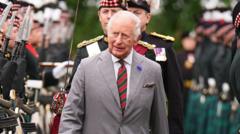
A man stands on the manicured lawn. He wears a heavy wool uniform, medals catching the pale Scottish light. He is seventy-seven years old. He has survived a grueling year of public health battles and private anxieties. Yet, here he stands, a monarch executing a choreography perfected over centuries. King Charles III has returned to Edinburgh.
To the casual observer scrolling through a news feed, the headline reads like standard bureaucratic theater: the King arrives for Royal Week. But beneath the surface of the press releases lies a delicate, high-stakes game of identity, belonging, and the invisible threads that tie an ancient kingdom to a modern crown.
The Velvet Cushion
Consider what happens when the helicopter blades finally stop spinning. The Lord Provost of Edinburgh, Robert Aldridge, steps forward. He carries a heavy, red-velvet cushion. Resting on that velvet is a massive piece of cast iron: the keys to the city.
The words spoken next are part of an unyielding script. The Lord Provost offers the keys to the "ancient and hereditary kingdom of Scotland."
The King looks at the iron. His hands reach out. For a brief second, he holds the symbolic ownership of the entire capital. Then, according to the script, he must give them back.
"I return these keys," the King replies, his voice steady against the wind, "perfectly convinced that they cannot be placed in better hands."
It is a beautiful, fragile loop of theater. Why do we still watch it? Because in an era where trust is a scarce commodity, this exchange represents a contract. The King acknowledges that his power is a loan; the city pledges that its loyalty is real.
The Balaklava Company of the 5th Battalion, Royal Regiment of Scotland, stands at absolute attention. Not a muscle twitches. The pipes swell, the drums roll, and the Royal Company of Archers—the monarch’s official bodyguards north of the border—lock their eyes forward. This is not a holiday. It is an intense, exhausting deployment of soft diplomacy.
The Ghosts in the Great Gallery
Behind the ceremonial gates, the Palace of Holyroodhouse breathes its own history. The building smells of old oak, beeswax, and centuries of damp stone.
Later that Tuesday, the King moves into the Great Gallery. The walls are lined with portraits of Scottish monarchs, many of them legendary, some of them tragic. Under their painted gazes, the King holds an investiture.
This is where the grand narrative of the monarchy meets the raw reality of ordinary lives. One by one, local citizens step forward. These are people who do not live in palaces. They are community leaders, charity founders, and innovators. Among them is Simon Milne, the regius keeper of the Royal Botanic Garden Edinburgh, waiting to receive a knighthood for his decades of quiet devotion to botany and conservation.
When the King pins a medal to a lapel, the interaction is brief, but the emotional gravity is massive. For a volunteer who has spent thirty years running a neighborhood food bank, this moment validates a lifetime of unnoticed sacrifice. The King listens. He nods. He asks specific questions. Despite his own physical exhaustion, he forces himself to be entirely present for each person. It is a grueling exercise in empathy.
But the palace walls do not just house solemn ceremonies. Out in the gardens, the energy shifts as 8,000 ordinary Scots flood the grounds for the annual Royal Garden Party.
Imagine a schoolteacher from Aberdeen or a nurse from Glasgow finding themselves standing on the same grass where Mary, Queen of Scots once walked. They hold tiny cups of tea, scanning the crowd as the King, Queen Camilla, Princess Anne, and Prince Edward move down split avenues of guests. The bodyguards in their dark green tunics form a gentle barrier, but the conversation flows easily. It is an intentional blurring of the lines between the ruler and the ruled.
The Highest Chivalry
The intensity builds as the week progresses. On Wednesday, the focus shifts up the Royal Mile to St Giles’ Cathedral. The air inside the cathedral is always cold, smelling of ancient dust and candle smoke.
The King gathers with the Duke of Rothesay—the title Prince William uses whenever he crosses the Scottish border—and the rest of the senior family for the Thistle Service.
This is Scotland’s highest order of chivalry, a group limited to just sixteen Knights and Ladies. This year, the ceremony carries a deeply personal weight for the monarch. Queen Camilla and Prince Edward are formally invested into the order, their names etched into a lineage that stretches back to the late seventeenth century.
To look at the ceremonial robes and the heavy insignia is to realize that Royal Week is a calculated reminder of permanence. Governments change, economies fluctuate, and political arguments fracture the landscape. The crown, however, positions itself as the constant baseline. It tells the people that whatever storms are raging outside, the foundational story of the nation remains intact.
The Border Game
The narrative does not stay confined to Edinburgh’s historic stones. The real test of this regional pilgrimage happens when the King leaves the capital behind.
On Thursday, the royal convoy winds down into the Scottish Borders, heading for the town of Jedburgh. The architecture changes from grand volcanic rock to low-slung stone cottages. The crowds here are different—weather-beaten faces, families wrapped in thick jackets, children sitting on their parents' shoulders.
The King arrives during the Jethart Callant festival, a community celebration deeply rooted in border history. He is led into the center of a chaotic, cheering crowd to witness a tradition that has survived since 1704: the annual game of hand ba’.
The sport is wild, ancient, and entirely unpredictable. It is a street game played with a small leather ball, where opposing sides of the town scramble, push, and sprint through the cobblestone streets to score. The King is invited to start the match. He tosses the ball into the sea of waiting hands, and the street erupts into immediate, joyful chaos.
Standing on the pavement, watching the mad scramble of the players, the King laughs. In this moment, the heavy mantle of the state drops away. The formal titles, the grand standard flying over Holyroodhouse, the historic iron keys—all of it shrinks down to a simple, human interaction on a cold northern street.
The visit highlights a fundamental truth about leadership: power is not maintained through distance. It is sustained when a leader is willing to step out of the palace, stand in the damp air, and throw themselves into the messy, beautiful traditions of the people they serve.
The music from the border pipes lingers in the evening air long after the royal cars have departed. The velvet cushion is stored away, the iron keys are back in the city’s vault, and the damp grass of Holyroodhouse settles back into silence. The contract has been renewed for another year.