The air inside the Élysée Palace does not move. It hangs heavy, steeped in centuries of polished mahogany, gilt-edged mirrors, and the silent ghosts of statesmen who once sat where the modern world now hangs by a thread. Outside, the Parisian rain slicked the cobblestones of the Rue du Faubourg Saint-Honoré, blurring the headlights of passing cars into streaks of amber and gray. Inside, time seemed to decelerate.
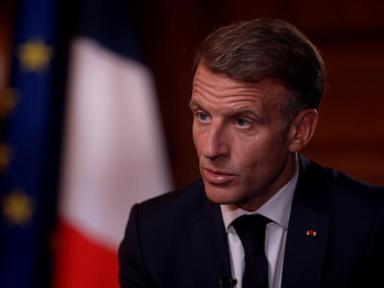
There is a distinct kind of stillness that precedes a high-stakes interview. It is the silence before a conductor raises the baton, or before a surgeon makes the first incision. Television cameras do not merely record; they compress reality, turning the chaotic friction of human survival into a pristine, broadcast-ready rectangle. When ABC News anchor David Muir sat face-to-face with French President Emmanuel Macron, the optics were immediate: two men in dark suits, separated by a low coffee table, beneath chandeliers that had witnessed empires rise and collapse.
Yet, looking past the broadcast framing, the encounter revealed something far more fragile than a standard geopolitical exchange. It exposed the raw nerve of a continent at an inflection point. Europe, long accustomed to resting under the umbrella of transatlantic stability, finds itself waking up to an unsettling truth. The old rules are dissolving. The Atlantic is feeling wider by the day. And the leaders who inherited the architecture of the twentieth century are suddenly forced to construct something entirely new in the dark, while the wind howls.
To understand why a conversation between an American journalist and a French president matters to a reader sitting thousands of miles away, one must first dismantle the illusion of distance. We live in an era where global shocks travel faster than light. A supply chain hiccup in the Suez Canal empties a supermarket shelf in Ohio. A mortar shell fired across a disputed border in Eastern Europe shifts energy bills in Lyon. When Macron speaks about European sovereignty, he is not merely spinning philosophical theories for Parisian intellectuals; he is shouting across a crowded room, trying to warn a distracted world that independence is not a given state of nature. It is a fragile garden that must be weeded in the frost.
Consider what happens when a leader assumes the burden of articulation. Macron has spent his presidency walking a tightrope between traditional French grandiosity and modern pragmatic realism. He is a man who speaks in paragraphs, often too complex for the thirty-second clip, searching for nuance in a culture addicted to outrage. When Muir pressed him on the shifting tides of American politics, the strains of the war in Ukraine, and the terrifying volatility of the Middle East, the translation went beyond mere language. It was a translation of urgency.
"We are living through a moment where history has accelerated," a veteran French diplomat once murmured over a cooling cup of espresso near the Seine. "For thirty years, we believed history had ended. We built our economies on cheap energy, predictable allies, and the comforting assumption that democracy was a permanent upward curve. Now, we are paying the bill."
That bill is itemized in every headline about inflation, defense spending, and migration. But beneath the numbers lies a deeper psychological fracture. Citizens across the Western democracies feel a growing sense of alienation. They sense that the steering wheel is spinning freely in the hands of invisible forces—algorithmic feeds, corporate conglomerates, and geopolitical chess players thousands of miles away.
When Muir looked across the table at Macron, he was asking the question every citizen wants answered: Who is actually steering this ship?
Macron’s answer, delivered with the characteristic intensity of a former philosophy student who refuses to offer easy platitudes, pointed back toward Europe itself. For decades, Europe’s strategy was outsourcing. Security was outsourced to Washington. Energy was outsourced to Moscow. Manufacturing was outsourced to Asia. It was a comfortable arrangement, provided nobody rocked the boat. But the boat has not just been rocked; it is taking on water from every direction.
The interview illuminated the difficult, often unpopular truth that autonomy costs money, requires sacrifice, and demands difficult domestic choices. It is easy to wave a flag at a rally; it is considerably harder to explain to voters why their heating bills are tripling because an authoritarian regime two thousand miles away decided to redraw a border with artillery shells.
This is where the narrative of modern leadership collides with human psychology. People do not want nuance when they are struggling to pay rent. They want certainty. They want an anchor in the storm. Yet, offering false certainty is the ultimate betrayal of leadership. Macron’s challenge, and the challenge of every democratic leader today, is how to tell the truth without inducing panic, and how to act decisively without sliding into authoritarian impulses.
To watch the exchange between Muir and Macron was to witness a masterclass in modern media choreography, but also a glimpse of the invisible architecture holding our collective sanity together. Journalism at this level is not just about extracting soundbites or trapping a politician in a contradiction. It is about holding up a mirror to power and asking: Are you seeing what we are seeing?
The domestic political landscape in France itself adds another layer of profound tension. Macron governs a nation that practically invented the art of public dissent. For the French, striking is not merely an economic tool; it is a cultural ritual, a national sport, a sacred right written into the DNA of the republic. Every time a reform is proposed—whether raising the retirement age or restructuring labor laws—the boulevards of Paris fill with tear gas, smoke flares, and chanting multitudes.
To lead a country that periodically tries to set fire to its own furniture requires a very specific kind of stubbornness. Macron possesses that stubbornness in abundance. His critics call it arrogance; his allies call it vision. The truth, as is usually the case, resides in the uncomfortable space between. He is a leader who looks ahead with absolute conviction, often forgetting to look down at the feet of the people walking beside him.
When the conversation turned toward the war in Ukraine, the stakes sharpened into razor-sharp focus. For generations, Europeans viewed war as a museum piece—something that happened in black-and-white documentaries or distant continents. Now, air raid sirens wail in cities just a few hours' flight from Berlin and Paris. The return of total war to the European continent shattered the post-Cold War consensus overnight.
Macron’s position on European defense independence has historically ruffled feathers in Washington, where American policymakers have long viewed NATO as an unquestioned American franchise. Yet, as the political winds in the United States fluctuate with every election cycle, European leaders are discovering that relying indefinitely on the political goodwill of a single ally is a perilous gamble.
"We cannot protect our way of life if we are passengers in our own security," an advisor to the French defense ministry noted privately. "If you are not at the table when the map is drawn, you are on the menu."
That stark reality hangs over every bilateral meeting, every summit in Brussels, and every television studio interview. It explains why Macron pushes so hard for a unified European defense capability, even when member states squabble over budgets and national pride. The luxury of internal bickering is a casualty of the new global reality.
Yet, diplomacy is fundamentally an exercise in human psychology. Behind the formal titles, the motorcades, and the simultaneous translation earpieces are individuals grappling with the limits of their own influence. A president can draft a policy, sign a treaty, or deploy a carrier strike group, but he cannot legislate human trust. Trust is earned drop by drop and lost by the bucket.
In the studio lights, as Muir probed for clarity on how the West plans to navigate the coming decade of multipolar chaos, Macron leaned forward. The gesture was subtle, but it shifted the energy in the room. It was the posture of a man who believes that intellect and willpower can bend the arc of history, even when the machinery of state threatens to grind everything to dust.
This brings us back to the quiet room in the Élysée Palace and the rain falling outside on the Parisian streets. We are all inhabitants of this fragile architecture. Whether we live in a suburb of Chicago, an apartment in Marseille, or a farmhouse in Iowa, we are tethered to these high-level calculations.
The danger of our current moment is not just geopolitical conflict; it is emotional exhaustion. When the news cycle is an endless cascade of crises—pandemics, wars, climate anomalies, and economic tremors—the human brain resorts to self-defense. We tune out. We scroll past. We retreat into our digital silos, hoping that if we close our eyes tightly enough, the storm will pass us by.
But storms do not pass by because we ignore them. They require navigation. They require leadership that is honest about the danger and resolute in the response.
When the cameras finally stopped rolling, the studio crew packed up their cables, the lights clicked off, and the silence rushed back into the room. The grandeur of the palace resumed its ancient watch. Macron returned to his desk, facing stacks of briefing papers detailing crises that would keep him awake until dawn. Muir prepared to fly back to New York, carrying the recording of a conversation that would be parsed, edited, and broadcast to millions of homes across an ocean.
Nothing had been solved in that half-hour exchange. No wars were ended, no treaties signed, no economic collapses averted. Yet, something vital had occurred. In a world drowning in noise, two minds had paused to articulate the terrifying, exhilarating reality of what it means to be alive at the edge of history.
They did not offer easy answers because easy answers do not exist. Instead, they offered something better: a clear-eyed look at the dark water we are all crossing together, and the stubborn, beautiful insistence that the ship can still be steered toward safe harbor if we are brave enough to hold the wheel.