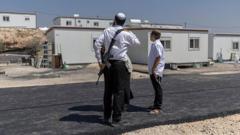
The media narrative on West Bank settlements is a masterpiece of intellectual laziness. You have read it a thousand times: "Israel is expanding settlements to reshape the West Bank," accompanied by hand-wringing about territorial continuity and the death of a two-state outcome. This framing treats the movement like an unforced error or a whim of political extremists.
It is neither.
To understand the reality of the West Bank, you must stop viewing it through the lens of international diplomacy and start viewing it through the brutal physics of national security. Israel is a country with the strategic depth of a sidewalk. Seventy percent of its population and the lion’s share of its economic engine are packed into a coastal plain that is, at its narrowest point, about nine miles wide. In the world of high-stakes defense, geography is destiny. Military planners do not care about the optics of "annexation"; they care about the fact that a hostile force occupying the mountain ridges of the West Bank could fire heavy weapons directly onto the country's most vital infrastructure and population hubs.
The "lazy consensus" ignores this reality, labeling the entire project as mere ideology. While religious attachment to the land of Judea and Samaria is undeniably a driver for many, it is a secondary factor to the primary survival strategy. Israel’s presence in the West Bank is the only way to ensure that no opposing entity gains the high ground.
Imagine a scenario where a hostile government takes control of that central mountain ridge. The entire northern and central coastal plain, including Ben Gurion Airport and the industrial heart of Tel Aviv, would be under constant, unavoidable threat. From a cold, calculating military perspective, leaving that ground unoccupied or undefended is not a "peace process"—it is suicide.
Critics love to point at the infrastructure, the bypass roads, and the legal maneuvers in Area C as evidence of an grand, Machiavellian design to "strangle" a potential Palestinian state. Let’s be brutally honest: they are right, but not for the reasons they think. It is not about greed; it is about the rejection of a "sovereign" neighbor that has demonstrated, repeatedly and violently, that it views Israel’s existence as a temporary condition. The current administration has simply stopped hiding the ball. By accelerating the transition from military administration to administrative integration, they are acknowledging the truth that has been obvious since 1967: military occupation is an unsustainable temporary state, and they have decided to stop waiting for a peace partner who does not exist.
The argument that settlements are just for "cheap housing" is another piece of intellectual dishonesty. Yes, middle-class Israelis move to Ariel or Gush Etzion for the same reasons anyone moves to a suburb: lower mortgage payments and better quality of life. But that is an outcome of state policy, not the cause of it. The state incentivizes this migration precisely because it creates "facts on the ground" that make unilateral withdrawal impossible. It is a cynical, effective form of emotional blackmail directed at future Israeli governments: "You cannot abandon these people because they are your citizens."
The real tragedy here is not the loss of a mythical "peace process" that died decades ago in the wake of the Second Intifada and the subsequent rise of regional instability. The tragedy is that both sides have locked themselves into a zero-sum game where the only options are total control or total vulnerability.
If you want to understand why the expansion is hitting record numbers—54 new settlements in 2025 alone—do not look for a diplomatic breakthrough. Look at the shift in Israeli security doctrine. The barrier fence reduced suicide bombings by 90 percent, proving that physical control works. The current strategy is an evolution of that same lesson: if you cannot trust your neighbor to prioritize their own development over your destruction, you take away their ability to choose.
The international community’s obsession with "international law" and "territorial integrity" is a distraction because it ignores the fundamental failure of these concepts in a region where treaties are treated as suggestions. You can cite the Hague Regulations or the Rome Statute until you are blue in the face, but those documents don’t have an army.
If you truly want to fix the West Bank, stop acting like this is a real estate dispute. It is a security crisis masquerading as a land grab. The current policy is designed to make the territory a liability for anyone other than Israel, effectively neutralizing the "threat from within." Whether this leads to a stable future or a permanent state of friction is irrelevant to the strategists in Jerusalem. They aren't playing for peace; they are playing for survival. And in their eyes, the cost of being called an occupier is a rounding error compared to the cost of being wiped off the map.
You want a different outcome? Change the threat environment. Until that happens, the concrete will keep pouring, the roads will keep being paved, and the geography will keep shifting. It is not a bug in the system; it is the entire point.
Understanding West Bank Settlement Expansion
This video provides a succinct breakdown of the administrative and military mechanisms currently being employed to alter the status of the West Bank.