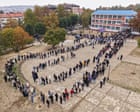
Every time Serbia goes to the polls, Western newsrooms pull out the exact same dusty template. They frame the ballot as a heroic, cinematic clash between an entrenched Balkan autocrat and a scrappy, idealistic grassroots movement fighting for democracy.
It makes for great headlines. It is also completely detached from how power actually operates in Belgrade.
If you read the mainstream coverage of Aleksandar Vučić facing a grassroots challenge to his twelve-year rule, you are being fed a comforting fairy tale. The lazy consensus assumes that street protests and municipal discontent translate directly into electoral vulnerability. They do not. In fact, treating Serbian politics like a standard Western two-party race is the exact reason international observers, opposition strategists, and foreign diplomats get blindsided every single election cycle.
I have spent over a decade watching political campaigns across Southeastern Europe burn through millions in foreign grants and grassroots energy, only to hit a brick wall on Sunday night. They lose because they are fighting a war that ended twenty years ago. They think they are battling a classic, brittle dictatorship. They are actually up against a hyper-efficient, transactional political machine that feeds on their exact brand of outrage.
The Myth of the Grassroots Tipping Point
Western journalists love a street protest. When tens of thousands of people march through Belgrade over environmental concerns, lithium mining, or municipal corruption, foreign correspondents immediately start writing political obituaries for the ruling Serbian Progressive Party (SNS).
Here is the cold reality of Balkan electoral mechanics: Belgrade is not Serbia.
A massive turnout in the capital’s central squares looks dramatic on an evening broadcast, yet it represents a fraction of the national electorate. While urban activists are organizing viral social media campaigns and debating ideological purity in Vračar cafes, the ruling party is operating a granular, door-to-door logistics network across the industrial towns, agricultural villages, and provincial municipalities that actually decide national majorities.
Political scientists like Steven Levitsky and Lucan Way coined the term competitive authoritarianism to describe regimes where formal democratic institutions exist, yet the playing field is tilted so heavily in favor of the incumbent that defeating them requires near-miraculous coordination. Serbia is the textbook case. In a competitive authoritarian system, grassroots energy without institutional muscle is just free cardio for the opposition.
Why Vučić’s Machine Is Built to Survive Outrage
To understand why a twelve-year rule does not crumble under the weight of street protests, you have to stop viewing Vučić as an ideological zealot and start viewing him as a master of clientelist patronage.
In Serbia, the state is the largest employer. Through a sprawling network of public enterprises, municipal contracts, and state-subsidized foreign investments, the ruling party has woven its survival directly into the economic survival of hundreds of thousands of households. When you control the local hospital jobs, the utility company payrolls, and the agricultural subsidies, you do not need to win hearts and minds. You only need to remind voters who signs the checks.
The Media Asymmetry Trap
Critics constantly point to media capture as the primary reason the opposition struggles. They are half right, but they draw the wrong conclusion.
Yes, national frequency television channels—Pink, Happy, and the public broadcaster RTS—operate with a relentless pro-government slant. They flood the airwaves with state achievements while painting critics as foreign-funded saboteurs. However, the opposition’s response to this media blockade is fundamentally broken.
Instead of building alternative distribution networks that reach working-class voters outside the capital, opposition leaders spend their time talking to each other on the few independent cable channels like N1 and Nova S. They are preaching to the converted inside an echo chamber, mistaking high ratings among urban professionals for a national wave.
The Geopolitical Shield Nobody Wants to Admit
If you want to know why Vučić remains untouchable, stop looking at Belgrade and start looking at Brussels, Washington, and Berlin.
The mainstream narrative loves to portray Serbia as a rogue Russian outpost destabilizing the Balkans. That framing is pure theater. In reality, Vučić has made himself indispensable to the very Western powers that claim to champion democratic norms.
Consider the transactional reality on the ground:
- The Lithium Factor: Europe’s green transition requires massive amounts of lithium for electric vehicle batteries. Serbia’s Jadar Valley holds one of the largest deposits on the continent. European leaders—most notably from Germany—have shown they will happily overlook domestic democratic backsliding if Belgrade guarantees access to strategic raw materials.
- The Kosovo Lever: Stability in the Western Balkans hinges on preventing open conflict between Belgrade and Pristina. Western diplomats treat Vučić as the only figure with enough domestic authority to sign and enforce a normalization deal, effectively giving him a free pass on internal governance in exchange for keeping the peace.
- Ammunition and Migration: While Belgrade refuses to join EU sanctions against Moscow, Serbian defense factories have quietly supplied hundreds of millions of euros worth of ammunition that ends up in Ukraine via third parties. Add Serbia’s role in policing the Balkan migration route, and you have a leader whom Brussels cannot afford to lose.
When Western ambassadors issue mild, boilerplate statements urging "free and fair elections," they are going through the motions. They want stability, lithium, and quiet borders. A fragmented, unpredictable opposition coalition offers none of those guarantees.
Dismantling the Opposition’s Fatal Flaws
It is easy to blame structural disadvantages, state media, and foreign hypocrisy for every opposition defeat. Doing so is also a massive cop-out. The Serbian opposition has consistently been its own worst enemy, trapped in a cycle of strategic self-sabotage.
First, there is the purity spiral. Grassroots movements in Serbia routinely fracture over ideological litmus tests. Pro-EU liberals refuse to cooperate with conservative nationalists, and environmental activists distrust established party politicians. Meanwhile, Vučić’s SNS operates as a ruthlessly pragmatic catch-all tent. It absorbs ultra-nationalists, technocratic liberals, social democrats, and local power brokers without blinking, united by a single shared interest: retaining power.
Second, the opposition consistently runs referendum campaigns instead of vision campaigns. Their entire pitch to the electorate boils down to a single, exhausted slogan: Vučić must go.
Imagine a scenario where you are a 52-year-old factory worker in Kragujevac. Your wages have barely kept up with inflation, your town’s infrastructure is crumbling, and you know the local mayor is corrupt. However, your pension is paid on time, your cousin got a job at the new state-backed plant, and the opposition candidates on television spend all their time arguing about abstract constitutional reforms and geopolitical alignments. Are you going to risk your family’s baseline security for a coalition that cannot even agree on who its prime ministerial candidate is? Of course not.
What Actually Disrupts an Entrenched Machine
If street protests, moral outrage, and international condemnation do not topple a twelve-year incumbent, what does? History—specifically Serbia’s own history in 2000, as well as recent municipal breakthroughs in neighboring countries like Hungary and Turkey—offers a clear blueprint.
1. Abandon the "All or Nothing" National Obsession
You do not dismantle a patronage network from the top down; you starve it from the bottom up. In 2019, the Hungarian opposition broke Viktor Orbán’s aura of invincibility not by winning parliament, but by uniting behind a single, pragmatic candidate to capture the mayoralty of Budapest. In Turkey, Ekrem İmamoğlu did the exact same thing in Istanbul.
Capturing a major municipal budget cuts off the ruling party’s access to local procurement contracts, real estate deals, and public sector hiring. It proves to cynical voters that the opposition can actually pave roads, run transit systems, and govern without chaos.
2. Speak the Language of Material Self-Interest
Grassroots movements fail when they sound like human rights NGOs. Working-class voters do not wake up worrying about media pluralism or judicial independence. They worry about grocery prices, healthcare wait times, and whether their children have to emigrate to Germany to make a living.
A winning challenger stops lecturing voters about democratic values and starts attacking the incumbent on kitchen-table competence. Expose the inflated cost of state infrastructure projects not as an abstract rule-of-law issue, but as money stolen directly from hospital renovations and school budgets.
3. Weaponize Discipline Over Enthusiasm
Enthusiasm peaks three weeks before an election and evaporates in the rain on Sunday afternoon. Discipline wins. That means recruiting, training, and paying tens of thousands of poll watchers to cover every single ballot box from Subotica to Vranje. If you cannot protect the count in rural precincts, your rally size in Belgrade is completely irrelevant.
The Uncomfortable Truth About This Approach
There is a massive catch to this strategy, and most idealistic activists hate hearing it: to beat a pragmatic machine, you have to become pragmatic yourself.
Winning requires making uncomfortable alliances with flawed local operators. It means shelving ideological pet projects to focus relentlessly on economic grievances. It requires accepting that you will not build a Scandinavian-style social democracy overnight; your immediate, unglamorous goal is simply to break a single-party monopoly on state resources.
Many grassroots organizers would rather lose with their ideological purity intact than win by compromising with moderate conservatives or ex-system insiders. As long as that mindset dominates, the ruling party will gladly let them march in the streets every Saturday evening.
Stop waiting for a spontaneous democratic awakening to sweep through the Balkans. Power in Serbia is not lost in the headlines of European newspapers, and it is never surrendered to a protest march. It is pried away, precinct by precinct, budget by budget, by opponents ruthless enough to match the machine’s own discipline.