The rain in Kyiv does not wash away the smell of pulverized concrete. It turns it into a heavy, suffocating paste that clings to the back of your throat. For those who live here, that scent is the olfactory signature of a modern war. It is the smell of a home transformed into a tomb in less than three seconds.
On a Tuesday that felt indistinguishable from any other Tuesday of the invasion, the courtyard of the Church of the Holy Myrrh-Bearers filled with a quiet that was far more terrifying than the air raid sirens. The sirens are loud. They demand action. They trigger adrenaline. But this silence was heavy, absolute, and hollow.
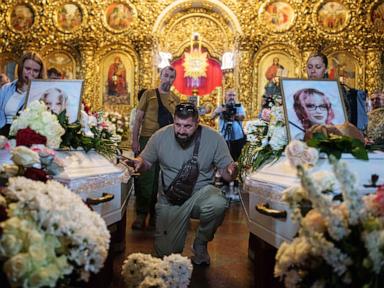
In the center of the courtyard sat two identical, small white coffins.
They looked like toy boxes. That is the first horrific realization that hits you when you stand before the casualties of a missile strike. Children do not fit into the standard architecture of death. Their caskets are short. They require fewer pallbearers. A single grown man can carry the entire weight of a child’s stolen future under one arm.
Inside those boxes were Yulia, age eleven, and her sister, Anna, age fourteen. Twins in everything but the calendar, separated by three years but bound by the identical, messy laughter that used to echo through their small apartment. Until a Russian ballistic missile tore through the ceiling of a pizza restaurant where they were eating dinner.
The Anatomy of an Ordinary Tuesday
To understand how a family ends up standing over two white boxes in the rain, you have to look at the geometry of modern warfare. This is not a story of soldiers entrenched in muddy trenches miles away. This is the reality of urban targeting, where the front line is a dinner table.
Consider the physics of the weapon involved. A ballistic missile travels at speeds that defy human reaction. From the moment of launch to the moment of impact, the timeline is often less than five minutes.
Five minutes is not enough time to finish a meal. It is barely enough time to pay the bill.
When the missile struck the crowded eatery in Kramatorsk, an administrative hub where the sisters were visiting family, it was filled with civilians. Volunteers, journalists, mothers, teenagers. The explosion generated temperatures that instantly melted steel. The pressure wave shattered windows blocks away, turning ordinary glass into millions of microscopic daggers.
The official reports from the ministry will tell you that eleven people died that day. They will give you coordinates. They will cite the caliber of the rocket. They will call it collateral damage or a successful strike on a logistics hub, depending on which propaganda channel you tune into.
But statistics are an anesthetic. They are designed to help us process the unbearable by turning people into math.
The math says eleven dead. The reality says that a mother named Valentyna went to a restaurant with her daughters and walked out into a crater, her hands covered in the dust of her own children.
The Weight of a Bedroom
Walk into any home where a child has been taken, and you will find a museum of frozen time.
Yulia’s sketchbook still sits on the desk. The page is turned to a half-finished drawing of a cat with oversized eyes. The colored pencils are scattered exactly where she left them, a bright yellow one rolling slightly to the left because the floorboards slope.
Anna’s favorite sweater hangs on the back of the chair. It still smells like cheap vanilla body spray and laundry detergent.
This is the invisible tax of war. The conflict does not just take life; it freezes the living in a permanent state of waiting. Every instinct in a parent’s brain is wired to expect the door to open, to hear the heavy thud of school bags on the floor, to yell at them to wash their hands before dinner.
Instead, there is only the rain outside and the sudden, agonizing realization that those items will never move again. They are artifacts now.
The neighbors gathered outside the church did not speak in the grand language of geopolitics. They did not debate the efficacy of air defense systems or the strategic value of the Donbas region. They spoke in whispers about how Anna used to help the elderly women carry their groceries up the broken elevator of their apartment block. They remembered how Yulia had a laugh so loud it used to annoy the downstairs neighbors.
Now, those neighbors would give anything to hear that noise through the ceiling again.
The Mechanics of Grief
There is a specific ritual to an Orthodox funeral in Ukraine during wartime. It has become a production line of sorrow, executed with a numbing efficiency. The priests know the liturgy by heart, not because they are pious, but because they have performed it three times a day for over two years.
The incense burns. The smoke rises, mixing with the damp mist of the Kyiv morning.
The mother, Valentyna, does not cry during the service. Her face has passed beyond the boundary of tears into a terrifying, crystalline stillness. She looks at the white wood of the coffins with the intense concentration of someone trying to solve a puzzle that makes no sense.
How do two teenagers vanish into a cloud of grey dust?
Her husband stands beside her, his arm wrapped around her waist, not to comfort her, but to keep her upright. His knees buckle every time the choir hits a low note. He looks like a man who has been hollowed out from the inside, a human shell maintained only by the sheer pressure of the atmosphere around him.
A friend of the family, a man named Dmytro who escaped the occupied territories in the south, watches from the edge of the crowd. His jacket is torn at the sleeve. He has seen this before. Too many times.
"You think you get used to it," Dmytro says, his voice dropping to a gravelly whisper. "You see the news. You see the buildings with the fronts ripped off, looking like dollhouses. You think, how terrible. Then you stand here. You look at the size of the box. And you realize we are all just waiting for our turn in the lottery."
The Narrative of Necessity
The world watches these events through a glass screen. It views them as a series of political maneuvers, a chess game played with human pieces. There are debates in distant capitals about budgets, supply lines, and escalatory thresholds.
But inside the wet grass of the cemetery, those debates feel like a cruel joke.
The stakes are not ideological. They are existential. The choice is not between two different political systems; it is between whether a child gets to finish her drawing or whether her sketchbook becomes a historical record of a life cut short at eleven years.
The funeral ends not with a grand speech, but with the wet, heavy thud of earth falling onto wood. It is a sound that stays with you long after you leave the cemetery gates. It is a rhythmic, dull strike.
Thud.
Thud.
The sound of two sisters being tucked into the earth, miles away from the restaurant where they just wanted to share a pizza on a rainy Tuesday afternoon.
The crowd disperses slowly, melting back into the grey streets of Kyiv. The air raid sirens begin to wail again in the distance, a rising and falling pitch that signals more metal is on its way from the east. People accelerate their pace. They look up at the sky. They walk toward the subways and the basements.
The city moves on because it must, but it moves on lighter, missing two voices that should have been loud enough to drown out the sirens.