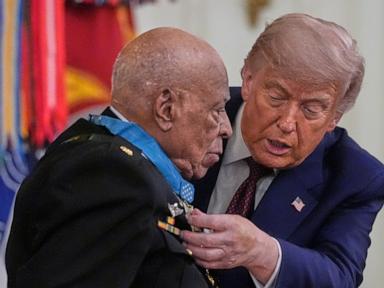
True heroism doesn't come with an expiration date. Decades can pass, geopolitical landscapes can shift completely, and the world can look entirely different, but the raw courage displayed on a chaotic battlefield remains absolute. We saw that clearly at the White House when President Donald Trump presented the Medal of Honor to three American veterans. Two fought in the dense jungles and river crossings of Vietnam more than fifty years ago. The third stood his ground against an overwhelming ambush in the mountains of Afghanistan in 2012.
The ceremony honored Marine Corps Major James Capers Junior, Army Major Nicholas Dockery, and Marine Corps Colonel John W. Ripley, who received the award posthumously. If you look past the political backdrop and the formal military dress, you find three distinct survival stories that show exactly what it takes to earn the nation's highest military decoration. These aren't just historical footnotes. They're masterclasses in leadership under extreme pressure.
The Indomitable Spirit of James Capers Junior
In March 1967, a routine reconnaissance mission turned into a multi-day nightmare in the Vietnamese jungle. Then-Lieutenant James Capers Junior was leading a small team to locate a suspected North Vietnamese base camp. By the fourth day, the jungle erupted. Capers and his men found themselves ambushed, cut off, and completely outnumbered by a massive enemy force.
A claymore mine exploded near Capers. The blast broke his leg and tore into his abdomen with shrapnel, peppering his body in seventeen different places. Most people would be completely incapacitated by wounds that severe. Capers didn't quit. He took a shot of morphine to dull the blinding pain and immediately took total control of the firefight.
He didn't just sit back and bark orders. Capers crawled through the dirt, directed his men, and systematically called in air support to keep the enemy fighters from completely overrunning their position. When an evacuation helicopter finally managed to land through the chaos, Capers made sure every single wounded Marine was loaded on board first. He refused to climb into the chopper until his men were accounted for.
The story takes an incredible turn during the actual extraction. The rescue helicopter was heavily overloaded and groaned under the weight of the team. Sensing the danger to his men, Capers actually tried to get back off the chopper to lighten the load. His team simply refused to let him go. They physically pinned their commander down inside the aircraft, refusing to leave the jungle without the man who had just saved their lives. Now eighty-eight years old, Capers stood in the East Room to receive the recognition that his men say was decades overdue.
John W. Ripley and the Bridge at Dong Ha
The second Vietnam veteran honored at the ceremony wasn't there to receive his medal in person. Marine Corps Colonel John W. Ripley passed away in 2008, but his actions during the 1972 Easter Offensive remain legendary within military circles. His son, Tom Ripley, accepted the award on his behalf.
In April 1972, a massive North Vietnamese army consisting of thirty thousand soldiers and two hundred tanks was barreling down toward the village of Dong Ha. The only thing standing between that overwhelming force and the southern provinces was a single strategic highway bridge. If the tanks crossed that bridge, the defensive lines would completely collapse.
Ripley took it upon himself to stop them. He didn't have a large engineering crew or heavy machinery. He had five hundred pounds of explosives and his own physical strength. Over the course of five grueling hours, Ripley crawled back and forth along the steel I-beams beneath the bridge. He was completely exposed to constant enemy automatic weapons and mortar fire.
He swung himself hand-over-hand along the steel structure, carrying heavy blocks of explosives and rigging them manually. He made five separate trips into the line of fire. His body was completely exhausted, but he kept going until the entire underside of the bridge was wired. Ripley said a quiet prayer, struck the detonators, and blew the bridge into the river just as the lead tanks arrived. The destruction of that single bridge completely halted the northern advance. Ripley was originally awarded the Navy Cross for his actions, but a meticulous review of the combat records finally resulted in an upgrade to the Medal of Honor.
Nicholas Dockery and the Ambush in Kapisa Province
The timeline shifts to October 2012, in the rugged terrain of Afghanistan. Then-Lieutenant Nicholas Dockery was leading an Army platoon guarding a compound in Kapisa Province when the environment turned hostile. An estimated one hundred and fifty Taliban fighters launched a coordinated ambush, unleashing a wall of machine-gun fire and rocket-propelled grenades.
Dockery didn't hesitate. He charged across completely open ground, fully exposed to the enemy, to pull his scattered platoon together and organize a defensive perimeter. During the frantic opening minutes of the fight, he realized one of his sergeants was missing.
Dockery ran back out into the crossfire to look for him. He spotted two Taliban fighters actively dragging the wounded American sergeant down an alleyway. Dockery moved in, eliminated both enemy fighters, and pulled the sergeant to a covered position. The soldier had stopped breathing, so Dockery performed CPR right there in the dirt under active fire until the man gasped for air.
The battle raged for four hours in tight, urban terrain. Dockery called in mortar strikes to break the enemy lines, using his own physical body to shield the wounded sergeant from the falling dirt and concussive blasts. To get his men out alive, Dockery climbed onto an open, unprotected rooftop to gain a clear line of sight. He threw smoke grenades directly at enemy strongpoints to guide American gunships into the target area. He stayed on that roof directing air support until the entire platoon was ready for evacuation. True to his leadership style, Dockery was the absolute last man to step off the battlefield that day. Because of his actions, every single member of his team survived the ambush.
Why Medal of Honor Upgrades Take Decades
Many people wonder why it takes fifty years for a Vietnam veteran to receive an award they clearly earned on the battlefield. The process is incredibly bureaucratic and requires an ironclad paper trail. For an award to be upgraded to the Medal of Honor, new evidence or eyewitness testimony usually has to come to light, or a formal review board must re-evaluate the original documentation to correct past oversights.
The military has strict statutory time limits for submitting recommendations, which means Congress often has to pass specific legislation just to waive the time limits for these historic cases. Every single combat report, radio log, and medical record is scrutinized by multiple layers of command, all the way up to the Secretary of Defense and the President. It is a slow, painful process, but it ensures the integrity of the medal remains completely intact.
The Strategic Reality of High Level Military Honors
These ceremonies serve a dual purpose. While they are designed to honor individual acts of profound bravery, they also function as highly visible symbols of national resolve and military tradition. When top officials like Defense Secretary Pete Hegseth, United States Ambassador to the United Nations Mike Waltz, and key senators gather in the East Room, it sends a deliberate message to both current service members and foreign observers.
It signals that the nation takes care of its own, even if it takes half a century to balance the books. For the families of those who served, these upgrades offer a profound sense of closure and validation. They remind the public that the freedom enjoyed today was bought and paid for by individuals who chose to stand their ground when everything around them was burning down.
If you want to understand the true cost of military service, look up the full, unedited citations for these three men. Read the tactical breakdowns of the battles they fought. Share these specific stories with people who think heroism is something you only see in movies. Real heroes don't look like Hollywood characters. They look like an eighty-eight-year-old Marine smiling in the East Room, or a family holding a box containing a medal their father earned underneath a bridge in Dong Ha.