The mountain doesn't scream before it moves. It exhales.
For those who know the high alpine stretches of Alberta’s Highway 93, that sound—or the lack of it—is the only warning you get. One moment, the Icefields Parkway is a cathedral of turquoise ice and limestone; the next, the cathedral walls are falling. This isn't just about a road closure. This is about the visceral reality of living at the mercy of the Canadian Rockies, where a single slab of wind-hardened snow can sever the artery connecting Lake Louise to Jasper.
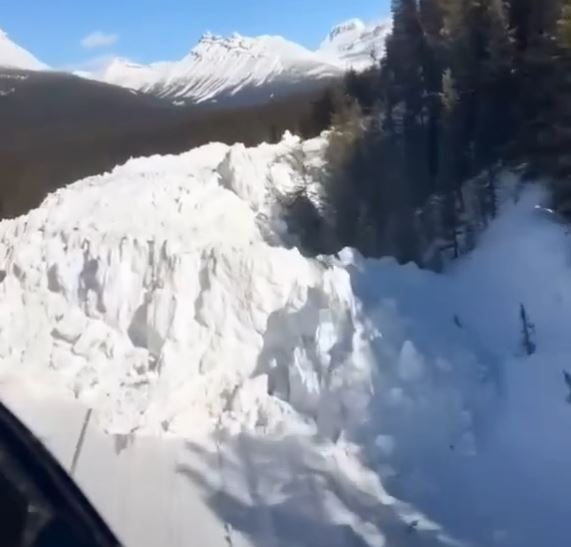
Earlier this week, the mountain spoke. A massive avalanche, triggered by a volatile mix of heavy accumulation and shifting temperatures, buried a significant section of the Parkway. Parks Canada officials didn't just put up a "Road Closed" sign. They locked the gates. The estimates for reopening are grim, stretching until at least Saturday, and even that feels like a whispered prayer against the weight of the snowpack.
The Invisible Wall
Imagine a traveler named Elias. He isn't a statistic, but he represents the thousands currently recalibrating their lives. Elias is driving a rental SUV, his trunk filled with gear for a bucket-list photography trip to Spirit Island. He reaches the gate at Lake Louise, expecting a scenic three-hour crawl through the most beautiful landscape on earth.
Instead, he finds a barricade.
The detour isn't a quick turn around the block. To get from the south entrance of the Parkway to Jasper now requires a massive loop through Rocky Mountain House or a long haul westward into British Columbia. We are talking about adding five to seven hours of driving time through secondary highways that are often just as treacherous. For the local supply chains—the trucks carrying fresh produce to Jasper’s isolated residents or the staff who commute between mountain hamlets—this isn't a scenic inconvenience. It is a logistical fracture.
The Parkway is a high-altitude tightrope. At its peak near Bow Summit, the road sits at $2,068$ meters above sea level. When you are that high, the weather doesn't follow the forecasts you see on your phone in Calgary or Edmonton. The wind creates "slabs"—compacted layers of snow that sit precariously on top of weaker, sugary crystals known as facets.
Think of it like a heavy marble slab resting on a floor covered in ball bearings. It looks solid. It feels permanent. But the moment the equilibrium shifts, the entire mass slides with the force of a freight train.
The Anatomy of the Slide
The particular slide that choked the Parkway this week was no "sluff" or minor spill. It was a structural failure of the mountain's winter skin. To understand the scale, you have to look at the math of snow. A cubic meter of settled snow can weigh up to $300$ kilograms. When an avalanche the size of the one near Parker Ridge comes down, it isn't just snow; it's a slurry of snapped timber, pulverized rock, and ice moving at $120$ kilometers per hour.
Parks Canada’s visitor safety technicians are the only reason this hasn't turned into a tragedy of human cost. These crews spend their mornings in helicopters, dropping explosive charges into known "start zones" to trigger slides before they happen naturally. They are essentially picking fights with giants to keep the rest of us safe.
But sometimes, the giants fight back.
The current conditions are so unstable that even the experts have had to pull back. You cannot send a snowplow into a path where a secondary slide might bury the operator. You cannot clear the bottom until you are certain the top has finished its tantrum. This is why the Parkway stays closed until Saturday. It isn't just about moving the snow off the asphalt; it’s about waiting for the mountains to stop moving.
The High Cost of the Scenic Route
There is a specific kind of silence that settles over a mountain town when the main road is cut off. In Jasper, the northern terminus of the Parkway, the atmosphere shifts. The hum of tourist traffic vanishes. The hotels, usually bustling with mid-winter adventurers, feel like islands.
For the business owners, every day the Parkway is closed represents a direct hit to the ledger. We often treat these mountain corridors as mere scenery, but they are essential infrastructure. When the road closes, the cost of everything rises. Fuel trucks must take the long way. Workers can't reach their shifts. The "scenic route" suddenly reveals its teeth.
If you are currently sitting in a hotel room in Banff or Jasper, staring at a GPS that has turned red, the frustration is real. You feel cheated of the glaciers and the high-alpine views. But there is a deeper lesson in the wait. We have spent a century convincing ourselves that we have tamed the wilderness with asphalt and guardrails. We haven't. We have only borrowed a path through it.
The Saturday Gamble
Saturday is the target, but in the Rockies, "Saturday" is a moving goalpost. The crews are looking for a window of blue sky and stable temperatures to begin the clearing process. If the wind picks up again, or if another "atmospheric river" dumps more weight on the peaks, the gates stay shut.
The process of reopening is a violent, mechanical ballet. Large rotary blowers—machines that look like they belong in a sci-fi novel—chew through the debris. They don't just push the snow; they throw it hundreds of feet off the shoulder. Then come the graders to find the actual road surface, hidden under meters of white chaos.
Until then, the Icefields Parkway belongs to the wolves and the wind.
There is a profound humility in being stopped by the weather. In our world of instant gratification and hyper-connectivity, the mountains provide a rare, blunt "no." They remind us that some things cannot be scheduled, optimized, or bypassed. You wait because the mountain demands it. You wait because the alternative is to be part of the slide.
The road will open again. The tourists will return to take their selfies at the Columbia Icefield, and the trucks will resume their steady pulse between the peaks. But for now, if you listen closely to the reports coming out of the Parks office, you can hear the true scale of the event. It’s the sound of a landscape reclaiming itself, reminding us that we are only ever guests in the high country.
The gates remain locked. The snow continues to settle. The mountain is still exhaling.