The gates of the All England Lawn Tennis and Croquet Club open on June 29 for the 2026 Wimbledon Championships, presenting a surface-level narrative of predictable elite dominance. Jannik Sinner stands as the heavy betting favorite to defend his title, flanked by a fading Novak Djokovic and a women's draw led by Aryna Sabalenka and defending champion Iga Swiatek. Yet beneath this familiar veneer lies a volatile reality defined by structural physical breakdowns, lopsided draws, and tactical regression that most mainstream previews completely ignore. This tournament will not be a smooth celebration of grass court elegance. It will be a grueling war of attrition.
The absence of two-time champion Carlos Alcaraz due to a right wrist injury has fundamentally warped the men's draw before a single ball has been hit. Television networks will spend the fortnight recycling historical footage and highlighting celebrity attendees, but the locker room understands the reality. The grass court season has shrunk to a structural afterthought, forcing modern baseliners to alter their entire biomechanical movement patterns over a mere three weeks. The result is an elite field holding its collective breath, praying their joints survive the slick, low-bouncing lawns of SW19.
The Vacuum at the Top of the Men's Game
Sinner enters the tournament with odds of -195 to lift the trophy again. That number reflects a massive vacuum rather than flawless historical invincibility. He has earned his status as the most clinical hard-court and grass player of the last eighteen months, but his path has been cleared by administrative and physical defaults.
With Alcaraz recovering in Spain, Sinner lacks a true contemporary peer capable of counteracting his flat, baseline weight of shot over five sets on a fast surface. The Italian starts his defense against Miomir Kecmanovic. It is a highly favorable opener that should allow him to find his footing without facing the kind of sliding, erratic defense that disrupts his rhythmic ball-striking.
Djokovic remains the great historical shadow over this tournament, entering at +650 odds while chasing a historic twenty-fifth Grand Slam title. The public sees a seven-time champion who can never be counted out on grass. The analytical reality is far more fragile. Djokovic bypassed the traditional warm-up tournaments at Halle and Queen's Club entirely, opting for isolated practice blocks to protect a body that has shown distinct signs of mechanical wear throughout the first half of 2026.
His first-round opponent, Wu Yibing, poses minimal threat on grass, but a projected second-round encounter with Stefanos Tsitsipas will immediately expose whether the Serbian's lateral movement can withstand the skidding bounces of the first week. Djokovic is betting his entire season on muscle memory and tactical acumen. It is a high-stakes gamble that ignores how quickly a slippery baseline can expose a thirty-nine-year-old frame.
Behind the top two seeds, the men's contenders represent a collection of flawed specialists. Alexander Zverev comes off a breakthrough triumph at the French Open, yet his booming serve has historically failed to yield a Wimbledon quarter-final appearance. The transition from the slow, high clay of Paris to the slick, low-skidding turf of London requires a total overhaul of knee-bend and swing preparation. Zverev faces Alexander Blockx in the opening round, a match that will immediately test whether his clay-court positioning has been successfully purged from his system.
The Myth of the Flat Grass Court Specialist
The modern tennis industry loves to discuss grass court specialists as if they belong to a distinct, noble lineage. The truth is much harsher. True grass specialists are extinct, killed off by the homogenization of court speeds and the evolution of modern racket technology. What remains is a group of players who simply possess a serve large enough to avoid playing tennis on the surface.
Ben Shelton and Taylor Fritz represent the American faction attempting to exploit this reality. Shelton, seeded fourth, possesses a left-handed delivery that compresses rallies down to three shots or fewer. On the pristine lawns of the opening Monday, his serve will look unreturnable against Otto Virtanen.
Fritz draws a far more perilous assignment in British number one Jack Draper. This is the standout matchup of the opening round. Fritz has won their last seven consecutive meetings, a statistical dominant streak that has skewed the betting markets. Draper is working directly with Andy Murray for this grass stretch, absorbing the precise, low-margin tactical geometry that Murray used to master SW19. Draper possesses the heavy lefty slice and low center of gravity that can make Fritz look stiff and upright.
The physical deterioration of the courts is the hidden variable that alters everything. During the first four days, the grass is lush, fast, and smooth. By the middle of the second week, the baselines turn into dry, uneven patches of dust and dirt.
The tournament changes character completely during this transition. A player who relies on the pristine skid of early grass suddenly finds themselves playing on a slow, bad hard court by the quarter-finals. This structural shift rewards well-rounded baseline defenders who can adjust to bad bounces, which is precisely why Sinner and Djokovic remain the safest bets despite the apparent threat of the big-serving contingent.
Chaos and Nostalgia in the Women's Draw
The women's tournament is a fascinating psychological study in contrast, split between the clinical efficiency of the modern top three and an aggressive dose of historical nostalgia. Aryna Sabalenka enters as the oddsmakers' choice to secure her first Wimbledon crown. Her flat, devastating groundstrokes do not require tactical nuance; they simply overwhelm opponents before the ball can bounce high enough to be redirected. Sabalenka could face Emma Raducanu in the third round, a potential blockbuster that hinges entirely on Raducanu's physical fitness after she missed critical practice sessions right before the draw.
Iga Swiatek enters as the defending champion, an achievement that quieted critics who claimed her heavy topspin was fundamentally unsuited to grass. Swiatek proved that raw athletic movement and baseline intensity could compensate for an unconventional grass technique. She begins her defense against Taylor Townsend, a tricky left-handed net-rusher who will test Swiatek's low-forehand execution immediately.
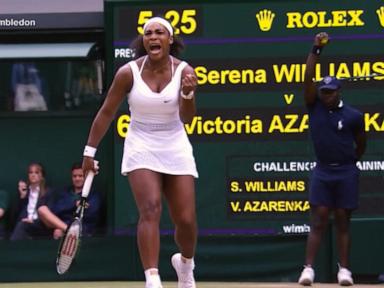
The real media storm, however, surrounds a wild card entry. Serena Williams has returned to the Grand Slam singles stage at forty-four years old.
Williams has also entered the doubles field with her sister Venus. The sisters boast a historic fourteen and zero record in Grand Slam doubles finals, including six titles in London.
The singles draw was not kind to the legendary American. Williams opens against Maya Joint, with a potential second-round match against Alexandra Eala waiting in the wings. If she survives those initial tests, a third-round date with Swiatek looms.
This is a brilliant commercial asset for the All England Club, but an athletic reality check for anyone expecting a deep run. Grass rewards explosive, reactive first-step movement. At forty-four, after years away from sustained singles competition, Williams is relying entirely on her serve to keep points short. If an opponent can extend the rally past four shots, the physical deficit becomes impossible to mask.
The Financial and Physical Toll of the Compressed Calendar
The underlying crisis of modern tennis is the absolute refusal of the governing bodies to address the calendar. Players are forced to transition from the brutal sliding of the clay season to the precise, dangerous footwork of grass in a matter of days. The joints do not have time to adapt. Ankles and wrists bear the brunt of this commercial mandate.
Consider the physical mechanics required to play on grass. A player must stay incredibly low to the ground, flexing the quadriceps and lower back constantly to meet a ball that rarely rises above the waist. On clay, they slide into the ball, using the surface to absorb their momentum. On grass, they must plant their feet and change direction instantly on a surface that offers zero give.
This physical reality explains why Alcaraz is sitting at home and why half the seeds in the draw are carrying taped joints and hidden anti-inflammatory regimes. The players are being pushed to a breaking point to satisfy a continuous touring schedule that prioritizes broadcast hours over human durability.
Tactical Realities of the First Week
The opening matches will expose the widening gap between those who can adapt their tactical identity and those who are stubborn products of the hard-court era. Watch the return positioning on Centre Court. Players who stand six feet behind the baseline, a common tactic on hard courts and clay, will find themselves aced off the court or forced to strike balls from their shoe laces.
Success in the first round requires an aggressive, forward-leaning posture. You must take the ball on the rise, cutting off the angles before the grass can work its erratic magic. Hubert Hurkacz and Casper Ruud will showcase this exact clash of styles in another brutal first-round pairing. Hurkacz understands how to shorten his backswing and charge the net; Ruud prefers the time and space that London strictly denies.
The All England Club will maintain its pristine, traditional image over the next fortnight. The white clothing will remain spotless, the grass will look perfect on television, and the commentators will speak in hushed, reverent tones about the magic of SW19. Do not let the aesthetic fool you. Wimbledon 2026 is a volatile survival tournament disguised as a garden party, and the champion will simply be the player whose body managed to break down the slowest.