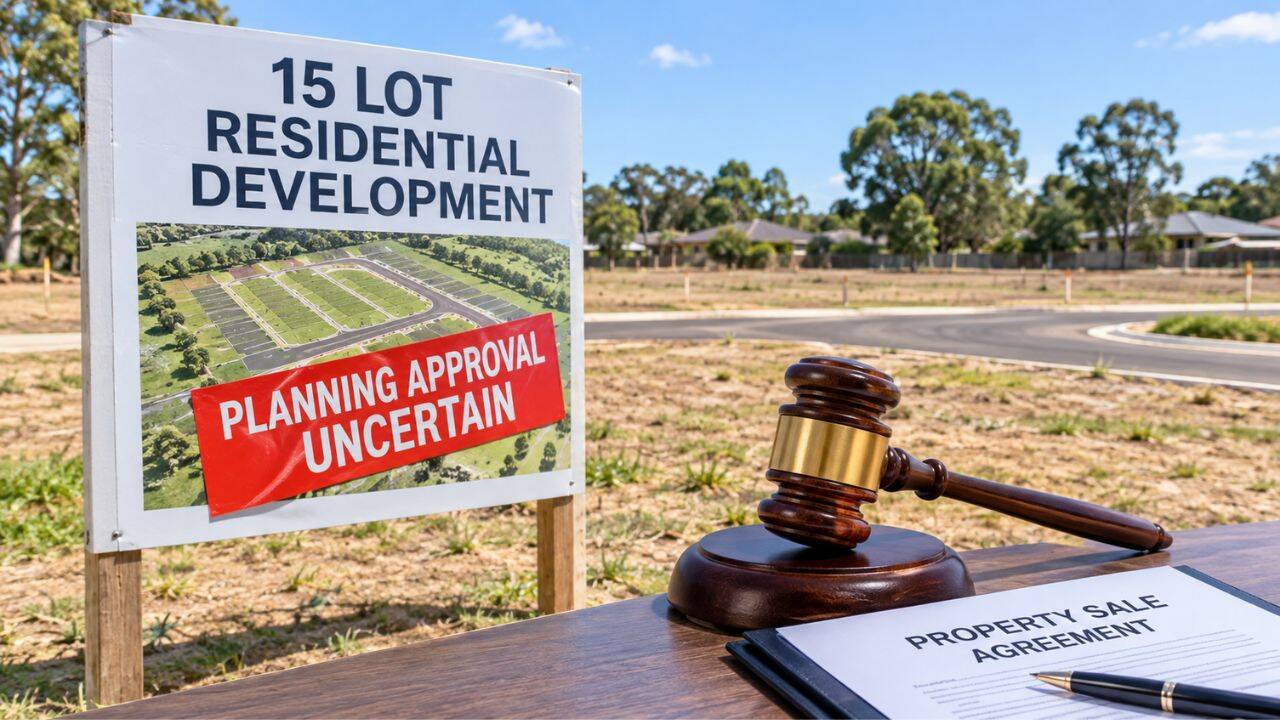
Everyone in the Australian property sector is popping champagne over a buyer rescuing a $220,000 deposit from a soured $2.2 million land deal.
They are celebrating a pyrrhic victory.
Mainstream property coverage frames these court wins as David slaying Goliath. A savvy purchaser spots a defect, pulls the ripcord, and walks away with their 10 percent deposit intact while the greedy vendor eats dust. That narrative sells clicks. It also bankrupts amateur developers and blinds commercial buyers to the brutal arithmetic of litigation.
Getting your deposit back in the Supreme Court after a two-year slugfest does not mean you won. It means you bled cash to stand still while inflation, legal fees, and lost opportunity cost quietly gutted your balance sheet.
The Lie of the "Protected" 10 Percent Deposit
Standard real estate wisdom treats the 10 percent deposit as a binary scoreboard. If the vendor keeps it, you lose. If you claw it back, you win.
I have sat across the table from seasoned syndicators and mid-tier developers who blew seven figures chasing "principles" on mid-sized dirt deals. On paper, they walked out of court vindicated. In reality, their internal rate of return was murdered before a single excavator touched the site.
Let's look at the actual mechanics of a $2.2 million land dispute in Australia. Under standard state-based contracts—whether you are dealing with the Law Institute of Victoria (LIV) general conditions, the REIQ contract in Queensland, or the Law Society of New South Wales standard form—a 10 percent deposit is held in trust as an earnest of performance.
When a dispute erupts over zoning, undisclosed easements, vendor disclosure statements (like a Section 32 in Victoria), or sunset clauses, that $220,000 freezes. Instantly.
Now do the math that the real estate press conveniently ignores:
- Direct Legal Burn: Taking a contested contract rescission all the way to a judgment in a state Supreme Court easily consumes $120,000 to $180,000 in solicitor and senior counsel fees. Even when a judge awards "party-party" costs to the winner, Australian courts typically only force the loser to reimburse 60 to 70 percent of your actual legal spend. You are instantly down $50,000 to $70,000 in unrecoverable solicitor-client costs.
- The Capital Trap: While $220,000 sits rotting in a statutory trust account earning negligible interest for 18 to 24 months, that equity is dead. For a commercial buyer leveraging at 70 percent LVR, $220,000 is the equity engine for a $730,000 acquisition—or the working capital needed to push a DA through council on another site.
- Management Drag: A senior executive or principal spending 150 hours briefing barristers, reviewing discovery affidavits, and attending mediation is not sourcing off-market sites.
If you spend $65,000 in unrecovered legal fees and lose two years of compounding equity velocity to save $220,000, you did not execute a masterclass in property law. You paid an expensive tuition fee for sloppy front-end risk management.
Why Buyers Actually End Up in Court Over Land Deals
The lazy consensus blames rogue vendors who hide material defects. Sometimes that is true. Vendors routinely try to offload contaminated fill, unapproved drainage works, or landlocked parcels with murky access rights.
Most of the time, however, a $2.2 million deposit dispute happens because the buyer treated a commercial land acquisition like buying a suburban three-bedroom house.
Buyers sign unconditional contracts under pressure from selling agents screaming about "other interested parties." They rely on a standard conveyancer charging $1,800 to skim a 200-page disclosure pack in forty-eight hours. They assume statutory vendor disclosure laws act as a safety net.
They do not.
In Australian property law, the ancient doctrine of caveat emptor—buyer beware—is alive, well, and ruthless. Statutory disclosure regimes only force a vendor to reveal specific, prescribed matters. If a risk falls outside those narrow statutory boxes, the vendor can sit there with a poker face while you sign your life away.
Imagine a scenario where a buyer agrees to pay $2.2 million for an infill development site based on a concept yield of twelve townhouses. The vendor provides a clean title search and standard planning certificates. Six weeks later, during detailed engineering, the buyer discovers a regional water authority trunk main running diagonally three meters below the surface. Moving it costs $450,000. Building over it is prohibited.
The vendor knew the pipe was there because a neighbor mentioned it three years ago, yet no formal easement was ever registered on the certificate of title.
Is the vendor guilty of statutory non-disclosure? Probably not. Is the buyer going to spend the next two years in court arguing equitable fraud, misleading or deceptive conduct under Section 18 of the Australian Consumer Law, or unilateral mistake just to get their $220,000 back?
Yes. And even if they win, their development pipeline just stalled for two years.
Dismantling the Myths Around Deposit Recovery
When deals go sideways, buyers ask the wrong questions. They ask, "Can I get my deposit back?"
The real question is: "Why did my contract allow the vendor to hold my capital hostage without a clear, unilateral exit trigger?"
Let's tear down the three biggest lies buyers believe when negotiating $2 million-plus land contracts.
1. "Section 52 of the Property Law Act (or equivalent) will save me."
In Victoria, Section 49(2) of the Property Law Act 1958 gives the court broad statutory discretion to order the return of a deposit where it would be inequitable for the vendor to forfeit it. Other states have comparable equitable relief mechanisms against forfeiture.
Relying on judicial discretion is not a strategy. It is a coin flip in a courtroom.
Courts hate rewriting commercial bargains. Judges consistently rule that if two commercial parties—or sophisticated individuals—sign a binding contract, equity will not intervene simply because the buyer made a bad commercial call or failed to run basic checks. To trigger relief against forfeiture, you generally have to prove unconscionable conduct, fraud, or a massive windfall to the vendor coupled with clean hands on your part. Proving that requires a full trial, cross-examination of witnesses, and catastrophic legal bills.
2. "A standard 'Subject to Due Diligence' clause is bulletproof."
Amateur buyers slap a generic three-line due diligence special condition onto the front page of a contract and think they are untouchable.
They are wrong.
poorly drafted due diligence clauses are litigation magnets. If your clause states the contract is conditional upon the buyer being "reasonably satisfied" with due diligence, you just handed the vendor a weapon. If you try to walk away because your feasibility numbers stopped working after interest rates ticked up, the vendor's lawyers will argue you acted subjectively, not "reasonably," and sue you for wrongful repudiation.
A commercial due diligence clause must be explicitly drafted as operating at the sole, absolute, and unfettered discretion of the buyer, with no obligation to provide reasons, and an automatic, self-executing refund mechanism directed straight to the stakeholder without requiring the vendor's written release.
3. "The real estate agent has to release the deposit if the deal crashes."
This misconception destroys cash flow faster than anything else.
Selling agents hold deposits as stakeholders, not as your personal bankers. The moment a vendor disputes your termination notice and threatens the agency with a lawsuit if they release the funds, the agent freezes. They will not touch that $220,000.
Under state trust account legislation, an agent facing competing claims will simply hold the money indefinitely—or pay it into court—until both parties sign a joint release or a judge hands down an order. The vendor uses your own $220,000 as leverage to force you into a painful commercial settlement. They know you need the cash. So they offer to give you back $150,000 today if you walk away and drop your claim.
Most buyers take the haircut just to stop the bleeding.
How Sharp Operators Structure $2M+ Land Deals
If you want to play in the multi-million-dollar land arena without funding a barrister's next holiday home in Byron Bay, stop trusting standard contract templates.
Here is the exact playbook institutional operators use to ensure they never fight a two-year court battle over a 10 percent deposit.
Replace the Cash Deposit with a Bank Guarantee or Deposit Bond
Never hand over $220,000 in hard cash on exchange if you can avoid it. Negotiate to secure the deposit via an unconditional Bank Guarantee from a Tier-1 Australian bank.
Why? Because your cash stays in your offset or working capital facility. More importantly, if a dispute arises over whether the vendor has the right to call on the guarantee, you can apply for an urgent interlocutory injunction to restrain the bank from paying out. While the injunction is pending, the vendor does not have your cash in their pocket, and you are not paying legal fees just to retrieve money you already own.
Split the Deposit into Tranches
If a vendor insists on cash, refuse to put 10 percent down on day one. Structure a two-stage deposit:
- Tranche 1 ($25,000 to $50,000): Paid on exchange to secure exclusivity during the due diligence period.
- Tranche 2 (Balance to 10%): Payable only upon the buyer waiving due diligence in writing and the contract becoming genuinely unconditional.
If you uncover a fatal flaw in week three—contaminated soil, a heritage overlay, or an impossible council crossover requirement—you walk away immediately. Even if a nuclear dispute breaks out over your exit notice, you are arguing over $30,000, not $220,000. Nobody goes to the Supreme Court over $30,000. The vendor folds, signs the release, and moves on.
Mandate Independent Stakeholder Escrow
Never allow a suburban real estate agency with a shaky trust account compliance history—or the vendor's own solicitor—to hold a six-figure deposit if you have the bargaining power to dictate terms. Specify in the special conditions that the deposit is held by a neutral, commercial escrow agent or your own solicitor's trust account, governed by strict, objective release triggers.
Audit What the Disclosure Pack Leaves Out
Before you waive a single condition, run a forensic checklist that goes far beyond what the vendor is legally forced to hand over:
- Dial Before You Dig (BYDA) & Asset Plans: Do not rely on the title diagram. Pull live utility asset maps for sewer, stormwater, high-pressure gas, and fiber trunks.
- Historical Aerial Imagery: Pull archives (Nearmap or state land registries) going back twenty years. Look for vanished industrial sheds, underground fuel tanks, or massive earthworks that signal uncompacted fill or asbestos dumping.
- Council Pre-Application Minutes: Never take a vendor's "concept scheme" at face value. If the vendor claims you can build 15 apartments, demand the written minutes from their pre-lodgement meeting with council statutory planners. If they never had one, price the land as if the concept scheme is fiction.
- Aboriginal Cultural Heritage Sensitivity: Check state overlays immediately. Triggering a mandatory Cultural Heritage Management Plan (CHMP) on a sensitive parcel can easily add nine months and $150,000 to your holding costs before you turn a single sod of dirt.
The Brutal Downside of Playing Hardball
Let's be completely honest about the trade-off here.
If you walk into a hot auction or a competitive expressions-of-interest campaign demanding a 2 percent initial deposit, a 30-day unfettered due diligence clause, and a bank guarantee, you will lose deals.
In a rising market, vendors hate conditional offers. They will take $2.15 million unconditional with a hard 10 percent cash deposit today over your $2.2 million conditional offer with a staged deposit. You will watch competitors snap up sites while your lawyers are still redlining special conditions.
That is the price of discipline.
Every seasoned developer eventually learns that the best deals they ever made were the ones they walked away from before signing. Getting out of a bad contract early costs you nothing but pride. Getting out of a bad contract two years later through a Supreme Court judgment costs you momentum, equity, and sanity.
Stop applauding buyers who survive two-year legal wars to rescue their deposits. Start firing the advisers who let them sign contracts where a rescue was ever necessary.