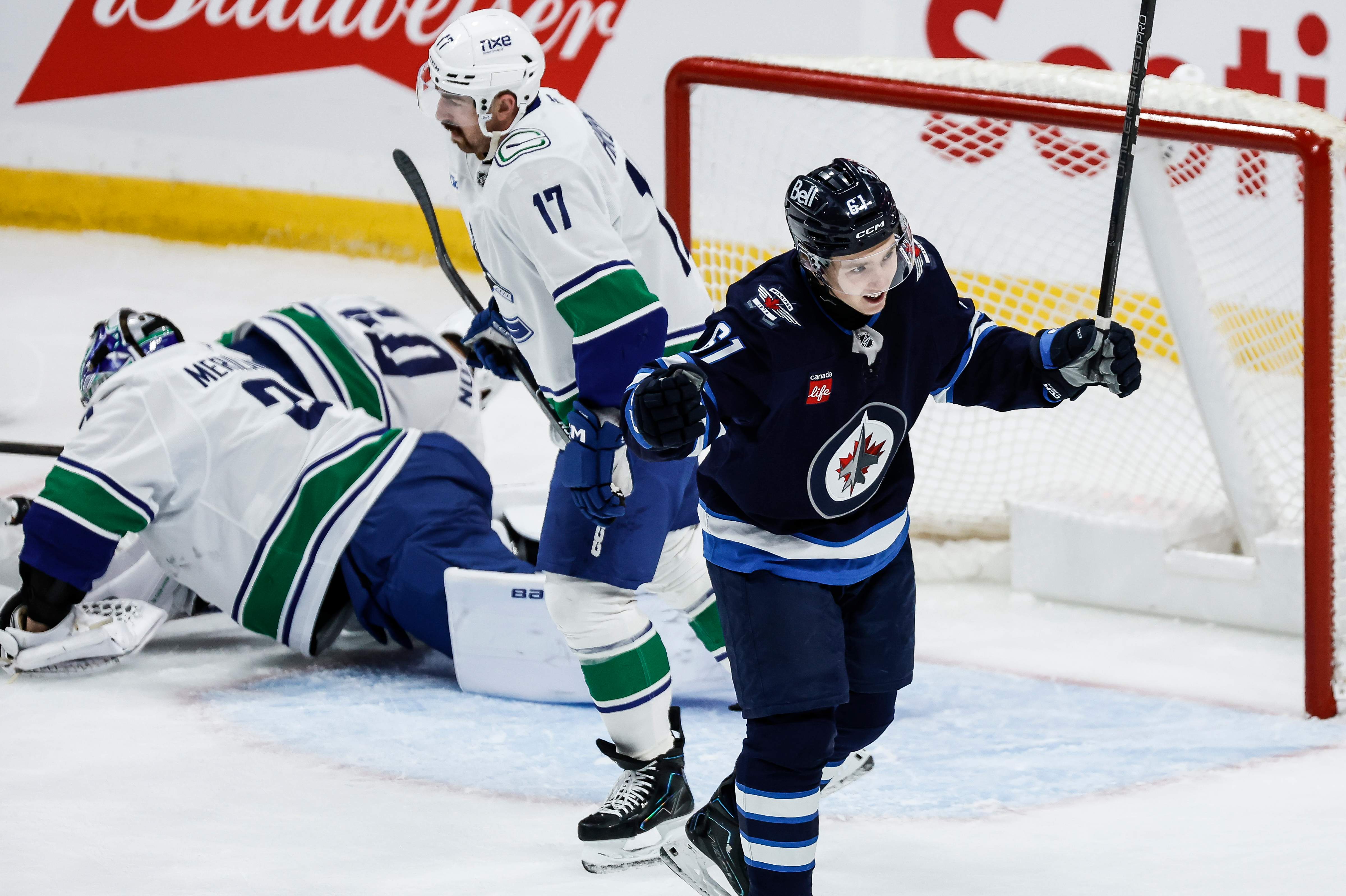
The Winnipeg Jets did not merely defeat the Vancouver Canucks 6-2 to secure their second consecutive victory. They systematically exposed the exact tactical, structural, and organizational vulnerabilities that separate legitimate Stanley Cup contenders from teams simply hoping to survive an eighty-two-game grind. While standard postgame recaps focus on box-score totals and highlight-reel goals, the true story of this lopsided result lies in neutral-zone suppression, goaltending insulation, and a ruthless transition game that left Vancouver chasing shadows for sixty minutes.
When a scoreline balloons to six goals against two, casual observers inevitably blame a bad night between the pipes or a handful of unlucky bounces. That explanation falls apart under scrutiny. In modern professional hockey, a four-goal margin between two Western Conference rivals is rarely an accident. It is almost always the direct consequence of systemic breakdown. Winnipeg dictated the tempo from the opening puck drop, turning Vancouver’s breakout patterns into predictable turnovers and converting those mistakes into high-danger scoring chances before the Canucks' defensive coverage could even set its feet.
The Anatomy of a Neutral Zone Chokehold
To understand how the Winnipeg Jets crushed the Canucks 6-2, you have to look at the middle fifty feet of the ice. Great teams do not wait until the puck enters their defensive zone to start defending. They suffocate plays before they develop, forcing opponents into low-percentage dump-ins that immediately surrender possession.
Winnipeg executed a layered 1-2-2 forecheck that completely neutralized Vancouver’s speed through the center of the rink. Whenever Vancouver’s defensemen looked up the ice for a stretch pass, their passing lanes were already occupied by active sticks and disciplined spacing. Forced to rim the puck around the boards, the Canucks repeatedly walked straight into physical pinching defensemen who held the offensive blue line with remarkable consistency.
Consider what happens in a hypothetical shift when a team loses control of the neutral zone. A defenseman retrieves a dumped puck under heavy pressure, makes a hurried pass up the strong-side wall, and watches an opposing winger intercept it at the hash marks. Within three seconds, the defending team is out of position, their center is caught below the goal line, and a cross-ice pass finds an unmarked shooter in the high slot. Multiply that sequence by twenty or thirty shifts over three periods, and a 6-2 blowout becomes a mathematical inevitability rather than a statistical fluke.
Vancouver’s inability to adjust to this pressure highlighted a glaring lack of tactical flexibility. Instead of utilizing short, quick support passes to bypass the first layer of Winnipeg’s forecheck, the Canucks persisted with long-bomb attempts that rarely connected. Each failed breakout drained their stamina, extended their defensive-zone shifts, and prevented their top offensive weapons from touching the puck in open space.
Transition Speed as a Weapon
Winning puck battles means very little if a team cannot capitalize on the resulting turnover. This is where Winnipeg’s roster construction shines brightest. The Jets do not rely on a single superstar line to generate offense; they roll four units capable of shifting from defensive posture to full-speed attack in a fraction of a second.
Once Winnipeg stripped the puck from Vancouver’s carriers, their forwards attacked the middle lane with relentless vertical speed. This forced Vancouver’s defensemen to back off their own blue line, conceding massive amounts of real estate at the top of the circles. With time and space to operate, Winnipeg’s playmakers picked apart a retreating penalty-kill-style formation even during five-on-five play.
The contrast in offensive philosophy was stark. Vancouver spent the night trying to manufacture offense from the perimeter, firing low-percentage wrist shots from near the boards that offered clear sightlines for the goaltender. Winnipeg, conversely, funneled everything toward the inner slot, utilizing screens, quick east-west puck movement, and relentless net-front traffic to turn routine shots into chaotic scrambles.
Goaltending Insulation Versus Goaltending Abandonment
Every veteran hockey analyst knows that goaltending statistics are frequently a mirage. A netminder’s save percentage tells you far more about the defensive structure in front of him than his individual athletic brilliance. The disparity between the two creases during Winnipeg’s 6-2 triumph provides a textbook case study in how team defense dictates goaltending outcomes.
In Winnipeg’s end, the defensive unit operated with a clear, non-negotiable mandate: protect the house at all costs. When Vancouver managed to establish zone time, the Jets collapsed into a tight, disciplined box that denied cross-seam passes and cleared rebounds before Canucks forwards could whack at loose pucks. Winnipeg’s goaltender faced plenty of rubber, yet the vast majority of those attempts came from outside the home-plate scoring area without lateral movement required prior to the release.
At the opposite end of the rink, Vancouver’s goaltending was effectively hung out to dry. Breakdowns in communication between defensemen and backchecking centers left the backdoor wide open on multiple occasions. No goaltender at the professional level can consistently stop back-to-back cross-crease one-timers when shooters have enough time to settle the puck, pick a corner, and fire uncontested. Blaming Vancouver’s netminders for surrendering six goals ignores the fundamental reality that they were asked to bail out catastrophic structural failures all evening.
| Performance Metric | Winnipeg Jets Approach | Vancouver Canucks Reality |
|---|---|---|
| Zone Entries | Controlled carry-ins through the middle lane | Forced dump-ins along the boards |
| Defensive Coverage | Tight slot protection and immediate rebound clearing | Chasing pucks into corners, leaving the backdoor open |
| Puck Support | Close-range outlets within ten feet of the carrier | Stretched formations creating massive passing gaps |
| Shot Selection | High-danger deflections and cross-slot one-timers | Perimeter wrist shots through unscreened lanes |
Why Consecutive Wins Signal a Dangerous Trend for the Division
Winning one dominant game in the middle of a grueling schedule is routine. Backing it up with a second straight decisive victory—especially against a familiar conference adversary—reveals something much deeper about a locker room’s psychological state and conditioning.
Momentum in professional hockey is notoriously fragile, often evaporating the moment a team gets comfortable with its own press clippings. The danger after a strong performance is subtle complacency: forwards cheating for offense, defensemen pinching recklessly, and detail work slipping by five percent. Winnipeg exhibited zero signs of that mental letdown against Vancouver. Their commitment to blocking shots in the third period while holding a commanding multi-goal lead demonstrated a level of professional maturity that separates genuine championship contenders from pretenders.
For the rest of the Western Conference, this two-game surge serves as an uncomfortable warning. Teams built around speed and finesse hate playing against heavy, structured opponents who refuse to give up easy ice. When Winnipeg plays to its identity, every square foot of the rink feels congested. Opposing stars get frustrated, take retaliatory penalties, and abandon their team systems in search of individual heroics. Vancouver fell directly into that trap during the second half of the contest, compounding their structural issues with undisciplined turnovers born out of pure desperation.
The Illusion of Roster Parity
Modern salary cap mechanics are designed to create parity across the league, theoretically ensuring that any team can beat any other team on a given night. In practice, however, parity often masks profound gaps in organizational depth and coaching execution.
When you strip away the marketing narratives, you see that successful franchises win on the margins. They win because their fourth-line center understands how to win a defensive-zone faceoff cleanly. They win because their third-pairing defenseman makes a crisp, tape-to-tape outlet pass under forechecking pressure rather than icing the puck. Winnipeg’s 6-2 victory over Vancouver was built entirely on those unglamorous, foundational habits.
Vancouver’s roster possesses undeniable top-end talent, capable of dazzling highlights when afforded room to breathe. Yet talent without structure is easily neutralized by a cohesive unit willing to outwork its opponent in the dirty areas of the ice. Until the Canucks address their defensive-zone exits and their willingness to absorb physical contact to make plays, they will remain vulnerable to heavy, disciplined clubs like Winnipeg.
What Vancouver Must Fix Before the Next Rematch
A loss of this magnitude leaves scars, both in the standings and in the video room. For Vancouver’s coaching staff, the film session following a 6-2 defeat cannot simply be brushed aside as an anomaly. If they treat this result as a one-off bad night, they guarantee a repeat performance the next time these two clubs share the ice.
First, Vancouver must overhaul its breakout support. Defensemen cannot be left on an island while three forwards fly the zone prematurely. Wingers need to curl back deeper into their own end, offering short, high-percentage passing targets that allow the team to exit the zone as a connected five-man unit. Breaking pressure requires patience and short passes, not blind hope up the boards.
Second, the Canucks need a massive recalibration in their net-front urgency. Too often during the loss to Winnipeg, Vancouver’s defenders watched the puck rather than tying up sticks in front of their own crease. In a league where deflections and rebounds account for a massive percentage of goals scored, allowing opposing forwards to camp unobstructed at the top of the blue paint is a death sentence.
Finally, there is the question of competitive response. When a team falls behind by two or three goals early, its collective body language tells you everything about its internal resilience. Against Winnipeg, Vancouver’s frustration manifested in disjointed individual rushes rather than a unified commitment to grinding their way back into the game shift by shift.
The Unforgiving Reality of Western Conference Hockey
There are no easy nights left in the Western Conference, and there are certainly no moral victories to be salvaged from a four-goal drubbing. Winnipeg’s 6-2 dismantling of the Canucks was a masterclass in modern, two-way hockey—a clinic in how disciplined structure, relentless puck pursuit, and clinical finishing can turn a competitive matchup into a one-sided rout.
The Jets walked off the ice with two crucial points and the unmistakable aura of a team that knows exactly who it is and how it needs to win. Vancouver left with a mountain of unanswered questions and the sobering realization that raw skill will never be enough to overcome a fundamental lack of defensive cohesion. In a conference decided by razor-thin margins come spring, the gap between these two organizations looks wider than ever.