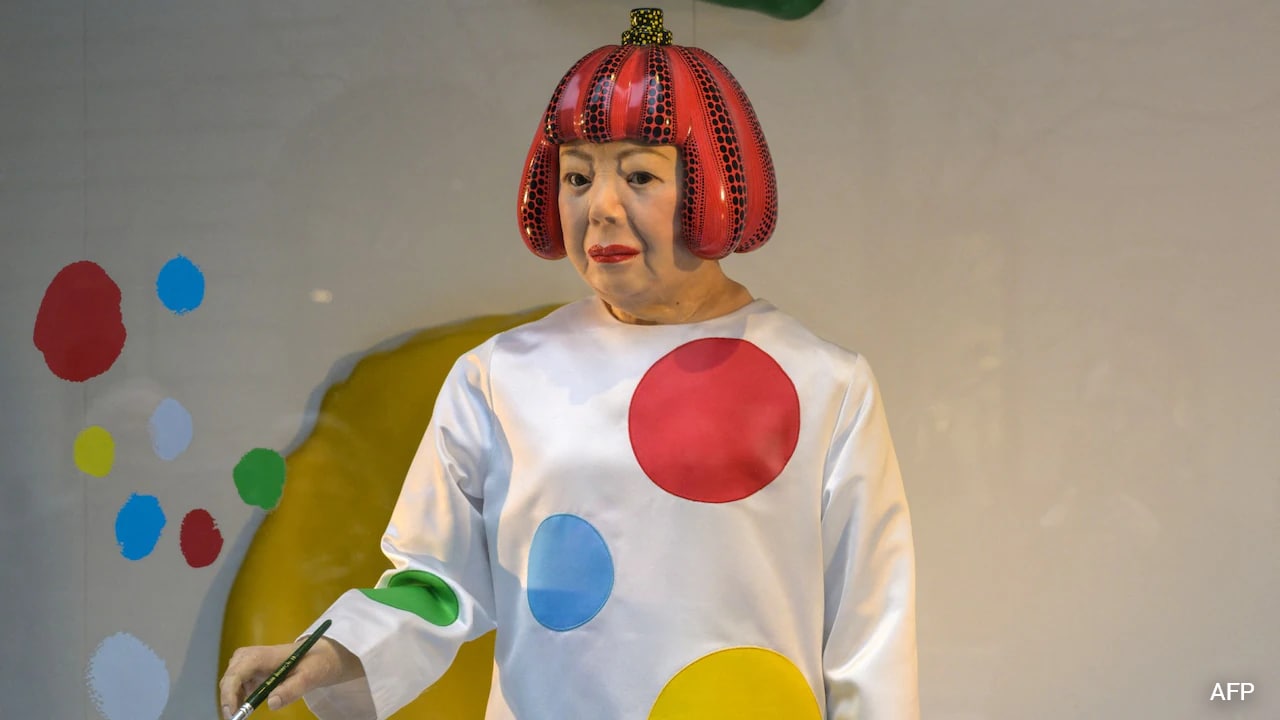
Long before her polka dots swallowed city blocks, before museums built white cathedrals just to house her infinite reflections, there was only a little girl in Matsumoto, Japan, sitting in the suffocating quiet of a plant nursery.
Imagine, if you must, the smell of rotting peony stems and damp hothouse soil. To the child, Yayoi Kusama, those flowers were not pretty decorations. They were breathing. They were multiplying. They were screaming at her.
She would sit among the fields of her family’s seed farm, staring at the petals, watching the blooms dissolve into thousands of spots that danced across her vision. Then, she would look up, and those same dots would coat the ceiling, the table, her own trembling hands. The world was disappearing beneath a relentless tide of circles.
She did what any terrified child would do. She ran. She grabbed a piece of paper and a pencil, and she began to copy what she saw. She trapped the dots on the page. If she could draw them, maybe they would stop eating her alive.
She spent nearly a century doing precisely that.
The Long War with Infinity
Art history loves to sanitize its geniuses. We prefer our creators neat, packaged in tidy biographies that end in triumphant retrospectives. But Kusama’s life was never a tidy narrative. It was an ongoing rescue mission.
For decades, the art world treated her like a colorful novelty. In the 1960s, she moved to New York City, a fierce, tiny silhouette in a sea of towering male abstract expressionists and pop artists. While Andy Warhol and Claes Oldenburg reaped fame and fortune, Kusama was quietly watching her aesthetic ideas migrate onto their canvases. She staged Happenings in Central Park, painting polka dots onto naked bodies to protest the Vietnam War, freezing in the damp grass while the police closed in.
She was brilliant. She was exhausted. She was constantly broke.
By the 1970s, broken by the relentless grind of the art world and her own fracturing psyche, she returned to Japan. She did not retreat to a quiet countryside estate. Instead, she checked herself into the Seiwa Hospital for Mental Illness in Tokyo. She has lived across the street from that hospital ever since, walking over every morning to her studio, and returning every evening to her room.
The hospital became her anchor. The studio became her church.
For a long time, the public forgot her. The dots vanished from the cultural conversation. But Kusama did not stop painting. Day after day, year after year, she stood before her canvases, applying dot after microscopic dot, waging a silent war against the void.
When the World Caught Up
Then came the mirrors.
If you have ever stood inside one of her Infinity Mirror Rooms, you know the strange, vertiginous jolt of stepping off the edge of the earth. The walls vanish. The floor disappears. You are suspended in a glittering, boundless cosmos of your own reflection, repeated infinitely into the dark.
When those installations burst back into global consciousness in the 2010s, they became a sensation for the digital age. Millions lined up for hours, clutching smartphones, eager to step inside her hallucinations for thirty seconds of transcendent isolation.
Some critics dismissed it as Instagram bait. They were wrong.
Those rooms are not designed for social media feeds. They are architectural blueprints of Kusama’s mind. For ninety-seven years, she lived inside a skull where the walls closed in and the boundaries of the self dissolved into a terrifying expanse. By building these mirrored chambers, she invited us inside her private terror. She transformed her psychiatric diagnosis into a shared playground. She took her worst nightmare and made it beautiful enough for strangers to weep inside it.
She showed us that the things that break us can also be used to build a universe.
The Final Dot
Now, the news has arrived from Tokyo. Yayoi Kusama has died at the age of ninety-seven.
The galleries will dim their lights. The auction houses will appraise the final canvases. Pundits will write sprawling obituaries about her influence on contemporary installation art, her record-breaking ticket sales, her enduring legacy as the polka dot queen.
None of that captures what she actually gave us.
Consider what happens when a human being spends an entire lifetime staring directly into the abyss, refusing to blink, refusing to look away, until the abyss finally blinks first.
She did not conquer her illness by pretending it did not exist. She outpainted it. She filled the silence with spots, covering the tables, the chairs, the pumpkins, the water, and the sky, until there was no room left for the dark.
At ninety-seven, her hands may have finally slowed. The brush has slipped from her fingers for the very last time. But somewhere out there in the quiet galleries of the world, a child is stepping into a mirrored room, gasping as the lights stretch out forever, entirely unaware of the lonely little girl in the nursery who had to draw a million dots just to survive the night.
The lights go on and on, long after the artist has laid down her brush.