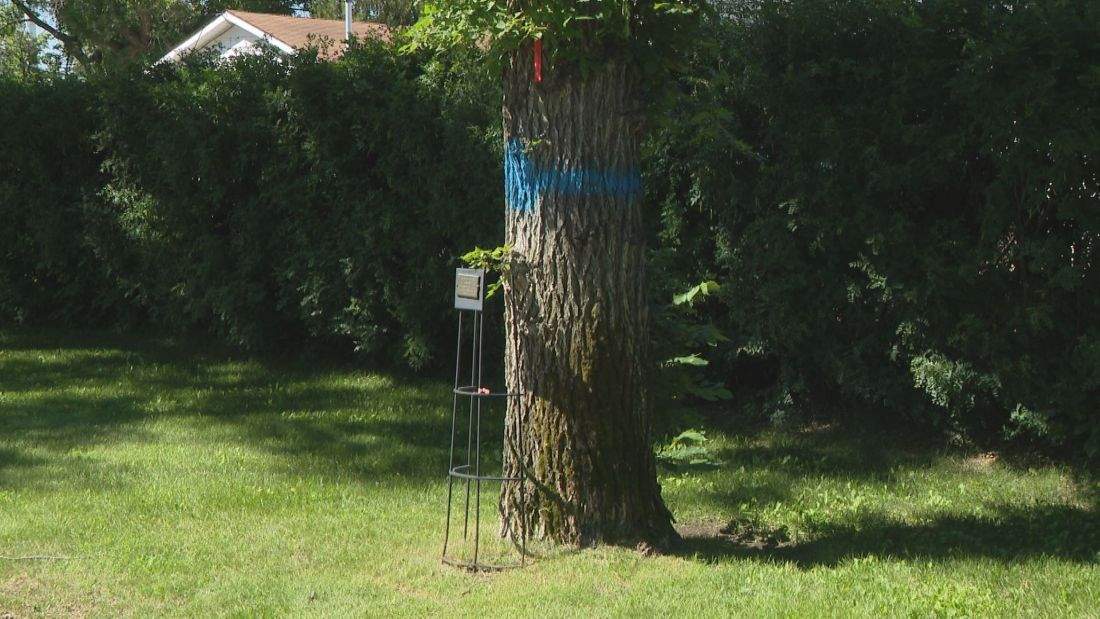
Saskatoon municipal arborists have marked a prominent, century-old American elm on Woodlawn Cemetery’s historic Next of Kin Memorial Avenue for immediate destruction. The diagnosis is Dutch Elm Disease, a highly infectious fungal pathogen that leaves city foresters with no choice but to cut the tree down. While city officials present this as an isolated, routine maintenance action to protect the remaining canopy, the loss of this memorial tree exposes a much deeper crisis. It reveals the fragile state of our aging urban forests, the biological vulnerabilities of historic monoculture plantings, and the chronic underfunding of heritage preservation.
The Next of Kin Memorial Avenue is not just a collection of shade trees. Established in 1923 and designated a National Historic Site in 1993, this avenue stands as a living monument to Saskatchewan’s fallen soldiers from the First World War and subsequent conflicts. Each tree represents a life cut short. When one of these trees is cut down, a piece of our collective memory is physically erased. Meanwhile, you can explore other developments here: The Geopolitical Cost Function: Deconstructing the Postponement of the Netanyahu-Trump Summit.
To understand why this tree is dying, we must look beneath the soil and behind the closed doors of municipal budget meetings.
The Monoculture Time Bomb of the 1920s
Urban planners in the early twentieth century loved the American elm. It grew quickly, tolerated compacted city soils, and formed a magnificent, cathedral-like arch over streets and walkways. This aesthetic preference led to massive monocultures. Millions of elms were planted in virtually every major Canadian city, creating a uniform green canopy that seemed permanent. To understand the complete picture, we recommend the detailed article by Al Jazeera.
It was a catastrophic ecological mistake.
When you plant miles of the same species, you create an uninterrupted highway for pests and pathogens. Dutch Elm Disease, caused by the fungus Ophiostoma novo-ulmi, spreads primarily through two vectors. The first is the elm bark beetle, which carries fungal spores from tree to tree. The second, and far more insidious, is root grafting.
Underneath the manicured lawns of Woodlawn Cemetery, the root systems of these historic elms do not remain separate. They touch, fuse, and share resources.
They also share disease.
Once the fungus enters one tree, it can travel through these underground root grafts directly into the vascular system of neighboring trees. What looks like a stately row of individual memorials is actually a single, interconnected organism. A pathogen introduced at one end of the avenue can quietly migrate underground, bypassing any surface-level chemical spraying or pruning.
The Anatomy of a Slow Suffocation
The public often notices Dutch Elm Disease only when a tree's leaves begin to yellow and wilt in mid-summer, a symptom known as flagging. By then, the damage is already done.
The fungus attacks the tree's xylem, the internal plumbing system responsible for transporting water and nutrients from the roots to the canopy. In response to the fungal invasion, the tree attempts to block the pathogen by producing tyloses, which are balloon-like outgrowths that plug its own vascular tubes.
The tree essentially suffocates itself in a desperate bid to stop the infection.
For a historic monument, this death is undignified. Within weeks, branches die, the bark begins to peel, and the wood becomes a breeding ground for the next generation of disease-carrying beetles.
Municipal policy dictates immediate removal and disposal. Wood from infected elms cannot be kept for firewood, stored, or repurposed without strict sterilization. It must be buried in designated landfill sites or burned immediately. The physical legacy of a soldier’s memorial is reduced to ash or buried garbage in an afternoon.
The Cost of Reactive Forestry
Municipalities across the Canadian Prairies are perpetually trapped in a cycle of reactive forestry. They allocate resources to remove dead and dying trees rather than investing in the intensive, long-term care required to keep heritage canopies alive.
Proactive management of Dutch Elm Disease exists, but it is expensive.
Systemic fungicide injections, such as Arbotect, can protect high-value heritage trees. These injections must be administered by trained professionals every two to three years. The process involves drilling small holes into the root flare of the tree and infusing hundreds of liters of fungicide under low pressure.
For a single mature elm, a single treatment can cost upwards of a thousand dollars.
When scaled across the hundreds of historic trees lining the Next of Kin Memorial Avenue, the annual cost quickly exceeds what municipal taxpayers are willing to fund. Consequently, cities reserve these treatments for a select few showcase trees, leaving the rest of the canopy to rely on basic pruning and luck.
When luck runs out, the chainsaws come out.
The Climate Factor Forcing the Beetle's Hand
We cannot discuss the decline of Saskatoon’s heritage trees without addressing the shifting climate patterns of Western Canada.
Historically, the brutally cold winters of the northern plains acted as a natural check on elm bark beetle populations. Sustained temperatures below minus thirty degrees Celsius kill overwintering beetle larvae hiding beneath the bark.
Those deep, prolonged freezes are becoming less frequent and shorter in duration.
With warmer winters, a higher percentage of beetles survive to the spring. They emerge earlier, feed longer, and produce larger populations. The fungus they carry spreads faster and further. The geographic buffer that once protected Saskatchewan's elms from the devastation seen in Eastern Canada and the United States is rapidly eroding.
At the same time, hotter, drier summers stress mature trees, reducing their natural ability to produce resin and ward off beetle attacks. A thirsty tree is a defenseless tree.
The Myth of Simple Replacement
When a historic tree is cut down, city spokespeople often soothe the public by promising to plant a replacement. This promise, while well-intentioned, ignores the realities of modern urban arboriculture.
You cannot simply swap a one-hundred-year-old elm for a sapling and call it even.
A mature elm provides immense ecological benefits. It cools the local microclimate, intercepts thousands of gallons of rainwater, and supports complex insect and bird populations. A newly planted sapling, often of a different, more resilient species like hackberry or disease-resistant hybrid elm, will take decades to provide a fraction of those benefits.
Furthermore, the soil in a century-old cemetery is often depleted of nutrients and compacted by decades of foot traffic and heavy maintenance equipment.
New saplings face incredibly high mortality rates. They lack the established, deep root networks of their predecessors and are highly vulnerable to drought, vandalism, and winter burn. The immediate visual and historical continuity of the memorial avenue is permanently fractured.
We are replacing giants with twigs, hoping they survive long enough for our grandchildren to see them reach maturity.
The Hidden Threat of Soil Contamination
There is another, rarely discussed consequence of removing infected trees from historic sites.
When an elm is removed due to Dutch Elm Disease, the fungus can persist in the remaining root system for years. If a new tree of the same or a closely related species is planted in the same spot, its roots may eventually find and graft onto the old, infected root system.
The new tree is infected before it even has a chance to establish itself.
To prevent this, foresters must sometimes use trenching equipment to cut root connections between the infected stump and surrounding healthy trees before the diseased tree is pulled down. This process is highly disruptive. In a historical cemetery like Woodlawn, trenching threatens to disturb old grave sites, historical markers, and the roots of other healthy, non-infected tree species nearby.
The logistics of removal become a delicate, stressful operation where one wrong move can damage the very history the city is trying to preserve.
Redefining Heritage Preservation
We readily spend millions of dollars to restore crumbling stone facades, historic train stations, and bronze statues. Yet, we treat our living heritage as disposable assets that can be managed through simple extraction when they become inconvenient or diseased.
This approach must change.
If we value the Next of Kin Memorial Avenue as a National Historic Site, we must fund its maintenance with the same seriousness we apply to structural monuments. This means establishing dedicated heritage tree preservation funds, independent of standard municipal park maintenance budgets. It means implementing mandatory, systemic fungicide treatments for all remaining trees on the avenue, regardless of the cost.
It also means accepting that the monoculture must end.
As the historic elms inevitably die, we cannot replant them in neat, identical rows of a single species. We must introduce diversity, planting a mosaic of species that can resist pests while maintaining the physical form of the avenue. It will look different. The perfect symmetry of the 1920s design will be lost.
But the alternative is a barren, treeless field where a living monument once stood.
The chainsaws at Woodlawn Cemetery are a warning. The loss of this single memorial tree is not merely an unfortunate consequence of nature. It is a direct result of historical design flaws, shifting environmental pressures, and a collective failure to fund proactive environmental stewardship.
We can continue to watch our history fall one tree at a time, or we can commit the resources necessary to defend what remains of our living past.

:max_bytes(150000):strip_icc()/master-bedroom-in-new-luxury-home-with-chandelier-and-large-bank-of-windows-with-view-of-trees-1222623844-212940f4f89e4b69b6ce56fd968e9351.jpg)