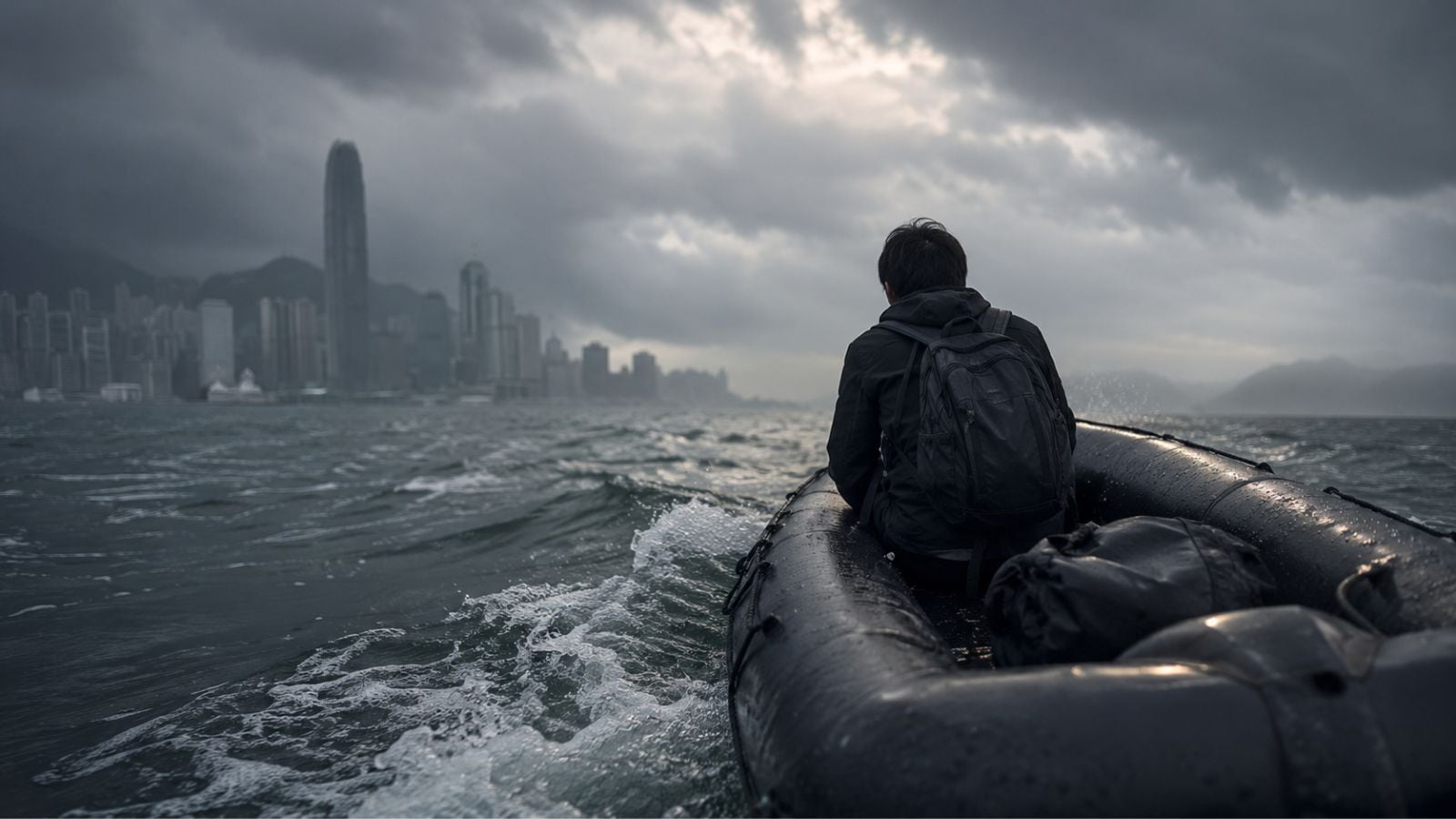
A 68-year-old Chinese political dissident, Dong Guangping, is currently in South Korean custody after surviving a treacherous 30-hour sea crossing on a small rubber boat to escape Beijing's surveillance state. Found drifting near a western South Korean island after his vessel's engine failed, Dong was detained by the coast guard for entering the country without authorization. While a local court recently denied a formal arrest warrant, citing insufficient necessity for physical detention, Dong remains caught in a complex bureaucratic and diplomatic limbo. He faces potential indictment or transfer to an immigration detention facility while he waits to see if Seoul will allow him safe passage to Canada, where his wife and daughters reside, or return him to the country he risked his life to flee.
This high-stakes maritime escape is not an isolated act of desperation. It exposes a growing, highly dangerous maritime corridor used by targeted Chinese dissidents who find themselves entirely choked out of the mainland's aviation networks by state-enforced exit bans. You might also find this related story useful: The Invisible Walls of Modern Conflict.
The Mechanics of an Extreme Escape
To understand why a man nearing 70 would push a 3.3-meter inflatable rubber boat into the unpredictable open waters of the Yellow Sea, one must understand the absolute finality of a Chinese exit ban. Under China's sweeping national security laws, individuals flagged for political dissent are permanently barred from purchasing commercial airline tickets or passing through official border checkpoints. The digital gridlocks are total.
Dong set off from the coastal city of Weihai in China's eastern Shandong province, a geographic projection that sits closest to the South Korean peninsula. As extensively documented in recent articles by Associated Press, the results are widespread.
The journey was brutal. According to accounts shared by his close associates, Dong spent more than 30 hours fighting intense sea winds, went without sleep for over 50 hours, and was on the verge of fainting from exposure when his boat neared the coastal town of Taean. The small engine on his inflatable craft cut out just as he reached South Korean waters, leaving him at the mercy of the tides until local fishermen spotted the vessel and alerted authorities.
This specific nautical route from Shandong to Western South Korea is becoming a harrowing pattern for those with no other options left. In August 2023, another high-profile Chinese activist, Kwon Pyong, undertook an equally extreme journey. Kwon crossed roughly 300 kilometers of open ocean on a 1,800cc jet ski, towing five 25-liter fuel tanks behind him, navigating solely with a compass and binoculars before running aground in the mudflats near Incheon.
These are not calculated, high-probability migrations. They are life-or-death gambles executed with minimal equipment, where a single engine stall or an unexpected squall means drowning in the open ocean.
Decades of Dissent and the Failure of Traditional Safe Havens
Dong’s flight across the Yellow Sea was his fourth attempt to permanently escape the reach of Chinese security services. His history of activism stretches back more than two decades, beginning in 1999 when he was dismissed from his position as a police officer after signing a public letter marking the 10th anniversary of the Tiananmen Square crackdown.
What followed was a repetitive cycle of state retaliation:
- 2001: Sentenced to three years in prison for "inciting subversion of state power."
- 2014: Detained for eight months following his participation in a private memorial service for Tiananmen victims.
- 2015: Fled overland to Thailand with his family and secured official UN refugee status. However, Thai authorities chose to deport him back to China, where he was handed another three-and-a-half-year prison term.
- 2019: Attempted to swim across the narrow channel to the Taiwan-controlled island of Kinmen, but was intercepted by Chinese fishermen and returned to police custody.
- 2020: Crossed secretly into Vietnam, hiding for two years before being arrested by local police and deported back to China yet again, resulting in an 11-month prison sentence that ended in late 2023.
Dong's trajectory highlights a grim reality for Chinese dissidents in Southeast Asia. Neighboring nations like Thailand, Vietnam, and Laos, which once served as viable overland pipelines to the West, have steadily capitulated to bilateral pressures from Beijing. Transnational repatriations are now common practice. For activists trapped behind an exit ban, the porous land borders of Southeast Asia have transformed into diplomatic traps, forcing them to look toward the hazardous northern maritime routes instead.
The Cold Diplomatic Reality in Seoul
South Korea now finds itself holding a hot potato it did not ask for. While human rights groups like Human Rights in China are publicly calling on Seoul to respect humanitarian principles, South Korea’s track record with asylum seekers is notoriously strict. The country's historical acceptance rate for refugee applications consistently hovers below 2 percent.
South Korea signed an extradition treaty with China in 2002. While the treaty includes clauses that protect individuals fleeing purely political persecution, the legal process in Seoul is heavily influenced by broader geopolitical calculations. Fully protecting or granting asylum to high-profile Chinese dissidents risks direct diplomatic blowback from Beijing, a major economic partner.
The precedent set by Kwon Pyong’s jet ski escape in 2023 offers a glimmer of hope for Dong, but it is far from a guarantee. Kwon was held in a South Korean detention center for several months and faced harsh prosecution under local immigration control laws before diplomatic maneuvering behind the scenes eventually allowed him to resettle in the United States.
The South Korean Ministry of Justice has indicated it will formally review Dong's case if he applies for refugee status. The local court's refusal to issue an immediate arrest warrant suggests the judiciary is exercising caution, recognizing that Dong is not a typical undocumented migrant or human smuggler. However, until a final administrative decision is reached, he remains locked within a bureaucratic holding pattern, a stark reminder that escaping the shores of the mainland is only the first half of a dissident's battle.