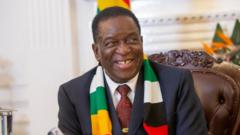
Emmerson Mnangagwa is not going anywhere anytime soon. If you thought Zimbabwe was on a slow march toward democratic normalcy, the legislative fireworks in Harare just shattered that illusion. On June 18, 2026, the country’s lower house of parliament quietly dismantled a core pillar of the 2013 constitution, voting overwhelmingly to stretch presidential terms from five to seven years.
The immediate fallout is obvious. This legislative maneuver pushes the next scheduled election from 2028 out to 2030. It hands the 83-year-old president, known universally as "The Crocodile," two extra years in power. But the real kicker is how the president will be chosen going forward. The bill scraps the direct popular vote entirely, transferring the power to elect the head of state to lawmakers instead.
This isn't a minor regulatory tweak. It’s a profound shift in how power operates in southern Africa, and it highlights a broader, troubling trend across the continent. While the African population grows younger by the day, its rulers are getting older and holding onto power longer.
The Anatomy of a Constitutional Rewrite
To understand how Zimbabwe reached this point, you have to look at the numbers from the parliamentary vote. The National Assembly needed 187 votes to secure the two-thirds majority required for constitutional alterations. They cleared that bar easily, with 216 lawmakers voting in favor of Constitutional Amendment Bill No. 3.
Only 42 lawmakers opposed the draft legislation. Intriguingly, 35 opposition members from the Citizens Coalition for Change actually crossed the aisle to vote with the ruling ZANU-PF party. That fragmentation within the opposition tells you everything you need to know about the current political state in Zimbabwe. The ruling party doesn’t just hold power; they have effectively fractured the mechanisms meant to check them.
The bill now heads straight to the Senate. Nobody expects a fight there. ZANU-PF holds an iron grip on the upper house, bolstered by traditional leaders and political proxies who historically vote in lockstep with executive dictates.
Supporters of the amendment, including Justice Minister Ziyambi Ziyambi, claim the changes are meant to protect policy continuity. The official narrative says five years is simply too short to implement massive infrastructure and economic development programs. They argue that longer terms cut down on the polarizing, expensive election cycles that frequently paralyze the country.
But let's be honest. Very few people outside the ruling elite buy that explanation. Critics and civil society groups see the bill as a blatant power grab designed to ensure Mnangagwa’s political survival without facing the unpredictability of a regular ballot box.
From Mugabe to the Crocodile
You can’t make sense of Mnangagwa’s current trajectory without looking back at how he took office. He assumed power in November 2017 following a military intervention that ended Robert Mugabe’s 37-year rule. For decades, Mnangagwa served as Mugabe’s right-hand man, managing internal security and holding various high-level cabinet positions, including vice president. When the two fell out in late 2017, the military stepped in, ousted Mugabe, and installed Mnangagwa.
When he took the oath of office, Mnangagwa promised a new dispensation. He spoke about economic openness, democratic reforms, and a break from the repressive tactics of the Mugabe era. He declared Zimbabwe "open for business."
Fast forward to 2026, and those promises ring hollow. While the economy shows pockets of growth, ordinary Zimbabweans still face brutal daily hardships, currency instability, and deep poverty. Meanwhile, the political playbook looks remarkably familiar.
Signs that the president wanted to extend his stay beyond the original 2028 limit emerged years ago. At ZANU-PF rallies, loyalists regularly chanted slogans demanding more time for the leader to finish his work. By February 2026, the cabinet officially backed the plan, setting the stage for the recent parliamentary vote.
Activists and liberation war veterans tried to stop the train before it left the station. They launched multiple legal challenges in the High Court, arguing that changing the rules mid-game violates the spirit of the constitution. They pointed out that the 2013 constitution explicitly prevents an incumbent from benefiting from an extension of term limits. Yet, just days before the vote, the courts threw out those cases on technicalities, clearing the runway for parliament to act.
Dropping the Popular Vote
The shift from a direct popular vote to a parliamentary selection process is the most radical part of this legislation. Under the new framework, the president will be elected by a joint sitting of the Senate and the National Assembly.
Think about what this actually means for the average Zimbabwean citizen. It effectively removes their voice from the highest office in the land. In a country where parliamentary elections are heavily influenced by rural patronage systems, state media dominance, and targeted intimidation, controlling parliament guarantees control of the presidency.
Local activists argue this completely hollows out the country's fragile democracy. Obert Masaraure, head of the Amalgamated Rural Teachers' Union of Zimbabwe, publicly warned that the amendment strips away the last remnants of citizen accountability. If a president no longer needs to campaign for the votes of ordinary people, their incentive to address public suffering evaporates.
State consultations on the bill were similarly controversial. A parliamentary committee report claimed that over 99 percent of public submissions supported the amendments. Human rights monitors laugh at that statistic. They documented widespread intimidation and violence during the public hearings, noting that state security apparatuses routinely silenced dissenting voices.
The Continental Trend of Aging Rulers
Zimbabwe’s political shift isn't happening in a vacuum. It reflects a wider pattern across Africa where long-serving leaders rewrite the rules to stay in office.
Consider the stark demographic contrast defining the continent today. Africa has the youngest population in the world, with a median age of around 20 years. Over 60 percent of the population is under the age of 30. Yet, many of its heads of state are octogenarians. At 83, Mnangagwa fits right into this club.
Leaders in nations like Cameroon, Uganda, and Ivory Coast have successfully altered or bypassed constitutional limits to prolong their tenures. Paul Biya of Cameroon has ruled since 1982, and Yoweri Museveni of Uganda has held power since 1986. They create systems where political succession is treated as a national security threat rather than a routine democratic process.
There are exceptions. Senegal recently elected 44-year-old Bassirou Diomaye Faye, proving that peaceful democratic transitions are possible. But in many parts of the continent, the avenues for younger generations to access real political power remain tightly shut. Young people are mobilized to march in rallies and cast ballots, but they are excluded from the actual halls of governance.
What Happens Next on the Ground
If you are a business owner, an investor, or a citizen living in Zimbabwe, this legislative shift alters your long-term planning. The illusion of a transitional democracy is gone. The current political structure is locking itself in for at least the next four years, and likely well beyond.
For the international community, the vote complicates diplomatic re-engagement efforts. Western nations have kept sanctions on specific Zimbabwean officials for years, citing human rights abuses and electoral flaws. This latest move signals that the administration in Harare is prioritized on internal political control over international approval.
If you want to track where Zimbabwe goes from here, stop looking at the standard election cycles. The traditional 2028 election milestone is gone. Instead, focus your attention on the internal dynamics of ZANU-PF and the impending Senate vote. Watch how civic groups react to the closure of legal and electoral avenues. With court challenges dismissed and parliament under executive control, the struggle for accountability shifts entirely to civil society, local labor unions, and independent grassroots movements. They face a steep uphill battle against an administration that just codified its longevity into law.


