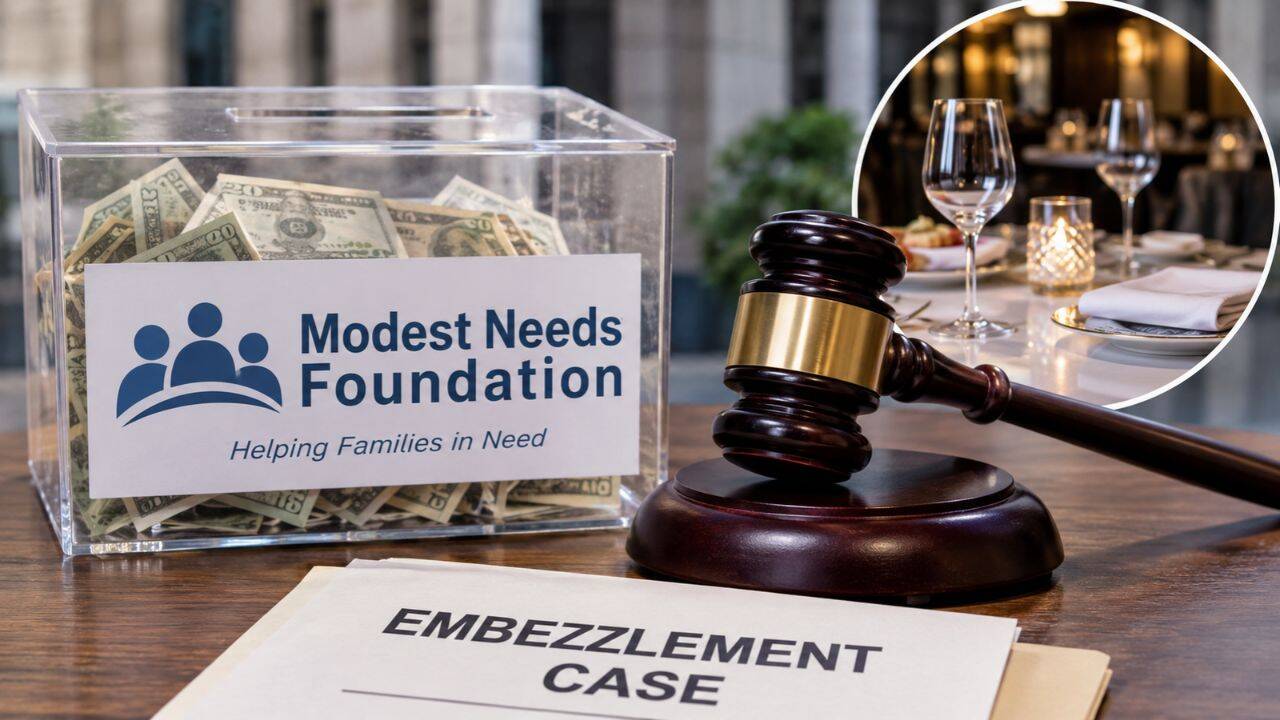
The clink of crystal stemware sounds remarkably like loose change dropping into a cardboard box.
If you sit in the corner booth of a Michelin-starred restaurant at nine o'clock on a Tuesday evening, you can almost hear the arithmetic happening in real time. A sommelier uncorks a vintage Bordeaux. A waiter sets down a plate of seared Wagyu beef, glistening under warm recessed lighting. Across town, or perhaps three thousand miles away, a fluorescent bulb flickers in a community clinic waiting room where the heater has been broken since November.
When federal prosecutors unsealed the indictment detailing how a prominent charity founder siphoned millions of dollars from public and private donations—burning through $320,000 on lavish dining trips alone—the headlines treated it like a standard white-collar tally. Numbers in a ledger. A cold recitation of wire transfers, shell companies, and luxury receipts.
Numbers, however, are an anesthetic. They numb us to the physical reality of theft.
Three hundred and twenty thousand dollars is not an abstract figure. It is an exact weight. It is the precise mass of thousands of warm meals never served, dozens of medical screenings never scheduled, and the quiet, suffocating despair of families who trusted a name printed on a glossy fundraising brochure.
To understand what actually happens when an executive treats a charitable endowment like a personal expense account, you have to step away from the courtroom transcripts and look at the invisible ledger—the one balanced on the backs of people who never got a seat at the table.
The Anatomy of a Slow Bleed
I spent four years working on the compliance side of nonprofit grant administration, reviewing the paperwork that small community organizations submit when they are desperate to keep their doors open. You learn quickly how to read the panic between the lines of a spreadsheet. You see directors skipping their own paychecks to cover utility bills. You see youth counselors buying art supplies out of their own pockets because a promised micro-grant was delayed by sixty days.
So when I read the forensic accounting reports of major charity embezzlement cases, I do not see clever financial engineering. I see an insult.
Consider a hypothetical scenario—a composite drawn from dozens of real victims left in the wake of nonprofit fraud. Picture a woman named Elena. She runs an after-school literacy program out of a rented church basement. She spends her evenings writing grant applications to a large, well-connected foundation whose charismatic founder appears regularly on morning television, speaking passionately about lifting up forgotten neighborhoods. Elena asks for $15,000 to buy phonics workbooks and hire a part-time reading specialist.
Her application is rejected. The rejection letter is polite, citing "budgetary constraints and shifting programmatic priorities."
Elena accepts the loss. She assumes the money went to someone whose need was even greater than hers. She does not know that during the exact fiscal quarter her request was denied, the foundation’s founder charged $18,400 to the organization’s corporate card at a steakhouse in Manhattan, followed by a weekend culinary tour in Napa Valley that cost another $22,000.
This is the quiet cruelty of charity fraud. Unlike a bank robbery, where the loss is insured and the victims are institutions, nonprofit theft steals twice. First, it takes the money from the donor who gave in good faith, often clipping twenty or fifty dollars from a modest paycheck because they believed in a mission. Second, it steals the lifeline from the intended recipient, who never even knows what was taken from them.
How $320,000 Disappears One Bite at a Time
People often wonder how someone manages to spend $320,000 on restaurants without triggering an immediate alarm. If you buy a sports car or a beachfront condo with stolen funds, the asset sits there in plain sight. Title deeds leave paper trails. License plates get registered.
Food and wine, by contrast, vanish completely.
A meal leaves no physical inventory behind. Once the check is signed and the plates are cleared, the evidence has literally been digested. In the architecture of white-collar crime, hospitality is the ultimate vanishing act. An executive can easily label a four-figure dinner as "donor cultivation," "board strategy," or "stakeholder outreach." Who is going to audit a memory? Who can prove six months later that the person sitting across the table was an old college friend rather than a prospective philanthropist?
The psychology behind this specific kind of excess is rarely about hunger. Nobody eats $320,000 worth of food because they are starving. Rather, it is an addiction to proximity—the intoxicating illusion of being a master of the universe.
Think of a charity’s endowment like a reservoir built to irrigate a drought-stricken valley. Every dollar donated is a gallon of water stored behind the dam, meant to be released carefully through irrigation channels to keep crops alive. A corrupt founder looks at that reservoir and sees a private swimming pool. They convince themselves that because they built the dam, or because they are the loudest voice talking about the drought, they are entitled to skim off the top.
At first, it is a single $400 dinner after a gala. The founder tells themselves they worked eighty hours that week and earned a decent meal. Then the threshold shifts. Four hundred becomes twelve hundred. A local bistro becomes a private dining room with a dedicated sommelier. Wine pairings are added. Flights are booked to cities renowned solely for their culinary scenes, thinly veiled as "fact-finding missions."
By the time the total crosses into the hundreds of thousands, the founder has lost all connection to the value of a dollar. To them, the charity is no longer a public trust; it is an extension of their own ego. They confuse their personal comfort with the health of the mission. If they are dining with important people in luxurious rooms, they tell themselves, the organization must be thriving.
The Structural Blind Spots That Enable the Theft
Whenever a scandal of this magnitude breaks, donors inevitably ask the same question: Where was the board of directors?
In theory, every nonprofit organization is governed by an independent board tasked with fiduciary oversight. They are supposed to review financial statements, approve executive compensation, and scrutinize expense reports. In practice, many boards operate on a currency of social deference rather than rigorous skepticism.
Charismatic founders are notoriously skilled at hand-picking their own overseers. They recruit wealthy acquaintances, celebrity figureheads, or busy executives who view board membership as a prestigious badge of civic virtue rather than a grueling compliance job. Meetings become celebratory slide shows highlighting a handful of success stories, while the granular credit card statements remain buried in dense appendices that nobody reads.
Even external audits—the gold standard donors rely on to verify a charity's legitimacy—are frequently misunderstood. An audit is not a forensic investigation designed to catch a determined thief. Auditors sample transactions to ensure that financial statements conform to general accounting principles. If a founder submits a receipt from a Michelin-starred restaurant with a handwritten note reading Strategic Partnership Dinner, an auditor checking a sample of receipts will often accept the stated business purpose at face value unless there is a glaring procedural violation.
Fraud thrives in the gap between polite assumption and hard verification.
I remember reviewing an expense ledger years ago where a minor official had billed a community fund for dozens of gas station charges in a city three hundred miles away from their service area. Nobody had caught it for two years simply because the amounts were small—forty dollars here, fifty-five dollars there—and the bookkeeper assumed there was a logical explanation. Nobody wanted to be the person who accused a dedicated public servant of lying over a tank of gas.
Multiply that polite hesitation by a thousand, scale it up to a multimillion-dollar budget, and you get a $320,000 dining tab.
The Ripple Effect of Broken Trust
The immediate damage of the stolen millions is easy enough to calculate in court filings. Prosecutors can trace the wire transfers, seize whatever luxury goods remain, and seek restitution orders that rarely recover more than pennies on the dollar.
The deeper damage, however, resists calculation. It is the slow poisoning of public generosity.
Charitable giving relies entirely on an invisible social contract. When you hand money to a stranger because they promise to feed the hungry, house the displaced, or cure a disease, you are engaging in an act of radical vulnerability. You have no way to personally follow your dollar from your bank account to the street corner where it is needed. You rely on the integrity of the middleman.
Every time a high-profile founder is caught treating donor money like a personal slush fund, that contract fractures. People do not just stop giving to the corrupt organization; they pull back from the entire sector. Cynicism sets in—a quiet, defensive hardening of the heart. Donors begin to think that every charity is a racket, that every emotional appeal is a grift, and that keeping their money in their own pockets is the only way to avoid being played for a fool.
And who pays the price for that cynicism? Not the disgraced founder, who may spend a few years in a minimum-security facility before quietly rebuilding a life elsewhere. The price is paid by the legitimate, underfunded organizations doing grueling, unglamorous work in the trenches. It is paid by the shelter director watching donations dry up in December. It is paid by the volunteer nurse trying to explain to a patient why the mobile clinic can no longer afford insulin supplies.
How to Read Behind the Glossy Brochure
We cannot eliminate greed from human nature, nor can we expect every donor to become a forensic accountant. Still, protecting your generosity requires shifting how you evaluate the organizations asking for your trust.
First, look past the founder. When a charity’s identity is completely fused with a single charismatic leader—when the website features more photos of the CEO than of the communities being served—treat it as a structural warning sign. Healthy, durable nonprofits build institutions that outlast any individual. They highlight the work of frontline staff, local partners, and measurable outcomes rather than the personal brilliance of the person at the top.
Second, examine the governance details buried in public tax filings. Every registered charity in the United States must file a Form 990, which is publicly accessible through databases like ProPublica’s Nonprofit Explorer. You do not need an accounting degree to spot red flags in a 990. Look at the compensation of the top executives relative to the total budget. Check whether the organization pays substantial sums to consulting firms owned by board members or relatives of the founder. Look at the "other expenses" category; if travel, conferences, and hospitality consume a disproportionate share of the budget compared to direct program grants, walk away.
Third, favor proximity over spectacle. Large national foundations with towering overhead and lavish fundraising galas inevitably create distance between the dollar given and the good done. Local organizations—food banks, community legal aid clinics, neighborhood tutoring centers—operate closer to the ground. Their budgets are tighter, their boards are often composed of people who live in the community, and your ability to witness the actual impact of your contribution is infinitely higher.
The Final Receipt
When investigators finally pieced together the full timeline of the stolen millions, the contrast between the two worlds the founder inhabited became impossible to ignore. On one side were the press releases, the heartfelt speeches about sacrifice and service, and the carefully curated images of compassion. On the other was a trail of thermal paper receipts from the most expensive dining rooms in the country, complete with vintage wine pairings, imported truffles, and gratuity lines larger than a minimum-wage worker's weekly paycheck.
Somewhere in a storage box inside a federal prosecutor's office, those receipts sit bagged and tagged as evidence. The ink is already beginning to fade, as thermal paper always does over time.
Yet the empty chairs left behind by that theft—at the clinics that never opened, the classrooms that never got their books, and the tables where hungry families sat waiting for help that never arrived—remain entirely solid, silent, and unyielding.