Most people assume public healthcare systems drown in red tape. Every dollar gets tracked, triple-checked, and signed off by three different managers before anyone touches a cent.
That assumption is completely wrong.
When a New Zealand hospital employee managed to divert roughly $1 million in patient payments through internal fraud, it wasn't because they pulled off some Hollywood-style cyber heist. It happened because legacy billing systems, high-trust workplace cultures, and fragmented oversight create massive blind spots right under management's nose. If you've ever worked anywhere near healthcare administration or corporate auditing, you already know how painfully easy it is for money to slip through the cracks when nobody checks the reconciliation logs.
What Actually Happened Inside the Hospital Billing System
Let's strip away the sensational headlines and look at the mechanics of how this type of fraud works in New Zealand's public health sector.
In public hospitals—formerly run by District Health Boards (DHBs) and later consolidated under Health New Zealand (Te Whatu Ora)—the overwhelming majority of care for citizens and permanent residents is publicly funded. Because local patients rarely get handed a bill at the front desk, administrative controls around incoming patient cash flows often receive far less scrutiny than procurement or payroll expenses.
Where does actual cash or direct payment come from in a New Zealand public hospital? Usually from non-residents, overseas visitors, or uninsured travelers who aren't eligible for publicly funded healthcare.
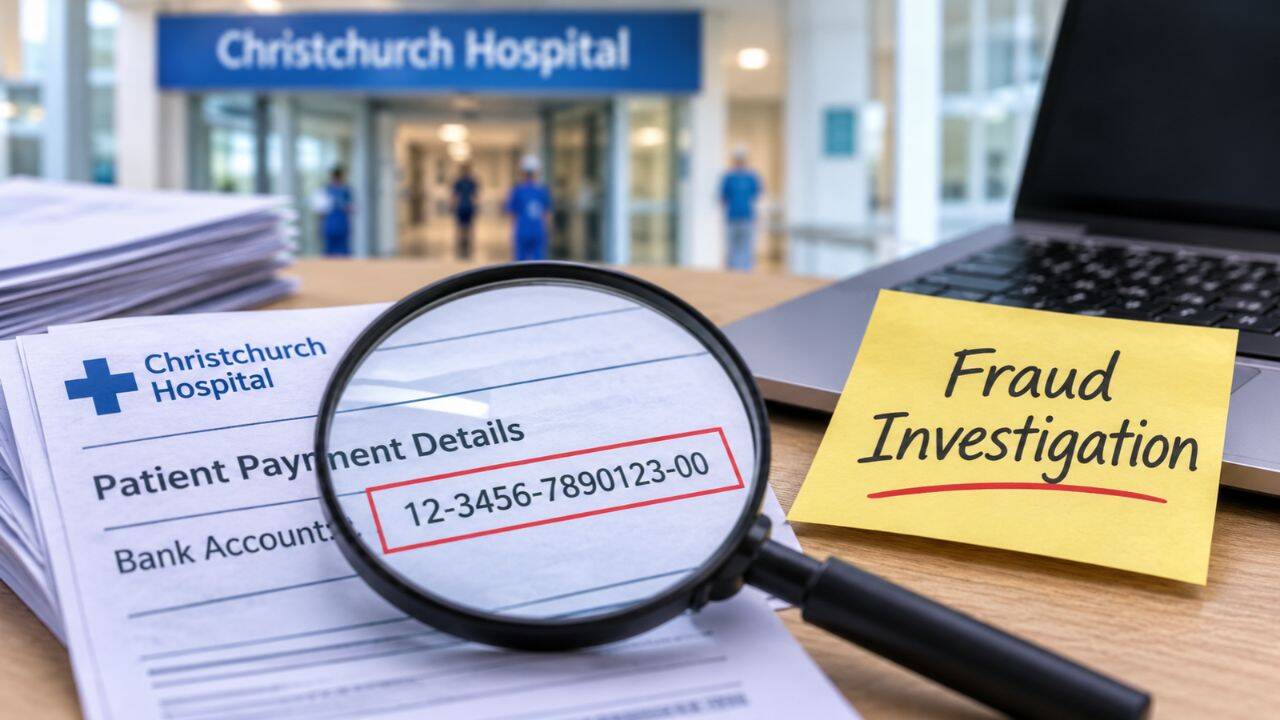
Here's the gap that makes diversion possible. When an overseas patient pays an invoice—or when refunds, adjustments, and manual write-offs get processed—a single staff member with broad system permissions can manipulate the payment trail. Instead of funds routing cleanly into the hospital's general ledger, bank account details get altered, manual credits get issued to cover up missing deposits, or payments get redirected into external accounts controlled by the employee.
It's a classic segregation of duties failure. When the same person who generates an invoice can also record a payment, issue a refund, and adjust the patient's balance to zero, the accounting software sees a closed file. Nobody follows up with the patient because the patient already paid. Nobody follows up internally because the system says the debt is settled.
Why Healthcare Billing Is a Goldmine for Internal Fraud
You might wonder how $1 million vanishes without triggering an immediate alarm. Honestly, it comes down to sheer volume and budget scale.
A major metropolitan hospital processes hundreds of millions—sometimes billions—of dollars annually. Within a budget that size, $150,000 or $200,000 a year in missing non-resident patient revenue doesn't look like a massive red flag on a high-level financial summary. Finance teams often write off fluctuations in overseas patient collections to seasonal tourism changes, unpaid foreign debts, or insurance claim delays.
I've seen this exact blind spot destroy internal controls across large institutions. Management obsesses over vendor invoices going out the door because suppliers complain loudly if they don't get paid. With incoming patient payments from travelers who fly back home to Europe, Asia, or North America a week after discharge, there's zero external pressure. Once the patient leaves the country, the paper trail goes cold.
Consider an illustrative example of how an employee exploits this dynamic over a multi-year period:
- Step one: An overseas patient receives emergency treatment and gets billed $12,000.
- Step two: The patient wires the money or pays via card, and the employee intercepts or redirects the settlement details.
- Step three: To keep automated debt-collection notices from going out to the patient (which would immediately expose the theft), the employee logs into the billing portal and marks the invoice as "written off due to uncollectible foreign debt" or applies a manual credit adjustment.
Repeat that cycle a few dozen times a year across four or five years. Suddenly, you're looking at a seven-figure loss that never once triggered an automated threshold alert.
The High-Trust Trap in New Zealand Workplaces
There's a cultural angle here that foreign observers often miss, and New Zealand's own Serious Fraud Office (SFO) has highlighted it repeatedly in public sector prosecutions.
New Zealand consistently ranks near the top of Transparency International's Corruption Perceptions Index. That's great for society, right up until it breeds complacency inside government agencies and public hospitals. When managers operate on default trust, they hand out "superuser" software credentials just to keep daily workflows moving smoothly.
Someone goes on annual leave? Give the senior billing clerk admin access so invoices don't back up.
A new patient management system gets rolled out without migrating old audit rules? Let the veteran staff member handle manual overrides because they "know how the old system worked."
Fraud thrives in the gap between operational convenience and strict financial governance. Almost every major public-sector embezzlement case in New Zealand—whether in regional councils, transport agencies, or district health boards—features a long-serving, trusted employee who was given unchecked authority because nobody wanted to create administrative friction.
What the Audits and Investigators Usually Find
When cases like this finally unravel, it's rarely because a routine annual audit caught the discrepancy. External financial audits sample transactions; they don't audit every single patient file unless forensic red flags already exist.
Instead, internal fraud usually gets exposed by accident:
- Mandatory vacation or sudden sick leave. The employee steps away for two weeks, someone else covers their desk, and a confused overseas patient calls asking why they received a second demand letter for a bill they already paid.
- System migrations. When Health New Zealand consolidated legacy DHB IT infrastructure into unified national platforms, historical write-offs and manual journal entries suddenly got scrutinized by fresh eyes.
- Whistleblowers. A junior colleague notices weird manual adjustments on high-value accounts and flags it internally.
Once forensic accountants pull the user-activity logs, the pattern is almost always identical. Dozens of after-hours logins. Unusual spikes in manual credit memos. Bank account numbers modified right before a refund batch runs, then changed back ten minutes later.
According to global benchmarks from the Association of Certified Fraud Examiners (ACFE) in their Report to the Nations, occupational fraud schemes typically last 12 to 18 months before detection, with billing and payment tampering schemes frequently stretching past three years when perpetrated by administrative staff with high system privileges. In healthcare specifically, weak reconciliation between clinical admission records and finance sub-ledgers remains one of the top vulnerabilities worldwide.
Misconceptions About Public Sector Embezzlement
Whenever a story breaks about a hospital worker stealing $1 million, public debate immediately spirals into two predictable, inaccurate extremes.
First misconception: "This proves the entire health system is corrupt from top to bottom."
No, it doesn't. Systemic corruption involves coordinated bribery or institutional kickbacks. What we're talking about here is opportunistic occupational fraud by an individual exploiting a technical control failure. Confusing the two leads boards to waste money on performative ethics seminars instead of fixing their accounting software permissions.
Second misconception: "The money is gone forever, and nobody faces real consequences."
In New Zealand, diverting $1 million from a public health provider triggers severe criminal prosecution under the Crimes Act 1961—typically charges of theft by a person in a special relationship or obtaining by deception, both carrying maximum penalties of seven years' imprisonment. Courts routinely impose custodial sentences for large-scale public fraud, and authorities pursue asset recovery under the Criminal Proceeds (Recovery) Act 2009 to seize property, vehicles, or bank balances funded by stolen money.
How Organizations Stop Payment Diversion Before It Starts
If you manage finance operations, run a clinic, or sit on an audit committee, you don't need an expensive consulting firm to close these loopholes. You need ruthless enforcement of basic accounting hygiene.
Start by auditing user permissions inside your billing and Enterprise Resource Planning (ERP) software this week. Nobody—literally nobody—should hold simultaneous permissions to create a customer or patient record, alter bank routing details, and approve manual write-offs or refunds. Enforce strict role-based access control so every financial adjustment requires secondary sign-off from a separate department.
Next, automate your bank-to-ledger reconciliations. If your clinical system shows an overseas patient was discharged after a five-day hospital stay, that record should automatically cross-check against actual cash received in the bank account—not just a "settled" status typed manually by a clerk. Any invoice closed via write-off or credit memo above $500 must trigger an automated alert directly to a finance manager who has zero operational contact with the billing desk.
Finally, institute mandatory block leave of at least ten consecutive business days for anyone handling cash, billing, or vendor master files, and lock their system credentials while they're out. Fraud requires constant maintenance to keep the lies aligned; force the person out of the chair for two weeks, and any hidden manipulation collapses on its own.