The stadium smells like damp concrete, stale lager, and roasted peanuts. It is a sharp, distinct olfactory cocktail that millions of people recognize instantly, a scent that triggers an immediate spike in cortisol and a sudden, involuntary tightening of the chest.
Down on the pitch, twenty-two athletes chase a sphere of inflated leather, their lungs burning, their calves corded with tension. But the true drama rarely unfolds between the players. The true drama happens in a quiet, climate-controlled room miles away, illuminated by the cold blue glow of multiple monitors.
Silence.
Then, a whistle blows.
Time freezes.
In the stands, fifty thousand souls hold their breath. At home, millions grip their remote controls. A man standing by a sideline monitor touches his earpiece, squinting at a replay that loops with hypnotic cruelty. Inches. Millimeters. The difference between glory and despair is often thinner than a sheet of paper. And for years, the explanation for why that whistle blew—or why it stayed silent—was wrapped in a shroud of professional courtesy and institutional mystery.
Referees made their calls in the dark. They walked off the pitch into tunnels guarded by security, their reasoning locked behind closed doors, leaving the rest of us to scream into the void.
Football is a game built on tribalism, but it is also a game built on faith. We hand over our weekends, our paychecks, and our emotional stability to a sport run by fallible humans. When a referee misses a handball or misinterprets a sliding challenge, the betrayal isn't just tactical; it is deeply personal. It feels like an affront to justice itself.
Consider a hypothetical supporter named Dave. Dave has spent forty years following his boyhood club through rain, sleet, and financial near-collapse. For Dave, Saturday afternoon is not a distraction from reality; reality is a distraction from Saturday afternoon. When a contentious VAR decision strips his team of a legitimate victory in the eighty-ninth minute, Dave does not look at the monitor and analyze frame rates. He feels a hot, acidic rush of anger in his throat. He feels cheated by an invisible hand.
The problem was never technology. The problem was opacity.
When video assistant referees entered the sport, the promise was clinical perfection. Cameras everywhere. Angles for days. Software that could draw lines down to the micron. Yet, the human element refused to vanish. Instead of eliminating controversy, the screens amplified it. We were given high-definition proof of human error, but zero insight into the cognitive process that led to it.
Why did the official look at the screen for three minutes and still miss the obvious? Was it pressure? Was it ego? Was it a misinterpretation of a rapidly evolving rulebook that seems to change its mind every summer?
Nobody told us. The Premier League operated like a medieval court, handing down edicts without trial transcripts.
Transparency is a terrifying thing for institutions. To explain yourself is to admit vulnerability. It invites critique from people who have never run a beep test in their lives, let alone managed twenty-two hyper-adrenalized professionals in front of a roaring crowd of sixty thousand baying fanatics.
Yet, the walls are finally cracking.
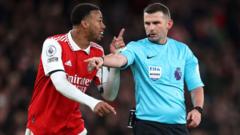
The Premier League's decision to publicly publish verdicts on referee and VAR decisions is not merely an administrative policy update. It is a seismic cultural shift. It is an admission that the curtain can no longer stay closed.
By pulling back that curtain, the governing body is doing something radical. They are humanizing the black-clad figures we love to hate.
Picture the referee's dressing room after a match. The adrenaline is finally crashing, leaving behind a hollow, nauseating fatigue. The whistle sits on the table, cold and heavy. On the phone screen, notifications pile up by the thousand—death threats from anonymous accounts, abuse hurled from screen names that hide behind cartoon avatars. Every missed call is cataloged, memeified, and broadcast to the globe.
Now, imagine those same officials having their decisions dissected not by howling mobs on social media, but through an official, transparent adjudication process. Independent panels reviewing the footage. Public explanations issued for why a threshold was met, or why it wasn't.
It changes the vocabulary of the argument.
Instead of screaming about corruption or incompetence, fans and pundits are forced to grapple with nuance. The public adjudication of these moments introduces a strange, foreign element to football discourse: accountability.
When an independent panel steps in to review controversial match-defining moments and publishes its findings, it creates a paper trail of truth. It separates the genuine refereeing mistakes from the fever dreams of aggrieved supporters. It acknowledges that a referee has roughly three seconds to process a collision happening at twenty miles per hour, while we have twenty replay angles and a slow-motion slider.
Grace is hard to find in modern sports. We demand perfection from athletes and officials alike, as if human biology were capable of software updates.
When a match ends, the noise usually ramps up. Radio phone-ins light up with red-faced callers. Bar stools bear the brunt of frustrated fists. But imagine a Monday morning where the debate shifts from what happened to why it happened, based on factual, published clarity.
The mystery begins to dissolve.
Of course, publishing verdicts will not stop the arguments. Football is fundamentally an argument disguised as a game. If we agreed on everything, the sport would wither and die of boredom. We need the controversy. We need the grievance. It is the fuel that keeps group chats alive through the miserable silence of the working week.
What the new era of transparency actually changes is the flavor of the grievance. It replaces paranoia with reality.
When a fan reads an official panel report confirming that their team was indeed wronged by a catastrophic VAR miscalculation, it does not give them the points back. It doesn't erase the lost bonuses for the club, or the heartbreak of the supporters who traveled four hundred miles in the freezing rain.
What it does offer is something quieter, yet infinitely more valuable.
Validation.
It says: We see it too. We know it was wrong. And here is how it happened.
That acknowledgment matters. It bridges the chasm between the boardroom and the terrace. It reminds us that behind the whistles, the VAR monitors, and the crisp suits of the governing bodies, there are still human beings trying to navigate a chaotic game moving at the speed of light.
The floodlights flicker off. The stadium empties of its noise, leaving behind only discarded programs and the rustling of crisp packets in the wind. The grass is watered, the lines are repainted, and somewhere in the quiet dark, the monitors wait for the next storm.
We walk away into the night, carrying our hopes to the next weekend, knowing at last that the ghosts in the machine are finally learning to speak our language.