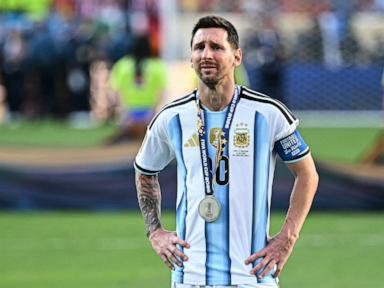
The departure of an elite athlete from international competition is rarely governed by a single variable; rather, it represents the intersection of biological depreciation, psychological exhaustion, and external life shocks. When Lionel Messi announced his retirement from the Argentina national team following a twenty-year career spanning multiple continents, major finals, and systemic tactical shifts, the farewell statement served as a textbook case study in career life-cycle management. Deconstructing the mechanics of this retirement reveals a calculated acknowledgment of physical capacity limits, generational succession pressures, and personal bereavement vectors that together finalized a decision originally drafted weeks prior.
The Biological Threshold and Energy Depletion
Elite athletic performance operates under strict physiological constraints. Over two decades of senior professional football, the cumulative workload—compounded by high-intensity sprints, international travel, and dense tournament calendars—creates a finite energy reserve. Messi explicitly framed his exit around the concept of depletion: having nothing left to give to the shirt. You might also find this related coverage useful: Why Aston Villa Faces the Ultimate Early Test Against Arsenal.
In high-performance analytics, this state reflects the point where marginal utility derived from continued participation drops below the physical cost of preparation and recovery. Unlike club football, where tactical setups can sometimes compensate for reduced defensive tracking or lower output volume, international football demands hyper-efficient transitions and high-intensity bursts against younger, structurally optimized opponents. Recognizing that his biological ceiling could no longer consistently match the standard required by the Albiceleste jersey marked the rational end of his tenure.
The Succession Pipeline and Generational Turnover
An effective exit strategy in team sports requires alignment with the talent pipeline. A common pitfall for aging icons is lingering past their functional utility, thereby blocking institutional growth and stagnating team evolution. Messi addressed this operational bottleneck directly by citing the emergence of young talent: As highlighted in latest coverage by FOX Sports, the results are significant.
- Pipeline Readiness: The presence of capable understudies ensures that structural continuity is maintained without a sudden drop in tactical quality.
- Cultural Handover: Stepping aside allows the leadership hierarchy within the squad to reorganize around a new core, preventing the over-reliance on a single focal point that often paralyzes team tactics.
By explicitly stating that incoming players deserve their place within the national setup, the decision transformed from a forced capitulation into a managed transition of authority.
Personal Catalysts and External Vectors
While the foundational decision was documented on July 21st, immediately following the conclusion of a major international tournament, external life events altered the velocity of its public execution. The passing of his father, Jorge Messi, acted as a psychological tipping point, shifting the internal cost-benefit analysis of maintaining an exhausting international schedule.
In high-stakes professional contexts, major life events frequently recalibrate personal priorities. When a foundational mentor and lifetime supporter exits, the psychological architecture supporting a demanding career path shifts. The confirmation of his retirement following this bereavement underscores that elite athletes are subject to the same human variables as any high-stress operator: personal loss supersedes professional momentum.
Strategic Operational Transition
The mechanism of moving from active competitor to spectator is a well-documented phase in sports management. Messi’s transition to supporting from the sidelines during both successful and turbulent periods establishes a blueprint for athletic stewardship. Rather than maintaining a distant relationship with the national setup, integrating into the supporter ecosystem preserves cultural capital while completely shedding the operational burdens of performance.
Future evaluations of elite career closures will likely reference this exit as a model for balancing institutional loyalty, physiological reality, and personal timing. The transition is complete not when the player can no longer physically kick a ball, but when the systemic cost of leadership outweighs the remaining impact.